
• This forum is the machine-generated translation of www.cad3d.it/forum1 - the Italian design community. Several terms are not translated correctly.

cooling fan reducer parallel axles

  • Thread starter Thread starter meccanicamg
  • Start date Start date

meccanicamg

Guest
Here we are with a new question.
I have a parallel axle reducer with my special design design design.
input 300kw-1200rpm rotation in both ways.
After calculations of the negative natural thermal dissipation, I decided to mount on the axis fast a nylon fan type faet ...the last of the page.
Screenshot_20240206_084105_Samsung Notes.webpI mounted a square sheet metal housing with perforated mesh.image.webpIs there any relationship between the various distances indicated on the drawing?
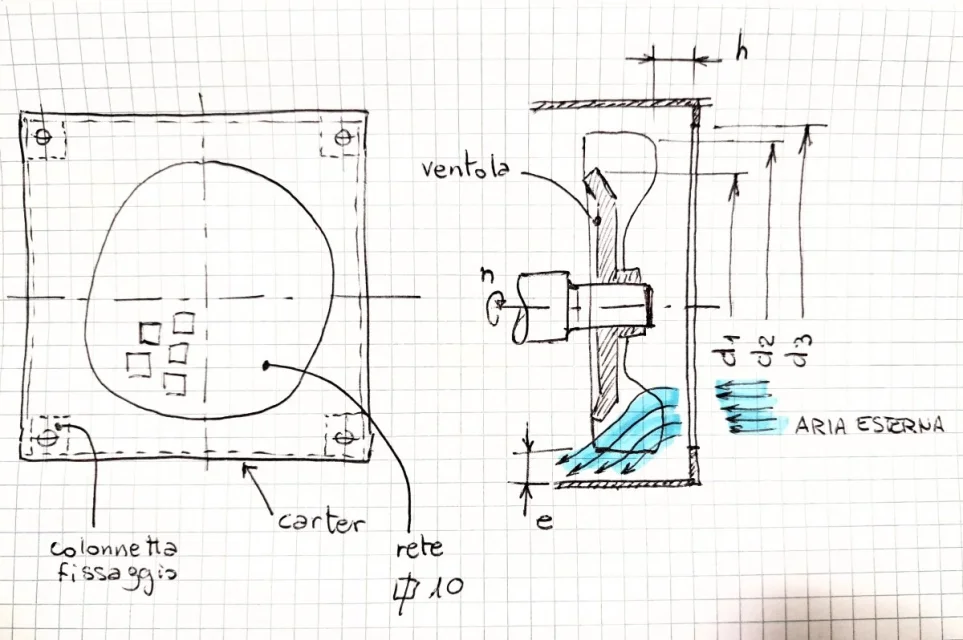
Should I put the fan close to the net? the diameter of the air passage hole which diameter must have? bigger... smaller?
Thank you.
 
looking at the engine catalogs, for an iec 180 engine, which has my own fan size, has a d3 worth about 235mm. Obviously with that diameter you have the greater suction capacity according to the shape of the palette.
It is true that the iec engines have the cap with bevel and are cylindrical with an intercapedine of about 10-15mm to pass the air flow. instead I am inside a much larger square box, with 6-7cm of air around does not channel, so this means that the air speed will be lower being a wider channel.
So if I make d3 of 300mm I don't suck air quite violently because the shovel is all discovered and I am obliged to descend to about 235-240 mm?

Does anyone have experience?@terastore Can you tell me something?
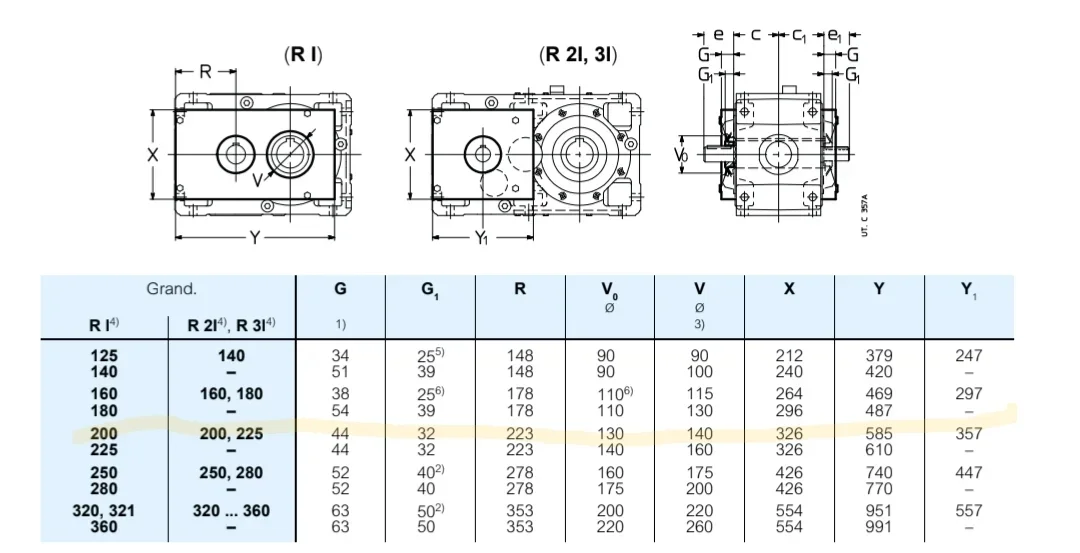
I do not want to buy aluminum fans because they really cost a lot more than those in nylon, but I see that for example red gearboxes does something similar to my application (sheet rectangle, fan - aluminum - hole in the cartter about a little less than the diameter equivalent to that of an equal motor size fan).Screenshot_20240206_183613_Samsung Notes.webpeven suck from a 160mm hole that would be my d3.
 
the type of fan you have chosen is the bidirectional model normally used in electric motors corresponding to the ic411 ventilation method (cei en 60034-6).
when I was in the company, we built three-phase electric motors until size 132 but, being unified, we could have standard components, such as fans, fan covers, crates, flanges available on the market, so the assembly in a certain position was obliged.
I have never heard of norms that regulate the size you mention, on the other hand also the fans and fan covers have different sizes even if slightly, depending on the supplier, idem for internal distances. As for the grids, a supplier told me, it was important that a person (even small) could not slip a finger from the holes; I think it should be covered by the machinery directive.
However I am preparing you some material related to engines and gearboxes that could be useful in your evaluations; I'll publish it by tomorrow.
with regard to the material of the fan we mounted those in aluminum only when there were high ambient temperatures for which the total external temperature of the motor, despite the ventilation, could exceed 80-85 °C.
 
the type of fan you have chosen is the bidirectional model normally used in electric motors corresponding to the ic411 ventilation method (cei en 60034-6).
when I was in the company, we built three-phase electric motors until size 132 but, being unified, we could have standard components, such as fans, fan covers, crates, flanges available on the market, so the assembly in a certain position was obliged.
I have never heard of norms that regulate the size you mention, on the other hand also the fans and fan covers have different sizes even if slightly, depending on the supplier, idem for internal distances. As for the grids, a supplier told me, it was important that a person (even small) could not slip a finger from the holes; I think it should be covered by the machinery directive.
However I am preparing you some material related to engines and gearboxes that could be useful in your evaluations; I'll publish it by tomorrow.
with regard to the material of the fan we mounted those in aluminum only when there were high ambient temperatures for which the total external temperature of the motor, despite the ventilation, could exceed 80-85 °C.
Thank you, I have good feedback from your words.
for the grid we also have on the casings the norms not to get hurt and therefore will take the fine net or perforated sheet with holes from 6/8 mm.
Okay, no aluminum.
I wait for your material. Thank you in advance.
 
by searching in my memory and looking for some references I managed to create the document that I attach and hope you can give you useful indications.
the pdf you attached to me helps me make all the reasonings of the case. I'll read my gear tomorrow and then I'll tell you.
Thank you.
 
I have a doubt in all this. as in the catalog no one put the flow that can generate the radial fan..... how do you know that a fan diameter 300 mm to 1500rpm moves x m3/hour?

I can also calculate how much heat I need to dissipate. . . .
q = w • cp • δtwhere:

q - amount of heat absorbed by the air (w),
w - maxic air flow (kg/s)
cp - specific air heat (joule/kg • k)
δt - air temperature increase (°c)

then calculate the required air flow.. . .
q = [q/(r • Cp • ΔT)] • 60where:

q - air flow (m3/min),
q - amount of heat to be dissipated (w)
r - air density (kg/m3)
cp - specific air heat (joule/kg • k)
δt - air temperature increase (°c)

If I consider 26°c I can simplify the flow as....
q = 0,05 • q/δtNow I have to compare the necessary calculated with the generated by the fan....so....how much is that generates the radial fan?
 
Last edited:
is not a question that has a simple answer:

the fan at the end is a hydraulic machine, therefore the mass flow is related to the piezometric load, that is to the pressure exerting on the air so that this passes through the motor, through the so called characteristic curve.

However, pressure is not easy to determine, depending on speed and geometry (closer passes or longer tanks will generate higher pressures at equal air speed).

it is in essence to make some tests, or to see if there are tables that for a medium geometry give the flow generated by the fan.
 
but I would look at the speed of air. on the basis of this in fact are found in literature the coefficients of convective exchange h. the heat exchanged in fact is expressible as:

q = h x (triductor-tear input) x exchange surface

It seems to me that the value of h is also found on the niemann elements of machines 2.
 
View attachment 70405Here are the pages that may interest you.
perfect. my calculation sheet for the dissipation of the reducer box I have already done it using the formulas of these niemann pages.
with these formulas calculation if the natural dissipation of the carcass is sufficient or if putting one or two fans I can dissipate more.

Now instead I have to size the fan, so a more specific job.

what you are right is the speed speech, which would seem more important than the volumetric speech of air.

as from table.....if I have no fan I have a shed with 1,25m/s air speed. if I can get to 1,5m/s the air with the fan start to dissipate already a slice.

therefore the correct question is: how to calculate the air velocity produced by a radial fan?
 
Let's see if the reasoning is correct.

we make the hypothesis that I use fan and fan of iec engines on my gearbox and I guarantee an air speed equal to the output condition between fan cover and motor case.

what does that mean?
that for a size 180 that turns to 1000rpm I can dissipate 15kw with yield 91.2% i have to calculate 100:91,2=8,8% of 15kw is worth 1.32kw that I throw them for thermal and win them with the fan?Screenshot_20240213_015321_Samsung Notes.jpgif so I can determine how much heat power dissipates each fan on each size and on at least three points (3000-1500-1000rpm).

is the calculation correct or have I misinterpreted?

but if it was right... what temperature does the engine set in s1?
 
Let's go with some science. .1707787215032.pngFor me it is the case two, where I have to perform the speed of tangential rotation and the output parallel to the blades.
I know her. How much is vr?

behavior is quite a downward curve.1707787311579.pngbut....how do you calculate by knowing the size of the fan?
 
therefore the correct question is: how to calculate the air velocity produced by a radial fan?
This is the hard part, I would do some tests with an electric motor and an anemometer... I don't think there are valid analytical formulations for such problems...
 
This is the hard part, I would do some tests with an electric motor and an anemometer... I don't think there are valid analytical formulations for such problems...
also because with the radial blade fan the air is conveyed to the motor or reducer by the shape of the end of the fan cover, which can be curved or inclined with various inclination values.
 
I'm not going to drop the hold.
in the immediate I could not do anything but see on the same size of reducer what builds the competition and try to make similar both the intake diameter and the vent air of the tank fan on the reducing carcass.
In the future I would like to be able to find some sort of formulation or proportion a little more scientific less empirical.
If you happen to have some point, the discussion is open.
while I thank you all.
 
If I can add something, for those who do not know it, mark that the radial palette fans, called helicals, should be mounted when air is passed from one wall to another.
when the air is switched into a channel, the centrifugal fan must be used.
 
I tried to make some arguments and compared with the cad geometries of an iec 180 engine.

I started from the consideration that a fan has hypothetically, as air shift volume, the geometric one of the cylinder of the blades. We know that centrifugal fans have a performance not exceeding 60%, so I know how much to reduce the volume.
if I multiply the volume/turn for rpm and for 60 I get the air flow.
if the vent area of my shaped carter is comparable with the engine cap area I get average simil speeds by calculating them as v=q/a assuming that load losses and turbulence do not interact.

Well... I get speed of about 2.4m/s at 1500rpm as it seems to suggest the niemann.

it will be an approximate calculation, empirical but it seems to us to be clear.

I share the formulas I used in reasoning.Screenshot_20240215_063111_Photos.webpthe fan volume was corrected with a coefficient that holds against the shape of the teeth.

the intake diameter is a smaller diameter than that of the engines but it serves to have more filling of the fan with a higher speed (similar to the diameter of the red casings).

the output area has the coefficient 4,1 which derives from the net area measured on a mgm 180l engine compared to the circular diameter of its inner cap.

if my cap will be rectangular it will have an area of vent between carter and reduced case with a value similar to that of output of an equal motor to get a similar speed.
 
I think a big help can give you someone who has, and who knows how to use, a good cfd analysis program. they are difficult to simulate and eventually they have to build scale models to verify the actual goodness of the system.
 

Forum statistics

Threads
44,997
Messages
339,767
Members
4
Latest member
ibt

Members online

No members online now.
Back
Top