• This forum is the machine-generated translation of www.cad3d.it/forum1 - the Italian design community. Several terms are not translated correctly.

correctly quote a technical design

  • Thread starter Thread starter _Pietro_
  • Start date Start date
I don't want to go into the quotation, they have already responded correctly in many.
if the type of piece has been set to you, I stop here.
If you made it up, I suggest you remove all the seeger locations except for the two ends.
the positioning of the various elements you get by interposing of the spacers.
I don't know how that tree has to work, but I've seen more than one break in the seeger area.
I have just assisted my son (4° itis) in a drawing task and I live to cry to see what they make you draw.

Bye.
exact!!! I don't think that at itis they have treated you on the fatigue as they do at the university... I don't think that you went to check the carving effect in those positions... so the gorges of seeger between the toothed wheels and the bearing remove them away... in their place you put nicer spacers much cheaper and save the throat processing in h13...

:cool:
 
exact!!! I don't think that at itis they have treated you on the fatigue as they do at the university... I don't think that you went to check the carving effect in those positions... so the gorges of seeger between the toothed wheels and the bearing remove them away... in their place you put nicer spacers much cheaper and save the throat processing in h13...

:cool:
ok I have inserted the seeger because I do not know alternative methods to "make so that the bearing makes joke" (forgive terminology)
I took into consideration the idea of spacers (although boh!!! never heard of mention. . . )
I looked at the web x these spacers, but I realized that there are a lot of spacers and multiple applications. . .
the less I would have understood how to put them... but I wonder what width these spacers have, why are they better than seeger? ?
Could you link me some examples? ? ?
Thank you very much x the interest. .
 
I took into consideration the idea of spacers (although boh!!! never heard of mention. . . )
the spacers are simply rings obtained from commercial tubes, cut by the right length to " keep at distance " the various components fit on the tree.
the spacers that, during assembly, meet the tabs must be worked with a quarry similar to that present on the hubs. (or open radially)
where the bearing is blocked by the seeger is good rule to interpose a support ring.

Bye.
 
Remember! ! here inside the sellers of cad 3d often claim that the table does not serve anything that the tables are exceeded etc...
a seller who claims such a thing should be frustrated by his employer and/or crucified by a possible buyer.
Luckily I've never met
 
but I wonder what width these spacers have, why are they better than seeger? ?
seeger needs a seat. the seat, made on a tree that has a minimum of bending stresses, it weakens of much the resistant section, and not because it reduces the section, but because it introduces a carving effect.
 
I give you a dispassionate advice if you want to learn well to make the tables take the three books of the straneo/consortia - design of mechanical constructions , vol.1-2-3 ... or (but is less complete than the strange ) the manfè-pozza-scarato always 3 volumes .. are both published by the principality.
You will always need them in your working life!! are books that never grow old!!
think of you that I used 35 years ago.
I jealously guarded them, they're still here on a shelf in the shop, along with baldassini, cremonese and red.
and still serve to take away some "rust" doubts from the head.

all the rest, including cad 3d, comes after.
 
ok I have inserted the seeger because I do not know alternative methods to "make so that the bearing makes joke" (forgive terminology)
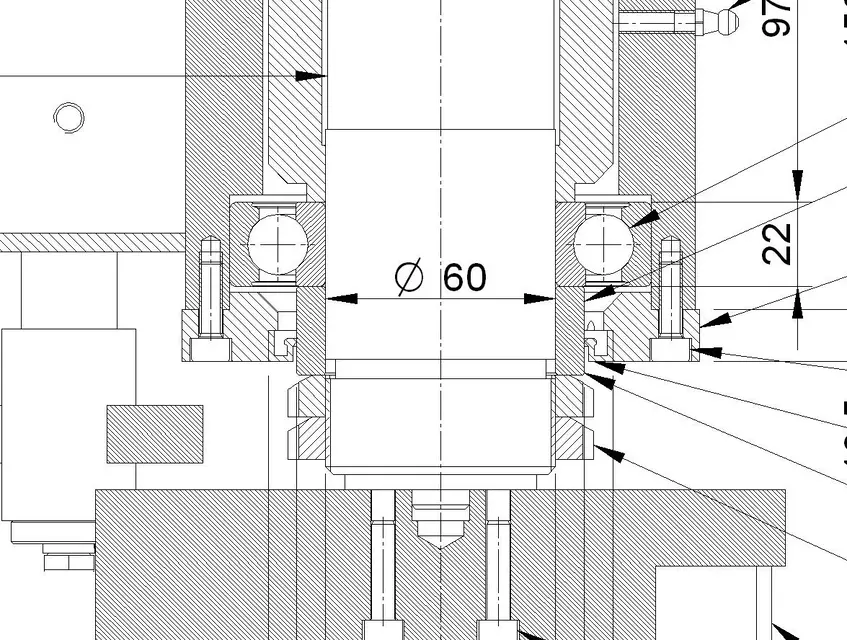
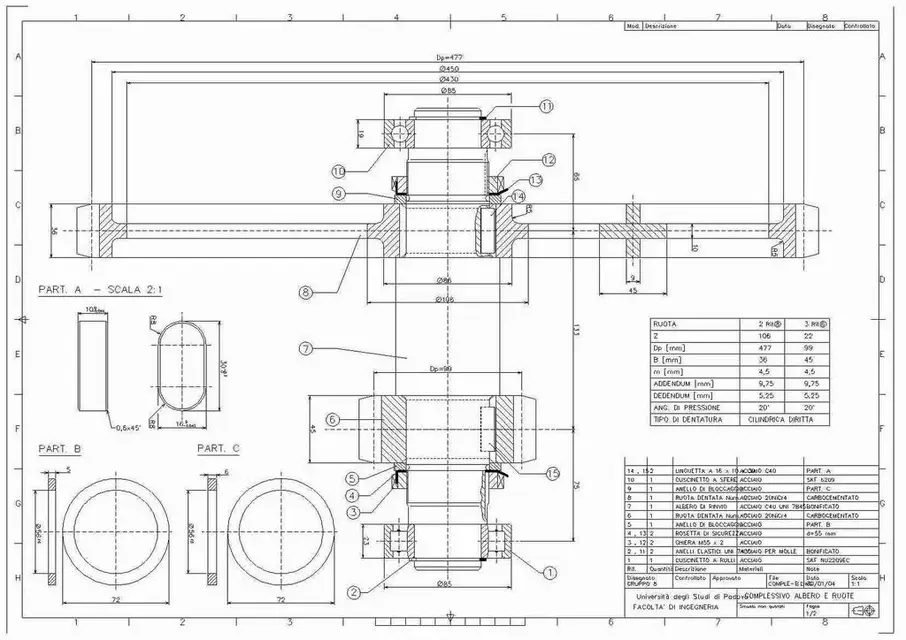
I leave you two examples, an axial locking with a wrench + spacer, and a table 2d of a tree for a very simple lump (although I think you can find many more on your textbook).

Bye.
 

Attachments

  • bloccaggio-assiale.webp
    bloccaggio-assiale.webp
    189.8 KB · Views: 254
  • esempio_albero.webp
    esempio_albero.webp
    20.7 KB · Views: 278
here are some twigs made 6 years ago at the university ...confesso che concerned you now after my work experience I find a tide of mistakes.... but for you at itis maybe they go more than well...
 

Attachments

  • albero_rinvio-001.webp
    albero_rinvio-001.webp
    78 KB · Views: 325
  • assieme_riduttore-001.webp
    assieme_riduttore-001.webp
    76.1 KB · Views: 255
Last edited by a moderator:
Well, I can't just join all the comments.
I can only suggest you to add the symbol of the first driedro as a projection system in the cartiglio.
 
Good afternoon!
I'm back at work. .
First of all I thank all those who have spent precious time devoting it to a fanciful student who is trying to recover the lost time by attaching drawings explanations and everything that is coming back useful to me right now. .
Today I have delivered the report albeit the design is ca*re. . .
Let's say I've been forced. ..however I decided to fix it the same anke x learn something in anticipation of the exam that I will hold in less than 5 months.
I took into consideration the idea of the spacer you recommended.
being ignorant I need to know if the outer diameter of the spacer I insert between toothed wheel and bearing must coincide with that of the bearing.
There are also catalogues where I can choose the spacer I need or can I create one with a width of 16,5 mm? ?
on the web I have seen that spacers have prisoners who serve to block the spacer...I'm fucking blocking it? ? ?

I look forward to some advice... thank you
 
I took into consideration the idea of the spacer you recommended.
being ignorant I need to know if the outer diameter of the spacer I insert between toothed wheel and bearing must coincide with that of the bearing.
I'd put a little lasco, or to the maximum tolerance with play.
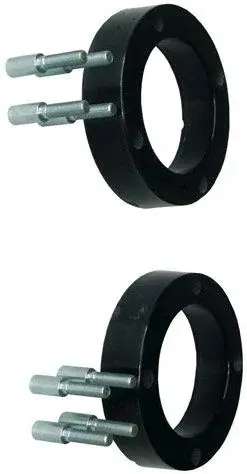
on the web I have seen that the spacers have prisoners who serve to block the space
put some example, because I spacers have always seen them free.
 

Attachments

  • foto_adattatore_alberidoppiacroc01.webp
    foto_adattatore_alberidoppiacroc01.webp
    8.7 KB · Views: 108
  • foto_adatt_albero_jimny2.webp
    foto_adatt_albero_jimny2.webp
    14.9 KB · Views: 63
  • foto_adatt_albero_jimny1.webp
    foto_adatt_albero_jimny1.webp
    13.4 KB · Views: 54
  • DB-4100.webp
    DB-4100.webp
    9.8 KB · Views: 56
  • 2587315676.webp
    2587315676.webp
    37.1 KB · Views: 60
Last edited by a moderator:
the two spacers you see them in the drawing of the total that I posted you ... are mounted with a Jew (I left little f5 on a diam=65 is a +30um +43um) but it's fine .... are the part.b and c.

those make "pack" on the toothed wheels... thanks to a threaded wreath m55 (p 218 straneo-consorti vol.2 ) which will never slip ...because it has a safety rosette d=55 (always p. 218 straneo-consorti vol.2 ) that has teeth that go to fold in the wreath...

if you look at the end of the threaded tract you have to do a drain throat to allow the tool that goes to file to conclude the filett. and go back
the unloading throat attention is not made as that of the seeger ... is round...that is radiated with radius never less than 2mm to not unleash the hell of the carving! !
 
You don't need to get some anodised aluminum stuff with racing pin screw holes ... take a commercial tubing of the diameter of your tree ... cut two slices of the thickness you need at the limit first work a down the int diameter to have a little game and just!
 
being ignorant I need to know if the outer diameter of the spacer I insert between toothed wheel and bearing must coincide with that of the bearing.
There are also catalogues where I can choose the spacer I need or can I create one with a width of 16,5 mm? ?
on the web I have seen that spacers have prisoners who serve to block the spacer...I'm fucking blocking it? ? ?
the maximum outer diameter of the spacer that you put on the bearing cannot have the same diameter of the bearing because it cannot be in contact with both the outer ring and with the inner ring of the bearing... if so were the bearings should not turn into 2 spacers a "on the shaft" that will rotate with the bearing and one on the housing part of the bearing that remains firm the maximum diameters for the spacer on the pole and the minimum one for the housing.
Spacers are not standardized elements (usually) you can use the thicknesses you feel most appropriate
 
2 spacers are inserted a "on the tree" which will rotate with the bearing and one on the housing part of the bearing that remains firm
I'm sorry, but I don't understand how I'm gonna put two.
I thought to put only one between the bearing and the toothed wheel.
I made 2 calculations (now I attach the size of the bearing and those of the spacer I thought) and I think it should work as assembly. . .

in practice the outer diameter of my spacer is 60 mm, in this way it would lean on the inner ring of the bearing (if the shaft rotates the inner ring wheel and the spacer as well) without touching the outer ring of the bearing that remains firm.

Tell me where I'm wrong. . .
Thank you.. and I apologize for ignorance
130
130.
 

Attachments

Last edited by a moderator:
if you go to the skf website (for example here: http://www.skf.com/skf/productcatal...ndowname=null&perfid=105001&prodid=1050010005 )
find diameters max and min that each bearing accepts.

bearings on a tree mount (almost ) always like this:

a fixed, generally on the side where you need more precision or stiffness or have the most important load.
this blocks it axially with spacers, or shavings or seegers, both on the inner ring and on the outer ring.

the other bearing must be free to flow axially to recover the games introduced by the tolerances of machining or thermal expansions.
this blocks it axially only on the inner ring or on the outer ring depending on the case, which you find always explained in the skf site (or similar manufacturers, more or less detailed ).

Bye.

ps. : It may be that skf requires you registration, do it without problems, you will need it often.

I wrote all this and you had already done!:frown:
 
Last edited:
I would say that it can go well 60 mm if you look at the bearing board that you attached to me you will notice that there is a ring spacer both for the inner ring and for the outer ring this the first one locks axially the bearing on the shaft but the entire shaft bearing system can still flow axially then it puts a second external spacer opposed to the bearing bar on its seat blocked by axial bearing.
known with pleasure that you use the online catalog skf I point out that on the page attached you find on the top left of the other links to windows that you might be useful to choose the couplings according to the use I write it because it is not very evident but it is quite useful.


----and I wrote all this when stefanobruno had already answered
 
then the problem in your case is that you made the whole tree with only one shoulder
the one where you go to lean the two toothed wheels and you didn't do one for the bearing... so doing the spacer will stand on the outer ring of the bearing.

You could make a double-diameter spacer...even if the best solution I recommend and always the one with the shoulder... as the toothed wheel even if it has the key would still be stuck with a wreath and a spacer like I did.

double diameter spacer
 

Attachments

  • distanziale.webp
    distanziale.webp
    8.9 KB · Views: 69
Last edited by a moderator:

Forum statistics

Threads
44,997
Messages
339,767
Members
4
Latest member
ibt

Members online

No members online now.
ciao
Back
Top