• This forum is the machine-generated translation of www.cad3d.it/forum1 - the Italian design community. Several terms are not translated correctly.

couple tightening and friction, doubt

  • Thread starter Thread starter peppemrc
  • Start date Start date

peppemrc

Guest
hi guys, I have a doubt about the torque represented in the various tables.
I have to fix a plate with screws and bolts, but the chockfast located under the plate must undergo a compression < 35kg/cm2.
I have to use m20 screws. but if I apply the cone values from table to 0.2 of attrite coeff., I quite exceed the compression of the chockfast. I also tried to use pairs with lower friction coeff. and to vary the grade of material to 6.8 but the value of compression grows.

My question is:
Can I reduce the value of the tightening couple?

example:
screws m20 8.8 to 0.20 friction, torque 471nm.
Can I use with same screw and friction a pair of 285nm? How do I know if this value creates vines workouts?
 
would have liked a scheme.
I imagine it's a resin filler or alternatively a rubber pad between machinery or plate that carries the load and wall or concrete floor.1718970703133.webpFirst you have to be sure of numbers.
if the filler can stand 35kg/cm2 i.e. 3,4mpa you have to calculate from the first the area to the plate in contact with the resin.
then to create a pressure you have to generate a known force (bolt insert).[math]f=\frac{p}{a}[/math]small delucidation:
- nut: fikettato female element
- screw: threaded male element with head
- bolt: nut+ screw

a coupling with a screw/gift will yield to the value of the traction breaking load of the weakest element of the two.

If you put the screws closed with your fingers and prevent them from unscrewing, perhaps with mechanical or loctite systems will go live under load moving the game more stretching and then you will have the strition with surrender.
then use the table torque is useless.

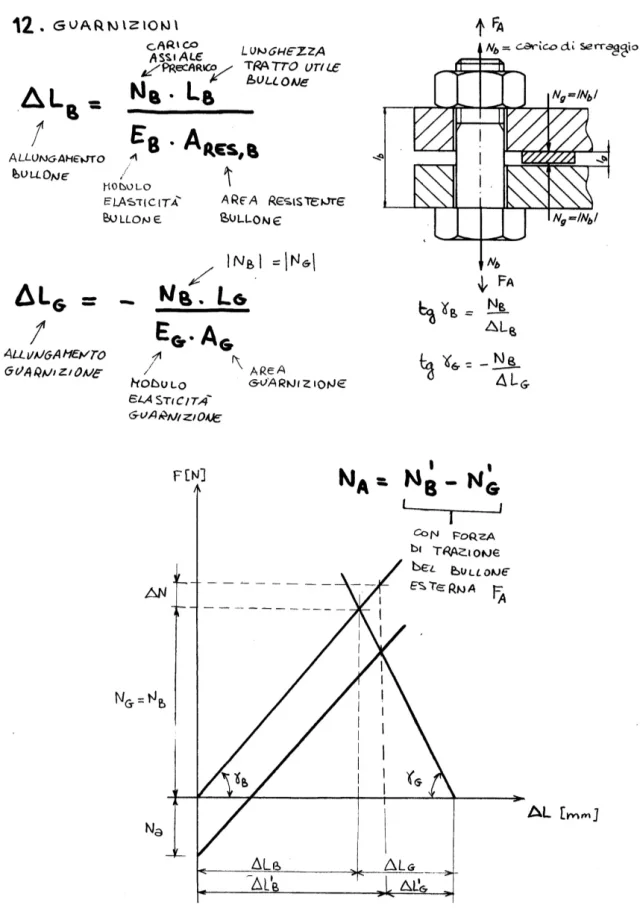
below an image of a calculation with formulas to relate coefficient of friction, torque and axial force.
Screenshot_20240621_140802_Microsoft 365 (Office).webp
 
I discovered that you and I have problems writing right m and n .. will be the phone concealer del

apart from this, you can see that a m20 in class 8.8 has a yielding voltage of 640mpa and a breaking voltage of 800mpa.
to see how many kn of equivalent force are, you have to calculate the resistant area and make the reverse formula of:[math]\sigma=\frac{f}{a}; \sigma=rs, rm[/math]clearly in all this I have placed the safety factor equal to one but it is good that it is well above, especially in dynamic load conditions.
 
would have liked a scheme.
I imagine it's a resin filler or alternatively a rubber pad between machinery or plate that carries the load and wall or concrete floor.View attachment 71497First you have to be sure of numbers.
if the filler can stand 35kg/cm2 i.e. 3,4mpa you have to calculate from the first the area to the plate in contact with the resin.
then to create a pressure you have to generate a known force (bolt insert).[math]f=\frac{p}{a}[/math]small delucidation:
- nut: fikettato female element
- screw: threaded male element with head
- bolt: nut+ screw

a coupling with a screw/gift will yield to the value of the traction breaking load of the weakest element of the two.

If you put the screws closed with your fingers and prevent them from unscrewing, perhaps with mechanical or loctite systems will go live under load moving the game more stretching and then you will have the strition with surrender.
then use the table torque is useless.

below an image of a calculation with formulas to relate coefficient of friction, torque and axial force.
View attachment 71498
wrong corrige post #2:[math]p=\frac{f}{a}[/math]
 
but the value indicated in the various tables, in theory does not represent the best torque to be applied for a certain screw (for example in my case m20 8.8 with k=0,2?)?
I had made them.
to give you an example, consider a lower welded structure, the chockfast and a top plate that is held firm by the preload of the screws. the upper plate is subject to a horizontal push, so the screws have to have a preload that exceeds the friction between the plate and the chockfast to avoid slipping and cutting break of the screws.1719213477434.webpthe calculation executed is as follows:
I verify the area of chockfast, the number of screws and the diameter.
subsequently calculate the corresponding voltage for each screw: [math]f = \frac{coppia}{k*d}\\[/math]torque = tightening
k = friction coeff.
d = screw diameter

putting as table (for m20, 8.8, k0,2) the pair=471nm
I get a screw voltage equal to[math]== sync, corrected by elderman ==[/math]and a request for [math]= \frac{f}{avite}\\ = 374.8n/mm2[/math]as stress of the screw are under the nerve, the problem is that for the calculation of the compression of the chockfast I get:[math]pchockfast = \frac{peso macchinario+(f*n°viti)}{achockfast}\\ = 0,77 kg/cm2[/math]but this value must remain below 0.35 kg/cm2.

the only is to reduce the torque to 280nm, but the friction coeff at 0.20 in the calculation.
In this way I get a pressure on the chockfast of 0.34kg/cm2

but my doubt is: can I lower the value of the table torque of a certain screw, do I maintain the friction coeff of 0,20?
 
if not put all data it is impossible that we verify formulas and results.
from your image you see that you have the external screws too close to the edge and then in that area unmatched the rubber cushion.

The first thing you have to do is calculate the horizontal friction force that you need not to move the mile.
[math]fo=f_a•(p+n_v)[/math]to generate fo you have the contribution of the machine weight and the crushing force of the m20 screws you are using.

if your force applied foa is less than foa generating then the system does not move.

only in this condition you must then check the specific pressure of the rubber. If it's too much you can only increase the contact area. the strength of the screws can not lower it otherwise This is more important than the and then move the car.

However I suggest you use euro code 3 uni en iso 1993-1-8 to have a current and not purely academic verification.

Keep in mind that the force that generates the screws, on an elastic element should be evaluated differently than the bolting of the plates.

I recommend you vdi 2230 which explains very well how you have to consider the interaction plate / rubber.Screenshot_20240624_111227_Drive.webpScreenshot_20240624_111245_Drive.webpthe pair tabled closing screws is that 70% of the yielding but no one says you have to pull up there. couple equal to the strength you need.
I repeat, a screw can also not close, if the machine weight multiplied the friction coefficient wins the applied horizontal force.
 
with regard to general issues, referring to your scheme, there are unfair graphic and design issues:
Screenshot_20240625_130708_Chrome.jpg- lacks the symmetry axis of the vines
- the distance from the edge is little to make uniform pressure effective
- the nut and counter-dead you used are not put in the right position. the low nut is used first to ensure the tightening torque at 20÷50%. the normal nut or long series lasts to iron the threads in order not to unscrew, thus bringing all the torque of the tightening and pushing the lower nut to the plate. read more This is what discussion post #26.
see the second image below:1719314129084.png
 

Forum statistics

Threads
44,997
Messages
339,767
Members
4
Latest member
ibt

Members online

No members online now.
Back
Top