drpulsae
Guest
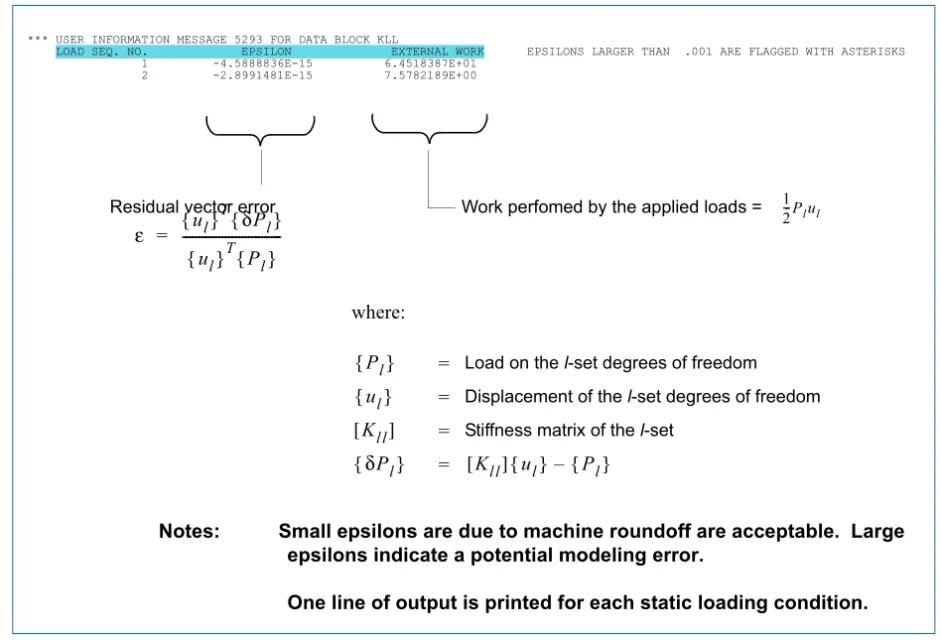
nice users of the forum. I have another question to propose. from a few months model with patran. the last two structures I modeled (aluminum frames) have a big problem: reading f06 about the load case of the analyses I launched I found an epsilon too high. in one is of the order of 10e-3 (at the limit of the acceptable), in the other even of 10e+3!! ! ! !
This result, especially the last one, is shocking. I can only tell you that the utility verification does not detect any problem sensitive to the elements (the model consists of elements 1d bar and 2d shell quad4 and tria3 for a total of cbar: 1387; cquad4: 122245; ctria3 7448; cry: 167998; rbe2: 683) (no element fails the test aspect ratio, taper etc...). welds were modeled making an equivalence with the firmness of combining the knots of the interested parties and bolts were modeled by means of mpc rbe2 connected by bar elements to the master nodes. constraints were applied to the master nodes of some mpc. loads are inertial. I tried to create a dof list by selecting all the degrees of freedom and knots of the whole model but it remains empty. the analysis is however good and shows results, unfortunately not significant due to the high epsilon values. I have three questions:
1) How can I control the epsilon value?
2) which tool do you recommend me for the quality assesment of the fem model?
3) using this tool, can I trace back to the origin of the problem?
are available to provide all the details that can help you find an answer. thanking you in advance, I look confident.
This result, especially the last one, is shocking. I can only tell you that the utility verification does not detect any problem sensitive to the elements (the model consists of elements 1d bar and 2d shell quad4 and tria3 for a total of cbar: 1387; cquad4: 122245; ctria3 7448; cry: 167998; rbe2: 683) (no element fails the test aspect ratio, taper etc...). welds were modeled making an equivalence with the firmness of combining the knots of the interested parties and bolts were modeled by means of mpc rbe2 connected by bar elements to the master nodes. constraints were applied to the master nodes of some mpc. loads are inertial. I tried to create a dof list by selecting all the degrees of freedom and knots of the whole model but it remains empty. the analysis is however good and shows results, unfortunately not significant due to the high epsilon values. I have three questions:
1) How can I control the epsilon value?
2) which tool do you recommend me for the quality assesment of the fem model?
3) using this tool, can I trace back to the origin of the problem?
are available to provide all the details that can help you find an answer. thanking you in advance, I look confident.