• This forum is the machine-generated translation of www.cad3d.it/forum1 - the Italian design community. Several terms are not translated correctly.

cutting effort

  • Thread starter Thread starter cliff23
  • Start date Start date

cliff23

Guest
Good morning to all,

I have a question about calculating the cutting effort on sheet metal molds:

Whereas I have to draw a sheet s355mc sp. 6 mm I wondered what value I have to use as a resistance to cutting.
on the tables of the material I find only the rm value (traction resistance) that varies from 430 to 550 mpa while my software considers me a value of
100 kg square.
What do you think is the right value?

Thank you.
 
how to get out of the tab qui si ha:
rm = max 550 mpa
rs = 355 mpa
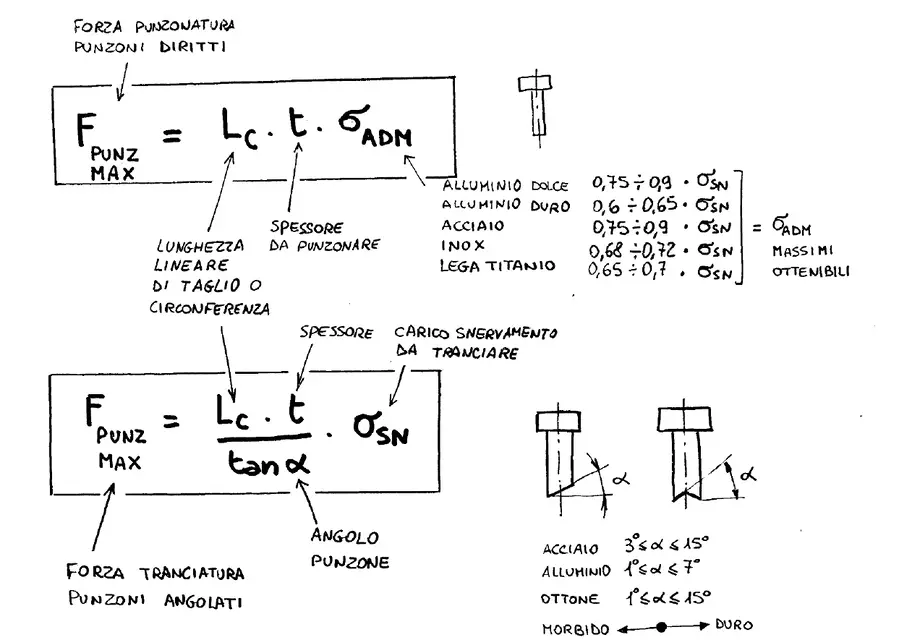
If you use a straight punch (see attachment) you will get, depending on the punch cut length the value you need. simplified will be:
f [N] = lc [mm] * 1704 [N/mm]that could be compatible with your 100 kg/m m since 1704/9.81 = 174 kg/mm even if the value you have in your car is a little low.

if you use an angled punch with angle 15° you will get
f [N] = lc * 7949 [N/mm] clearly because the area is small and the force increases.

(source: handbook of die design - mcgraw hill - 2nd edition)
 

Attachments

  • Fpunzone.webp
    Fpunzone.webp
    67.5 KB · Views: 94
how to get out of the tab qui si ha:
rm = max 550 mpa
rs = 355 mpa
If you use a straight punch (see attachment) you will get, depending on the punch cut length the value you need. simplified will be:
f [N] = lc [mm] * 1704 [N/mm]that could be compatible with your 100 kg/m m since 1704/9.81 = 174 kg/mm even if the value you have in your car is a little low.

if you use an angled punch with angle 15° you will get
f [N] = lc * 7949 [N/mm] clearly because the area is small and the force increases.

(source: handbook of die design - mcgraw hill - 2nd edition)
I'm sorry, I'm gonna be fat but I can't figure out where 1704n comes from?
 
I'm sorry, I'm gonna be fat but I can't figure out where 1704n comes from?
if you look at the formulas in attached image you have 0.8*rs = 0.8*355=284 mpa which is the admissible sigma.

thickness is 6 mm therefore 6*284 = 1704

If the formula f = lc * t * admissible sigma .... I collected t*admissible puzzle = 1704
 
how to get out of the tab qui si ha:
rm = max 550 mpa
rs = 355 mpa
If you use a straight punch (see attachment) you will get, depending on the punch cut length the value you need. simplified will be:
f [N] = lc [mm] * 1704 [N/mm]that could be compatible with your 100 kg/m m since 1704/9.81 = 174 kg/mm even if the value you have in your car is a little low.

if you use an angled punch with angle 15° you will get
f [N] = lc * 7949 [N/mm] clearly because the area is small and the force increases.

(source: handbook of die design - mcgraw hill - 2nd edition)
Bye to all,
I take this post as I'm finding the same problem.
my question is in the formula in the image because we used the stress of yielding and not that of breaking, I can not understand this detail.

Thank you.
 
Bye to all,
I take this post as I'm finding the same problem.
my question is in the formula in the image because we used the stress of yielding and not that of breaking, I can not understand this detail.

Thank you.
Yeah, I'm curious to know why. Among other things, even that fract tan alpha sounds strange because for values close to 0 the force tends to infinite, and however for elicit values the force is greater than straight punches (it should be the opposite).
 
Usually we use the breaking load because as in the traction test we have the separation of the material when it reaches rm and not rs.
then clearly there are all the coefficients that take into account enlargement and therefore how much more or less fragile the break and therefore the force rises or falls.
The subject is not so trivial.
 
Yeah, I'm curious to know why. Among other things, even that fract tan alpha sounds strange because for values close to 0 the force tends to infinite, and however for elicit values the force is greater than straight punches (it should be the opposite).
the straight punch has greater strength than a stripped.
tan alpha....the smaller alpha and the higher the strength.... always.
are formulas reported identical press on new, old, Italian and international books.
then one can also put there with a square meter of sheet metal and try the punches at different angles and sample the force so it gets the law practice.
 
the straight punch has greater strength than a stripped.
tan alpha....the smaller alpha and the higher the strength.... always.
are formulas reported identical press on new, old, Italian and international books.
then one can also put there with a square meter of sheet metal and try the punches at different angles and sample the force so it gets the law practice.
Right.
the formula says the opposite.
tan0=0, that is infinite force. tan3 =0.052 or force greater than the flat punch.
only with tan45° comes to the same force of the flat punch. is not correct.
 
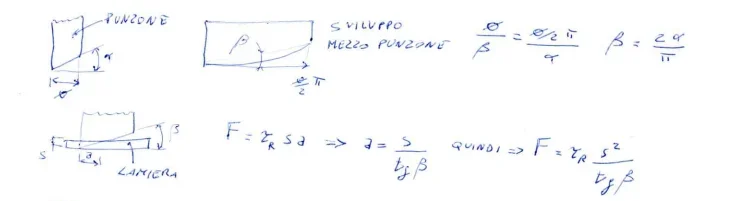
Immagine 2023-09-28 165959.pngwe have the diameter punch phi ed inclinazione alpha.
if development half punch we have the angle alpha that is tied to the corner beta for the following report:[math]\frac{\phi}{\beta}=\frac{\frac{\phi}{2}\pi}{\alpha}[/math]the sheet will be affected by the quota a per lo spessore s. therefore, the force that affects half punch is equal to:[math]f=\tau_{r}sa[/math]but the side a The Rich:[math]a=\frac{s}{tg\beta}[/math]now, the force that affects half punch is equal to:[math]f=\tau_{r}\frac{s^{2}}{tg\beta}[/math]for the criterion of von mises:[math]\sigma_{r}=\tau_{r}\sqrt{3}[/math]Finally, the force that affects the whole punch is:[math]f=\frac{2\sigma_{r}s^{2}}{\sqrt{3}tg(\frac{2\alpha}{\pi})}[/math]naturally validates if and soil if:[math]2a\leq \phi\pi[/math]otherwise it applies the formula used for straight punches.
 
Thank you very much.
I have the doubt about the tension of yield. I try to look around.
Thanks again.
 
6 years later, the formulas of my post #2 have been retouched and seen qui.

definitely in the tracking formulas you need to win the cutting tau then theoretically 0.58*rm. Then depending on the materials you have a more or less fragile behavior that makes vary also not little the cutting effort.

Although simplified compared to complete biz treatment here works correctly:1696148171458.webpa retouching of the second formula which will replace the yielding sigma with an admissible sigma formed by the cutting tau and an evaluation of the yield and the collaboration with the fracture.

in reality the forces are always different from the formulas for the speech game matrix/punzone, lubrication, elongation percentage and therefore collaboration to fracture.
 

Forum statistics

Threads
44,997
Messages
339,767
Members
4
Latest member
ibt

Members online

No members online now.
Back
Top