• This forum is the machine-generated translation of www.cad3d.it/forum1 - the Italian design community. Several terms are not translated correctly.

cutting stress and bending moment on tree

PaoloMUTZ

Guest
Good morning to all,
I ask kindly support for the sizing (approximate) of the diameter of the stem of the hydraulic cylinder represented in figure.

basically the stem of an oleodynamic cylinder has a f force of 43'000n applied at the end and this cylinder passes through the hole of a fixed support (the various masses are ignored, the bike of the cylinder). you can consider contact between the support hole and the stem as if it were a skate
material is 39nicrmo3 with rm=1000[N/mm^2] what puts me in trouble is how to consider cutting stress and stinging moment together.

Thank you and wish you a good day.
good make
 

Attachments

  • CatturaA.webp
    CatturaA.webp
    23.5 KB · Views: 35
If the load is concentrated only on the end of the stem and since the arm is not irresistible, I don't think it is necessary to consider the cut.
 
Good morning to all,
I ask kindly support for the sizing (approximate) of the diameter of the stem of the hydraulic cylinder represented in figure.

basically the stem of an oleodynamic cylinder has a f force of 43'000n applied at the end and this cylinder passes through the hole of a fixed support (the various masses are ignored, the bike of the cylinder). you can consider contact between the support hole and the stem as if it were a skate
material is 39nicrmo3 with rm=1000[N/mm^2]what puts me in trouble is how to consider cutting stress and stinging moment together.

Thank you and wish you a good day.
good make
In general, cutting stresses are neglected and simplified by assessing the only bending.
 
I would never charge with a radial force the stem of a hydraulic or pneumatic cylinder, but only in thrust or traction.
 
happens in different applications of having to radially load a cylinder stem. to do this you always do so to have a support or bronzine in the load point of the force that supports the entire load, so you do not have to deform the bronzine and the head seal of the stem.
Moreover if you can screw a extension on the stem (or you take it with length above the standard) to support it.
if the hole of the support is not too lascous you can consider that and the cylinder a whole and consider a shelf studded for the part that comes out from the support.

the scheme is this:1628180915053.pngcalculated the maximum bending moment and known the maximum cut that is equal to the applied force, you pass to the voltage assessment in the circular section.
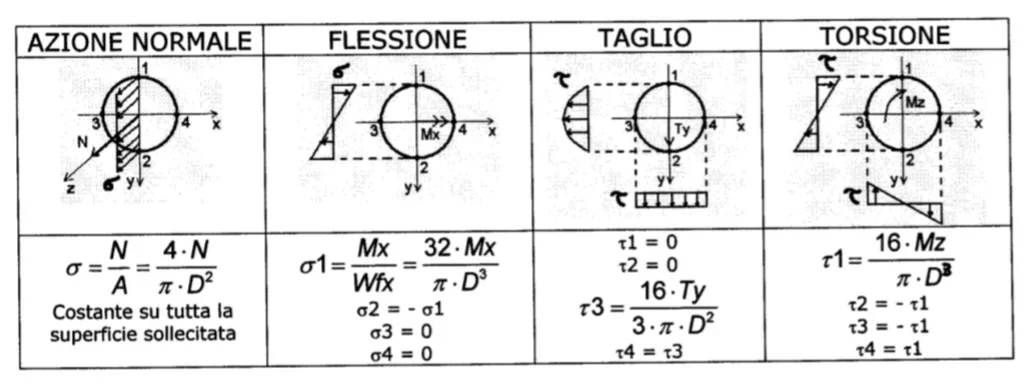
calculation sigma bending and tau cutting with these formulas:Screenshot_20210805_183153.webpthen applies von mises:Screenshot_20210805_183512.webpcalculations then the admissible voltage as the yielding load of your tree divided at least 1.5.
if it is verified that the tension of von mises is less than the permissible means that it is okay, otherwise it breaks.
 
happens in different applications of having to radially load a cylinder stem. to do this you always do so to have a support or bronzine in the load point of the force that supports the entire load, so you do not have to deform the bronzine and the head seal of the stem.
Moreover if you can screw a extension on the stem (or you take it with length above the standard) to support it.
if the hole of the support is not too lascous you can consider that and the cylinder a whole and consider a shelf studded for the part that comes out from the support.

the scheme is this:View attachment 63006calculated the maximum bending moment and known the maximum cut that is equal to the applied force, you pass to the voltage assessment in the circular section.
calculation sigma bending and tau cutting with these formulas:View attachment 63008then applies von mises:View attachment 63009calculations then the admissible voltage as the yielding load of your tree divided at least 1.5.
if it is verified that the tension of von mises is less than the permissible means that it is okay, otherwise it breaks.
Thank you very much @meccanicamg , always al top
 
Thank you very much @meccanicamg , always al top
try asking a manufacturer of hydraulic cylinders you think! This time I'm sorry but I disagree with mechanicalmg! I would not do it and put a system of external guides.. but you are free to replace the cylinder in no time, everything has a cost, evaluate the costs and benefits of different solutions!
 
try asking a manufacturer of hydraulic cylinders you think! This time I'm sorry but I disagree with mechanicalmg! I would not do it and put a system of external guides.. but you are free to replace the cylinder in no time, everything has a cost, evaluate the costs and benefits of different solutions!
pietro, from the image that placed on the left the cylinder in norm and on the right the plate with the compass. the compass in the plate carries the radial load. does not hold the radial load to the cylinder head bronzine.
That's what I understand.
 
pietro, from the image that placed on the left the cylinder in norm and on the right the plate with the compass. the compass in the plate carries the radial load. does not hold the radial load to the cylinder head bronzine.
That's what I understand.
I also understood that, to me they always "prohibited" to do so when I was a barbatello and I thank the "old" for teaching me, as they taught me not to rigidly connect the cylinder stem to the application to move, always interposing or a spherical snout or a "baionet" attack. but maybe the new school leaves these finesses. .
 
I also understood that, to me they always "prohibited" to do so when I was a barbatello and I thank the "old" for teaching me, as they taught me not to rigidly connect the cylinder stem to the application to move, always interposing or a spherical snout or a "baionet" attack. but maybe the new school leaves these finesses. .
Unfortunately for economic needs we do so many things that are not strictly done well.
 
Hello, everyone.

I put myself in this discussion with a question.

I would like to know the cutting resistance of a steel plate area 1.2311
subject to a-b forces as attached image.
I would like to know how to detect this magnitude to think about the sizing
Some turret could help me by pointing out a table or an example of calculation
with the data provided?
1642227713214.webp
 
Hello, everyone.

I put myself in this discussion with a question.

I would like to know the cutting resistance of a steel plate area 1.2311
subject to a-b forces as attached image.
I would like to know how to detect this magnitude to think about the sizing
Some turret could help me by pointing out a table or an example of calculation
with the data provided?
View attachment 64327
your piece cannot be assimilated to a beam where the section is two orders of magnitude smaller than the length. therefore the only effective method is a fem analysis.
 
thanks for the answer .
but 30 years when the fem did not exist as it was possible to calculate the cutting resistance of such a form?
 
Empirically and with overestimation.
take the 125x125 fictitious beam section and apply the two forces. you will get two orthogonal cutting tau between them to compose to determine the most stressed point.
then compare it to the admissible tau and see how far you are.
then you will need to check the specific pressure on the contact faces.
non-existent bending because ultra-thick.... but you can calculate it and then use the comparison with the voltage of von mises.
 
Thank you very much.
Would you be so kind to throw me down two numbers to help me understand better?
would help me a lot in understanding
 
for the cut background in rectangular section I bring back the formulas that you use normally.
Screenshot_20220116_090133.jpgthe mechanical characteristics of the 42crmnmo7 qui and also qui and depending on the state of supply you will have a breaking load and a yield.

the permissible cutting voltage is calculated as:[math]\tau_{adm}=0,58•\frac{rs}{k}[/math]where k should be a safety factor at least greater than 1.5. but everything depends on the application and what it has to do.

How much are the forces at stake?
 
Last edited:
If it is the turret of a lathe, I expect it to be extremely oversized for the efforts, as it must be very rigid, then I would make a dimensioning rigidity, and then purely for formality, a verification of tensions
 
in the first approximation, Vedial as a beam, is a gross pattern as it is a rough body, but at least it gives you an order of magnitude of the numbers in play
 

Forum statistics

Threads
44,997
Messages
339,767
Members
4
Latest member
ibt

Members online

No members online now.
Back
Top