Riccardo1990
Guest
Good morning to all, I am a mechanical engineer of bologna and work in dental field
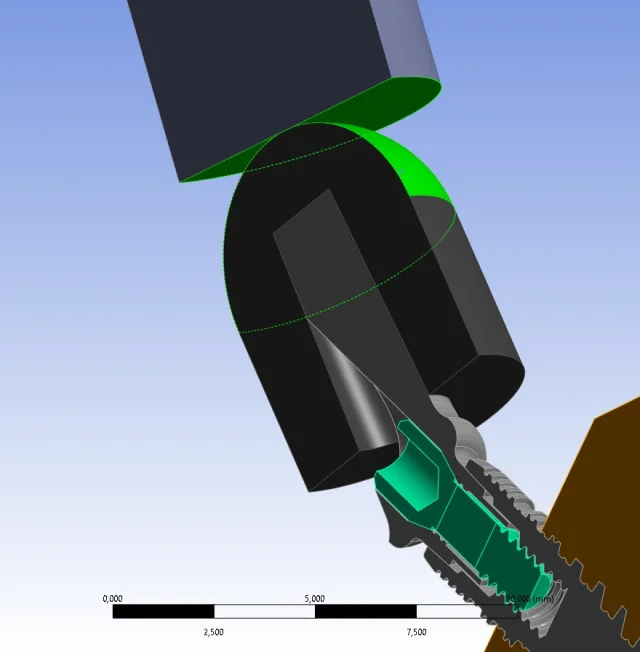
I am designing a new dental implant and before going to production I am trying to perform a static test, according to the law uni en iso 14801, to verify the seal of the entire structure. the system is composed: - plant (inserted in the sleeve/support of brown brass);
- an angled ram fixed by a screw at the plant itself;
- a titanium carbide cap (cemented on the black moncone);
- steel cylinder simulating an actuator/pistone.
 I'm studying half the surface to simplify the simulation. I have set the materials (earned directly from the granta software) so I am sure of their validity, I have simplified the entire structure with spaceclaim, I have put in contact the components so that there are no interference or compnetrations and finally I have put the constraints:
- fixed support: put to the brass support (brown)
- displacement: null shift in the direction of symmetry (long z) figure below
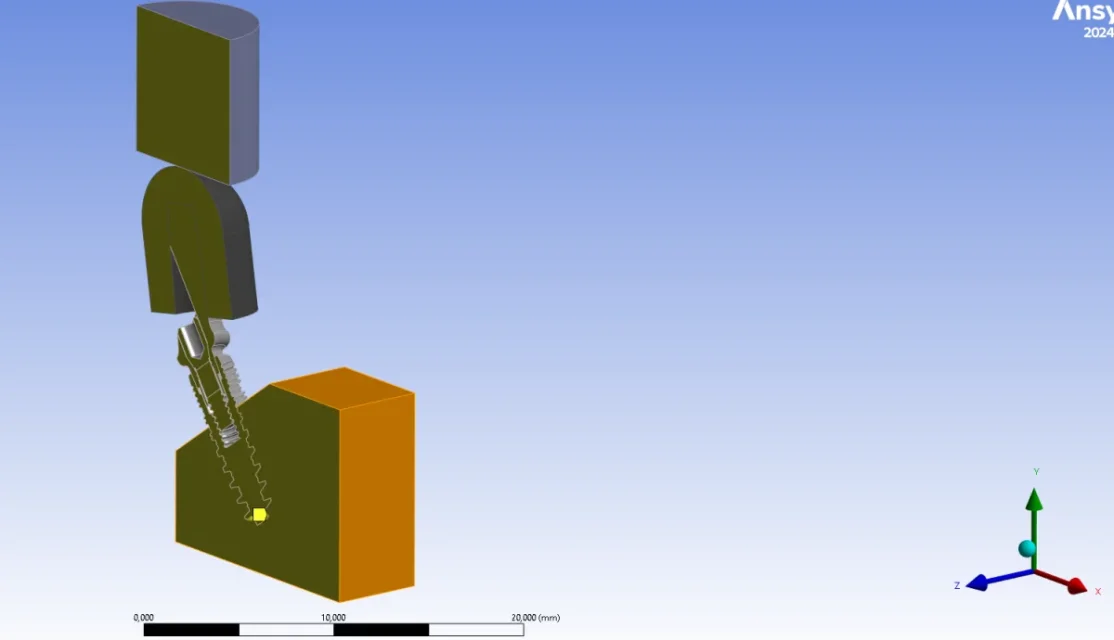 - Bolt pretension: screw pretension calculated with the motosh formula
- remote displacement: between the spherical and piston cap (contacted with a frictionless) so that during the pretension of the screw, rams + hood + piston come down together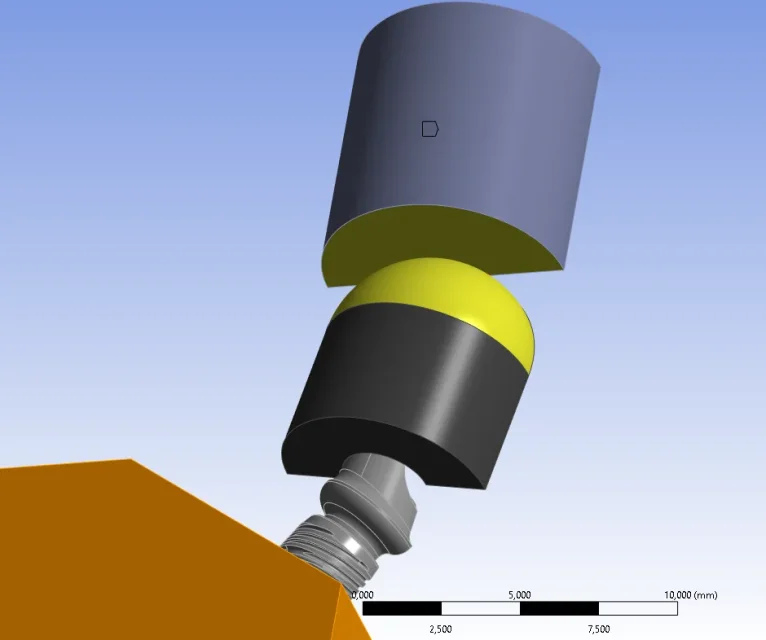 I'm breaking down static simulation in two steps:
1) only the pretension of the screw (piston + cap does not contribute energyly, on them there are no efforts; therefore when the screw puts in pretension moncone and plant the other two follow only the moncone in the descent, since the hood is cemented)
2) application of force by the actuator on the structure "altered already from the pretension"
in the first phase I managed to make the accounts square, during the pretension of the screw, the moncone drops in the plant of 0.17mm (exactly as in reality), carrying behind hood and piston (it is as if there were, in fact there are neither efforts nor energy on the components)
in the second phase, when I apply the remote force on the piston, it happens that the piston and the cap lose the contact and the piston starts from the initial condition and not from that "altered" from the screw. in a few words the initial point of the second phase must coincide with the end of the first. Moreover the piston must move only vertically and the spherical cap, during the descent flows without friction on the piston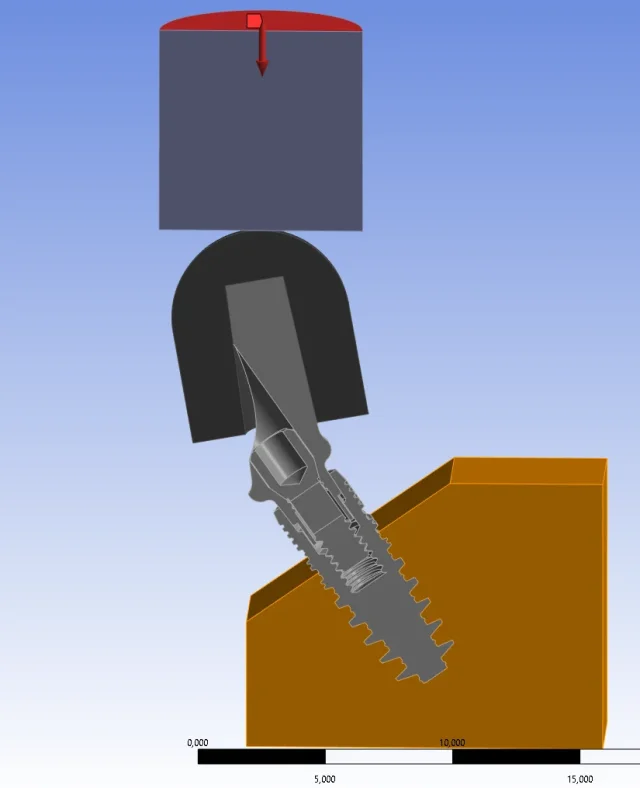 in a few words there is first the pretension of the screw and then the application of force with active pretension.
I'm almost sure it's a matter of system constraints and I'm not succeeding in setting them properly, I always get stuck with simulation.
I apologize for the long description
waiting for your answer, I wish you a good day
richer
I am designing a new dental implant and before going to production I am trying to perform a static test, according to the law uni en iso 14801, to verify the seal of the entire structure. the system is composed: - plant (inserted in the sleeve/support of brown brass);
- an angled ram fixed by a screw at the plant itself;
- a titanium carbide cap (cemented on the black moncone);
- steel cylinder simulating an actuator/pistone.
I'm studying half the surface to simplify the simulation. I have set the materials (earned directly from the granta software) so I am sure of their validity, I have simplified the entire structure with spaceclaim, I have put in contact the components so that there are no interference or compnetrations and finally I have put the constraints:- fixed support: put to the brass support (brown)
- displacement: null shift in the direction of symmetry (long z) figure below
- Bolt pretension: screw pretension calculated with the motosh formula- remote displacement: between the spherical and piston cap (contacted with a frictionless) so that during the pretension of the screw, rams + hood + piston come down together
I'm breaking down static simulation in two steps:1) only the pretension of the screw (piston + cap does not contribute energyly, on them there are no efforts; therefore when the screw puts in pretension moncone and plant the other two follow only the moncone in the descent, since the hood is cemented)
2) application of force by the actuator on the structure "altered already from the pretension"
in the first phase I managed to make the accounts square, during the pretension of the screw, the moncone drops in the plant of 0.17mm (exactly as in reality), carrying behind hood and piston (it is as if there were, in fact there are neither efforts nor energy on the components)
in the second phase, when I apply the remote force on the piston, it happens that the piston and the cap lose the contact and the piston starts from the initial condition and not from that "altered" from the screw. in a few words the initial point of the second phase must coincide with the end of the first. Moreover the piston must move only vertically and the spherical cap, during the descent flows without friction on the piston
in a few words there is first the pretension of the screw and then the application of force with active pretension.I'm almost sure it's a matter of system constraints and I'm not succeeding in setting them properly, I always get stuck with simulation.
I apologize for the long description
waiting for your answer, I wish you a good day
richer