
• This forum is the machine-generated translation of www.cad3d.it/forum1 - the Italian design community. Several terms are not translated correctly.

design/constructive design without end screw reducer

@ndreaR

Guest
hello to all, I am going to a student of mechanical ing at the athene of bologna. I've been following the forum for a while and finally I've decided to enroll myself taking advantage of the fact that I wanted to ask for your opinions about a mechanical design/design exercise. I would point out that I am a member of the industrial plant curriculum and that these two subjects are not my strong point, but I also understand that they must be part of the cultural baggage of every mechanical engineer. said this I attach you the track of the exercise. the demands were to opt for all commercial components and make changes if necessary, to make a static check of the tree (the latter not I send it for now, to give precedence to another) and then to make the construction design 2d with all the necessary info (quotes, roughness, geometric and dimensional tolerances). I list below the components I choose and my design 2d. If you want to give us an eye and tell me where I was wrong and various other tricks of the trade. Thank you very much!!! :

problem data:
p=13 kw,
No 132 rad/s
number of screw principles = 1
for quotas and commercial components refer to the design and make the appropriate changes.

- bearings
from the type of mounted bearings I hypothesized that the reducer can work in both rows of rotation. for the right bearing I chose from catalog skf a nu 2314 ecp, i.e. a bearing to a crown of cylindrical rollers and in particular the nu type so that it can allow an axial slide (carriage vine). for the right bearings I chose skf 7314 becbp ball obliques arranged with x mounting. These I schematized them as a hinge bond and hypothesized that each of the two takes 50 % of the radial + tangential load and alternately 100 % of the axial one (i.e. the axial load is "absorbed" by a bearing at a time according to the direction of the load). I checked from static load catalog, dynamic with lh10 and maximum number of turns (for the verification of the loads I did not apply the corrective coefficients skf but I obtained directly reactions found solving the isostatic associated with the endless screw. here I ask you how you would have done?). If you need to go further, I will send you the calculations. regarding geometric tolerances I have put total oscillation on seat and shouldering according to skf catalog, but I have not much experience in regurado.

- bearing locking
1) Roller bearing stuck left by ring seeger uni 7435-70 and right by shaft shouldering with check from catalog skf of minimum shouldering radius. I have rectified the seat to ra 0.8 but not the shoulder because it does not work axially (is it correct? )
2) Oblique ball cuscients ( x-mounting) blocked by shouldering (with verification radius min shouldering by skf) and right by a wreath m70 x 2 din 1804 h or alternatively a skf km14 wreath with respective rosette antisvitamento mb14 skf. I then made on the tree the thread for the wreath and the seat for the rosette.

- seals
a left there is a felt seal of diameter 70. I adjusted to 0.8 the seat of the estate (is it necessary even if it is felt? do you need special input bevels?). other question: is it better to replace the felt seal with a oil ?

- tongue
I chose a tab uni 6604-a 20x12x56. having a diameter section 63 mm and a torque moment to transmit about 75 000 nmm I made the choice of length with this formula (which comes from pressure verification) l = (2*mt/(((h-t1)*pamm*d)))+b with
mt = torque; h = tongue height; t1= alt. hollow tree, pamm = 90mpa;d= shaft diameter; b = hollow width;
I found a minimum of 25 mm and chose the l min available for a diameter of 63 mm.

- endless lives
I hypothesized an angle of propeller (delta) of 30° and a pressure (alpha) of 20° I found the forces transmitted as:
t = 2*mt/dp
r = t*tg(alpha)/sin(delta)
a = t/tg(delta)
for the geometric sizes I have made hypotheses starting from the wheel with which I am ingrained and I have obtained form, axial step etc. however they do not evaluate us much on this (we talk more about it if needed). I then put a roughness 0.8 of rectification on the primitive diameter (I have distant memories of technology that rectifies the wheels) while I don't know if geometric controls should be inserted

let me know if you think these choices are correct and if you would have kept that bearing assembly or opted for something different. I also attach the constructive design to you.
 

Attachments

Shit. Of course it's a nice project. I see you're putting your head on and that's great.
if you go to see our various discussions about the gearbox you will find the formulas and reasonings that we have made that can serve you to compare your choices.
remember that in the vsf system that has a low yield, the forces on the screw start of direction and type on the crown and unfortunately you lose strength due to low performance.

felt seals haven't been using them for decades. the seals for rotating trees are used in nbr din 3760-a, so I have no idea of the necessary requirements. is too obsolete technology.

the seats of the seals should not be rectified but the turning shaft must be tempered and rectified with at least 58hrc.

for shafts and hubs where bearings go there are at least geometric tolerances for bearing seats found on oscillation skf.
 
Shit. Of course it's a nice project. I see you're putting your head on and that's great.
if you go to see our various discussions about the gearbox you will find the formulas and reasonings that we have made that can serve you to compare your choices.
remember that in the vsf system that has a low yield, the forces on the screw start of direction and type on the crown and unfortunately you lose strength due to low performance.

felt seals haven't been using them for decades. the seals for rotating trees are used in nbr din 3760-a, so I have no idea of the necessary requirements. is too obsolete technology.

the seats of the seals should not be rectified but the turning shaft must be tempered and rectified with at least 58hrc.

for shafts and hubs where bearings go there are at least geometric tolerances for bearing seats found on oscillation skf.
Thank you! I will recover the old discussions to make conphonies.
As for the tunutes of felt I had a feeling that they were a little obsolete, I would say at this point that I will replace them with those that indicated me.
while if you want to insert in construction design 2d the tempering treatment there is a "normative" way to do so? or just enter a note.
 
notes on the design of the endless screw:
- roughness is not indicated in that way, but adjacent to the quota line, moreover each affected surface must have its roughness (see the tongue seat that has only one side)
- it is simple and fast to indicate the regulations, but thinks it is the operator, or programmer, that must stop the processing to go to dispel the norm and deduct the measurements of the throat.
- Same thing for tolerances, especially for tolerances where you automatically put the program, which must measure must waste time finding the correct range for the data measurement.
-the position of the seeger throat is wrong quoted; if the bearing rests on the shoulder the position of the seeger can not start from the left end (just that the 95 is along a couple of tenths and the bearing has axial play)
-the known "skf rattle" does not serve anything; the operator is interested in measures, not what should be mounted
-looking the assembly an important quota is the distance between the bearing shoulders, so instead of 48+220+37 the quota 305 with tolerance must be placed; the definition of the dented zone is then quoted knowing that the operator must never make calculations to know how much a bevel is
- general tolerances are not correct; on the drawing you indicated 3.2-1.6-0.8 while on the cartilage is indicated general roughness 3.2 and in brackets, that is present on the drawing, 1.6-0.8. the fact that 3.2 general is excessive the information is incongruent.
- Are you sure of the primitive diameter indicated in the table?
-no external diameter
 
hi, I try to say something about the design, to facilitate and make better understandable the realization of the detail:

put the outer diameter (dp + 2 times the module ).

put tolerance on diameter 63.

to quote the bevels of the endless screw (long stretch 220 ).

put fine stretch lines indicating thread m 70 x 2.

indicate the heat treatment : cementing (depth) - tempering - distension - hrc hardness.

Maybe use a larger sheet format.

quotate the seat for the rosette. rightly you indicated the type but it serves for the miller.

quota the exhaust gorges for grinding. rightly you've indicated the guy but it's for the turner.
 
I answer both to mammals that you pietro2002. First of all I thank you because you have given me a lot of ideas of reflection and you have made me notice of my views a little silly of which I did not notice, like the primitive diameter of 256 mm that I do not know from where I pulled it out ahahahah.
for the rest I wanted to ask the quota of 305 between the two shoulders where the bearings rest as I rule to insert a tolerance? forwarded for tolerance on diameter 63 I have to make a reasoned based on what will bind on that section of the tree, correct?
 
Hi, a note on the flight:
the prescriber task of roller bearings of type n, not nu.
see:
 
I answer both to mammals that you pietro2002. First of all I thank you because you have given me a lot of ideas of reflection and you have made me notice of my views a little silly of which I did not notice, like the primitive diameter of 256 mm that I do not know from where I pulled it out ahahahah.
for the rest I wanted to ask the quota of 305 between the two shoulders where the bearings rest as I rule to insert a tolerance? forwarded for tolerance on diameter 63 I have to make a reasoned based on what will bind on that section of the tree, correct?
not knowing what should be coupled on diameter 63, I would put a h7 tolerance, with wrinkle 0.8.

As for tolerance on bearing 305 shouldering height, I would not put too tight tolerance, so much the roller bearing has the possibility to accept axial flow between inner ring and outer ring.
 
a doubt that came to me.. is it not that the shouldering between diameter 95 and diameter 70, how bearing shoulder is excessive? must be checked on the catalogs... Maybe you already did!
 
I wanted to ask the 305 share between the two shoulders where the bearings rest as I stand to insert a tolerance?
the sum of tolerances of the various dimensions must be made; in this case it is not even very difficult being the 305 equal to the shouldering of the outer rings of the bearings
 
a doubt that came to me.. is it not that the shouldering between diameter 95 and diameter 70, how bearing shoulder is excessive? must be checked on the catalogs... Maybe you already did!
I had done only the verification on the minimal shouldering, but in this case it is better to do it also on the maximum diameter because from 70 to 90 is a nice jump. I'll check it out tomorrow.
 
However I wanted to thank you again because you really gave me a great help. I scored everything on the notebook and tomorrow I put myself under the table! :
 
I had done only the verification on the minimal shouldering, but in this case it is better to do it also on the maximum diameter because from 70 to 90 is a nice jump. I'll check it out tomorrow.
it is not a matter of verification, the skf site indicates the shoulderings for the internal and external rings; a shoulder that exceeds the ring is likely to ruin the bearing hold.
In fact in the assembly it is seen that the left bearing has the shouldering slightly lower than the inner ring.
in bearing technical cards nu 2314 ecp it is seen that the mounting provides a maximum diameter of the shouldering of 86.
for the right bearing 7314 becbp the same speech (although on the mounting is slightly higher); skf indicates the dimensions of the shoulders with the opposite mounting compared to that of the exercise, but a useful measure can also be deducted. d1 is 101.1 and skf suggests a shouldering (from) of 82, therefore a difference of radial 9.5mm; if you have that d2 is 84.4 you would have the theoretical shouldering of 84.4-9.5-9.5=65.4 which is a obviously absurd dimension, in this case you use common sense and you make the maximum admissible diameter that will be slightly lower than the diameter of the ring and that is 83.5/84
 
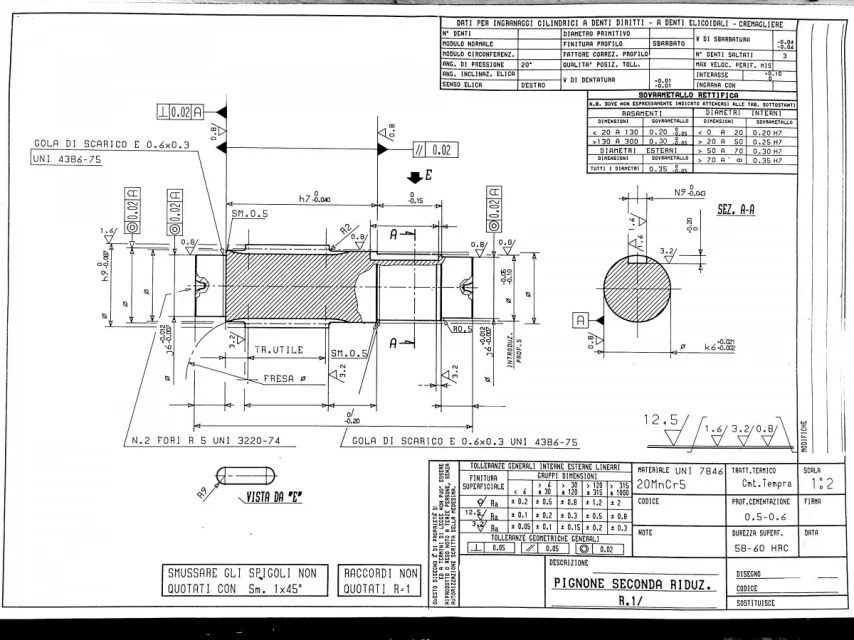
if you can be useful I attach a quoted design from which you can take inspiration,
in addition to what you have been told, I add:
- heat treatment: the indication and depth of cementation is necessary (in your case, 0.6-0.8 mm).
- tab length: normally you prefer to make the most of the length of the tree by placing it symmetrically at 5 (or 10) mm from the bar and the shaft end. this because we do not know a priori if the semi-joint or pulley or other that will be coupled will use the whole tree.
- diameter tolerances: shaft ledge 63 k6, shaft bearing seats j6 (for normal use not excessively stressed), the seat of the oil on the shaft, adjacent to that of the bearing (same diameter) : f7, this to prevent the assembly of the bearing this seat being scratched by affecting the seal of the oil. Obviously you have to repeat the diameter quota with the differentiated tolerance. 12.5 roughness, in your case, as in the one of the pinion that I attach, can be fine if the particular is obtained from cutting bar and the two holes from center (which you have to predict and quota) for subsequent processing without making the header of the two ends.
p.s. the drawing that I attach is referred to a pinion with two bearing seats at the ends and a seat for crown toothed in correspondence of the quarry for tongue. being an internal component, obviously it does not provide an oil.
 

Attachments

  • Disegno pignone.webp
    Disegno pignone.webp
    133.4 KB · Views: 124
for bearing hubs and for shaft bars there are indications that skf are indicated for each bearing. The spaces are vital to accommodate cages that are dirty or other parts that can move or move. You can't scratch a spacer on the wall of a bearing seal... otherwise you eat it out.
of a few mm can be changed, optimizing a little but it needs caution.
very important thing is to understand how and what to lock and leave free in every type of bearing and application.
 
Thank you! I have not noticed, but I think that a cuscientto nu is still correct.
There is a reason why type n would be preferable, and it is mounting mode.
provided that the nu 2314 ecp type is super robust and probably overflowing with respect to the loads it has to bear, adopting a type n314 having the same diameters but less length it is necessary to verify that the inner diameter of the outer ring is greater than the diameter of the screw. If this were the case, it would happen in this way:
- slip the outer ring of n314 into the case.
- mount the inner ring on the screw blocking it with the seeger
- thread the screw into the case by introducing it from the left, if the outer diameter screw is lower than the outer ring hole, the screw can pass until the first thread meets the wheel, then rotate it by screwing it in the wheel gorges acting on the part that still protrudes from the case until reaching the final quota, then the two oblique bearings from the right blocking them with the wreath. it could be objected that even the mounting with the nu type is feasible by preassembling the inner ring and introducing the screw from the right, but the thing is not as easy because the protruding part does not have the key to use as a key to manoeuvre and dulcis in fundo type n314 allows the support bar of 95 mm without having to do down, thus guaranteeing a greater robustness.
I realize that the speed of assembly is a matter of whim wool, but if it were a series assembly the times would count. I therefore address to super experienced tetrator in the field to have his welcome opinion!
 
if you can be useful I attach a quoted design from which you can take inspiration,
in addition to what you have been told, I add:
- heat treatment: the indication and depth of cementation is necessary (in your case, 0.6-0.8 mm).
- tab length: normally you prefer to make the most of the length of the tree by placing it symmetrically at 5 (or 10) mm from the bar and the shaft end. this because we do not know a priori if the semi-joint or pulley or other that will be coupled will use the whole tree.
- diameter tolerances: shaft ledge 63 k6, shaft bearing seats j6 (for normal use not excessively stressed), the seat of the oil on the shaft, adjacent to that of the bearing (same diameter) : f7, this to prevent the assembly of the bearing this seat being scratched by affecting the seal of the oil. Obviously you have to repeat the diameter quota with the differentiated tolerance. 12.5 roughness, in your case, as in the one of the pinion that I attach, can be fine if the particular is obtained from cutting bar and the two holes from center (which you have to predict and quota) for subsequent processing without making the header of the two ends.
p.s. the drawing that I attach is referred to a pinion with two bearing seats at the ends and a seat for crown toothed in correspondence of the quarry for tongue. being an internal component, obviously it does not provide an oil.
Thank you! The fact about the j6 and f7 tolerance is brilliant, also because I happened to see bearing mounts on youtube and I actually saw that if you don't have the induction heater they hunt it in hahahahahah bearing.
 
There is a reason why type n would be preferable, and it is mounting mode.
provided that the nu 2314 ecp type is super robust and probably overflowing with respect to the loads it has to bear, adopting a type n314 having the same diameters but less length it is necessary to verify that the inner diameter of the outer ring is greater than the diameter of the screw. If this were the case, it would happen in this way:
- slip the outer ring of n314 into the case.
- mount the inner ring on the screw blocking it with the seeger
- thread the screw into the case by introducing it from the left, if the outer diameter screw is lower than the outer ring hole, the screw can pass until the first thread meets the wheel, then rotate it by screwing it in the wheel gorges acting on the part that still protrudes from the case until reaching the final quota, then the two oblique bearings from the right blocking them with the wreath. it could be objected that even the mounting with the nu type is feasible by preassembling the inner ring and introducing the screw from the right, but the thing is not as easy because the protruding part does not have the key to use as a key to manoeuvre and dulcis in fundo type n314 allows the support bar of 95 mm without having to do down, thus guaranteeing a greater robustness.
I realize that the speed of assembly is a matter of whim wool, but if it were a series assembly the times would count. I therefore address to super experienced tetrator in the field to have his welcome opinion!
I had not done these considerations. Also I checked and mount a nu 2314 leads you to choose a much more robust solution than you need. Thank you very much! I really like to talk to experienced people in the industry.
 
then I also wanted to ask you two more questions:
1) in the event that a bearing blocked by a shoulder only works radially it is right not to rectify the shoulder and therefore to predict a throat x rectification type and ? therefore basically I go to rectification the shoulder only if there were axial loads on the bearing and in that case put a throat type f

2) I have a bearing stuck right by a shoulder and left by a seeger and the bearing has a width of 51 mm. from the answers you have already given me I realized that the share of the seeger quarry should be given by the shoulder on which the bearing rests. So I take 51 mm from the shoulder and start the quarry (obviously towards the opposite side of the bearing) is correct ? then should I put a tolerance on this quota?
 

Forum statistics

Threads
44,997
Messages
339,767
Members
4
Latest member
ibt

Members online

No members online now.
Back
Top