• This forum is the machine-generated translation of www.cad3d.it/forum1 - the Italian design community. Several terms are not translated correctly.

design lamp system x improposable

  • Thread starter Thread starter Markdesigning
  • Start date Start date

Markdesigning

Guest
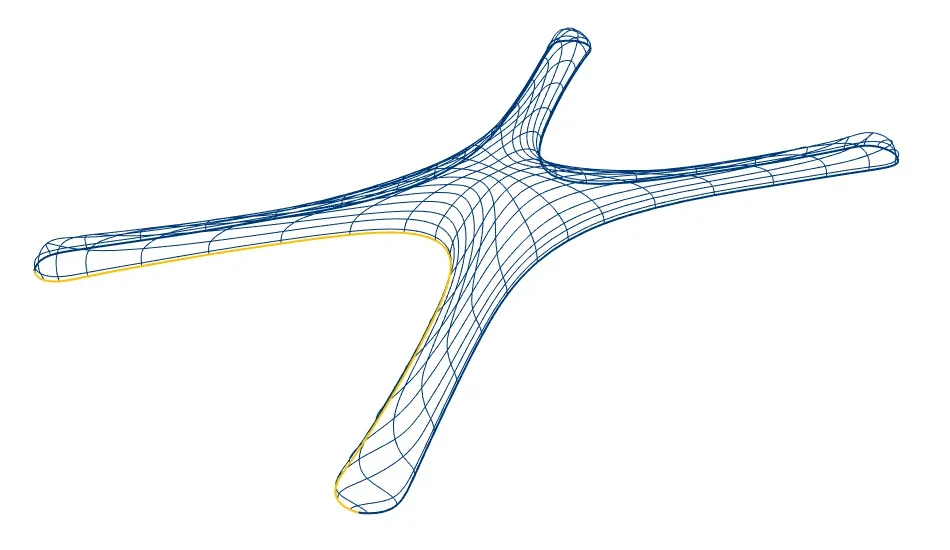
for the university require 3d reproduction with rhino of the lamp system x. from the teacher (poor recommended) the curved method of edge for every quarter of leg, which shows signs of the junctions of the surfaces too obvious. I tried to find the net solution of curves but I never get a satisfactory result. Could someone solve this dilemma? I mean the right procedure through a network of curves to have a controlled and especially unique surface?img75.webpimg103.webpimg76.webpIt's okay if I can get the upper and lower half separately.
through the section and the prospectus with a curve of 2 views I got the real curves that run the lamp along the axes of the legs;
I tried in all the sequences but nothing. the main test was to click the shape from above and the different sections running along it but nothing.
I am sincere that all curves intersect and that there are no duplicates or curve residues in the design.
Any suggestions?
who accepts the challenge?
 

Attachments

  • Immagine.webp
    Immagine.webp
    23.9 KB · Views: 10
However, to make a network you have to have 4 curves as a delimitation of the surface and as many sections as you need to control it.

from what I see you have only one curve.
with those curves, maybe, you could patch.

control it but it is hard
 
a unique surface? as you have already been told, with those construction curves you can only get patches. the reason why with those curves you did not succeed in fact lies in the nature of the nurbs, it is not a problem of functions of the cad. to find the correct approach it is necessary to imagine working with an extremely deformable "fazzoletto" to which to give the desired shape, without stropicciarlo or without folding it on itself. in this analogy, the warp and the plot are represented by the two parameters u,v (the isocurve) of the nurbs surface, so your surface will always have to have 4 sides (even in the sphere are four, although only one sees it).

Therefore, if you want to achieve the upper (or lower) half of the whole object with only one surface, you should work like this:
SystemX4V.webpI highlighted one of the four sides to show how they are arranged. I see two possible cases, this is just one of them.
it is immediately seen that the reproduction with only one handkerchief is very little indicated to the geometry of this object; requires much more work than it would serve for the construction of the fourth, at equal results.

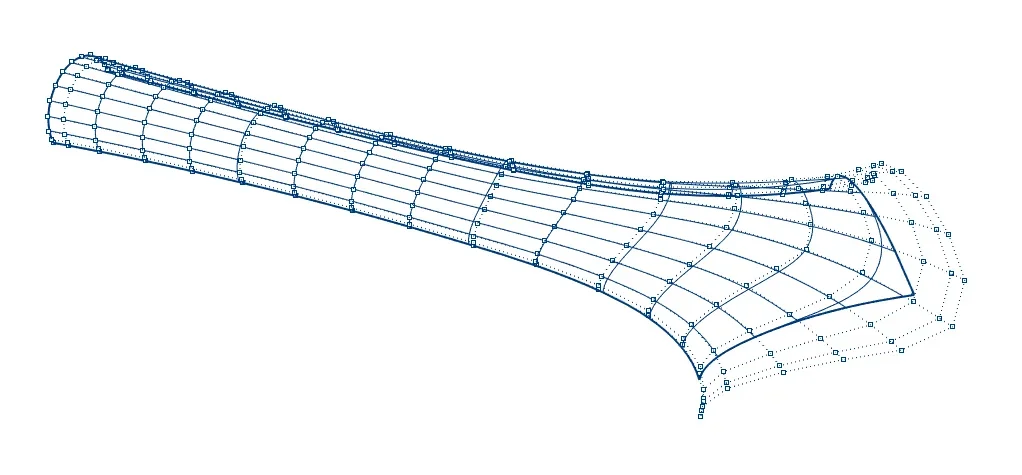
In the end, I think that the most practicable way is what your teacher told you. Moreover, if you want to avoid using patches, and maintain a good control of curvature continuity in the joint, you can extend your surface beyond the symmetry lines and get a quarter trimming.
SystemX_1di4.webpThere are many other possibilities, but this could be a good solution.
 
I'd kind of follow this road, maybe work harder.

upper surface flat to deform with the udt (command _cage) to give it a bombed run.
then an extrusion surface (verse z negative) using the x external profile, this surface only serves to be able to connect in g1 or g2, using a blend surface, with the upper surface.
then join the two surfaces and sucessive mirror to get the lower half shell. . with final join of the two shells to get the solid.
 

Attachments

  • lampada_system_X-3.webp
    lampada_system_X-3.webp
    8.2 KB · Views: 6
  • lampada_system_X-0.webp
    lampada_system_X-0.webp
    36.3 KB · Views: 5
Last edited:

Forum statistics

Threads
44,997
Messages
339,767
Members
4
Latest member
ibt

Members online

No members online now.
Back
Top