
• This forum is the machine-generated translation of www.cad3d.it/forum1 - the Italian design community. Several terms are not translated correctly.

design of a gearbox with two pairs of straight toothed wheels powered by a four-time diesel engine

  • Thread starter Thread starter Gabbro01
  • Start date Start date
I have lost all the data....continue to change and I don't know more than chemodules and than teeth that couples ..
Give me a clear, synthetic board.
I think there's still something wrong but I don't understand the data you use...
 
motor 30kw-1600rpm-179nm
multiply ka=1.5 have 268nm to z1
get 268*2=537nm to z2
that is the same pair of z3
that multiply for 2 and get 1074nm to z4

now apply the formulas of forces ft and fr.

the wheel on the intermediate shaft with a few teeth has 573nm and dp3=72mm
the wheel on the middle shaft with so many teeth has 573nm and dp2=108mm...the 144 from where it comes from?
first coupleMudulo m=3
z1=18
z2=36
dp1=54mm
dp2=108mm
second pairMudulo m=4
z3=18
z4=36
dp3=72mm
dp4=144mm
 
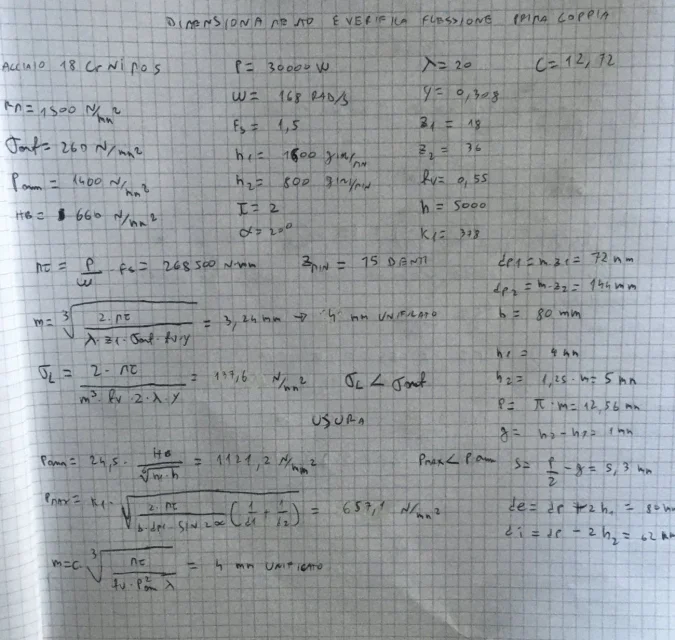
I had to remake the calculations because at bending they were not verified, now it is
data and formulas taken from my book of mechanics
 
but at this point, if you have the same number of teeth and the same module....would you do a coaxial reducer or continue to maintain the classic parallel axle?
 
Coaxial coaxial are more compact in the radial sense at equal transmission ratio. the parallels are ideally more compact in axial sense;)
 
How is it going with the reducer? What choices have you made? Has everything turned off or begins to turn the reducer?
 
I'm sorry if I didn't respond anymore but I had to do, however for the bearings helped me a professor of my school and also made me the card
I have delivered it, thanks to all for the help and information, we hope well
 
There he is.
The only thing that leaves me a little like this... that I have said so many times... is that you write the formulas without an explanation, a description, a scheme.... .
It is good that you do not ask yourself to do astronomical things but for example to comment that the hours are 5000 because it is believed that the use of the machine is occasional, or the scheme of the final forces ft fr etc....in what direction are they? applied to what?
lewis....hertz... a minimum of indication that the force is on the top of the tooth rather than not.... the rectification materials are not....
who reads the technical process, especially if competent, must be able to understand exactly what reasoning you have done. an incompetent does not know what is written though if you describe even a little you can make an idea and some logical passage understands it.
 
I was going to comment on it, since the exam we have to make a discussion
Remember that if the writing is incomplete .... there is a wide scenario of questions... Obviously because the document does not have all the elements to understand it but it is a collection of formulas and numbers.
You'll need it for the future too.
 
I was looking and rereading your computer and I dwelt on the bearings....you used its cylindrical roller bearings with the external connective track but with the floating inner track.Screenshot_20200614_230036.jpgJust give a small transversal push and the axis with the bearings run axially. Those bearings aren't good.
Couldn't you use two normal ball radials?
If you want to use a roller one you used nu 1009 ecp but the other nup 209 ecj....that you do not do it axially.Screenshot_20200614_230810.jpgor use two oppositions nj 2009 ecp.

If you were making a drawing, you might have noticed...
 
@young people , as soon as you have written, you have made various interventions which do not understand the usefulness and even the motivation.
it would be the case to contextualize and argue its own interventions.
 

Forum statistics

Threads
44,997
Messages
339,767
Members
4
Latest member
ibt

Members online

No members online now.
Back
Top