• This forum is the machine-generated translation of www.cad3d.it/forum1 - the Italian design community. Several terms are not translated correctly.

designing fatigue

  • Thread starter Thread starter nicodm
  • Start date Start date

nicodm

Guest
Hello everyone, my name is nicola, I am a student of mechanical ing. and I am new to the site!
I explain my problem: short I have the construction examination of machines, which mainly will be on the fatigue sizing of trees and components.
I wanted to ask if you can explain to me, "in a few words" the guidelines to design fatigue (both trees and other components), and above all how wohler and haigh diagrams are used, how to deal with carving phenomena, etc...maybe with examples!
I apologize for the question perhaps a little too generic perhaps, but unfortunately I cannot find exhaustive exercises on the internet and the prof, and indeed I take the opportunity to ask you if you can post them (maybe done)!

thanks in advance to all!
greetings
 
Hello everyone, my name is nicola, I am a student of mechanical ing. and I am new to the site!
I explain my problem: short I have the construction examination of machines, which mainly will be on the fatigue sizing of trees and components.
I wanted to ask if you can explain to me, "in a few words" the guidelines to design fatigue (both trees and other components), and above all how wohler and haigh diagrams are used, how to deal with carving phenomena, etc...maybe with examples!
I apologize for the question perhaps a little too generic perhaps, but unfortunately I cannot find exhaustive exercises on the internet and the prof, and indeed I take the opportunity to ask you if you can post them (maybe done)!

thanks in advance to all!
greetings
to say the truth, coming to this point means that either your prof explains badly or you for various reasons did not follow the same course.

then, in any mechanical structure that is a tree, bolting or welding, after static verification useful to see if under static load the piece resists or not, the fatigue verification comes.
static verification
la static verification should always be done and however, especially if static loads work in time or forces and moments applied in quasistatic regime (see rotation of trees below 30 rpm). tend to be used von bets especially for realistic ducts but also for fragile materials of the steel family, gues tresca for the ductiles in the restrictive field, Galilee ranchine for the fragile.

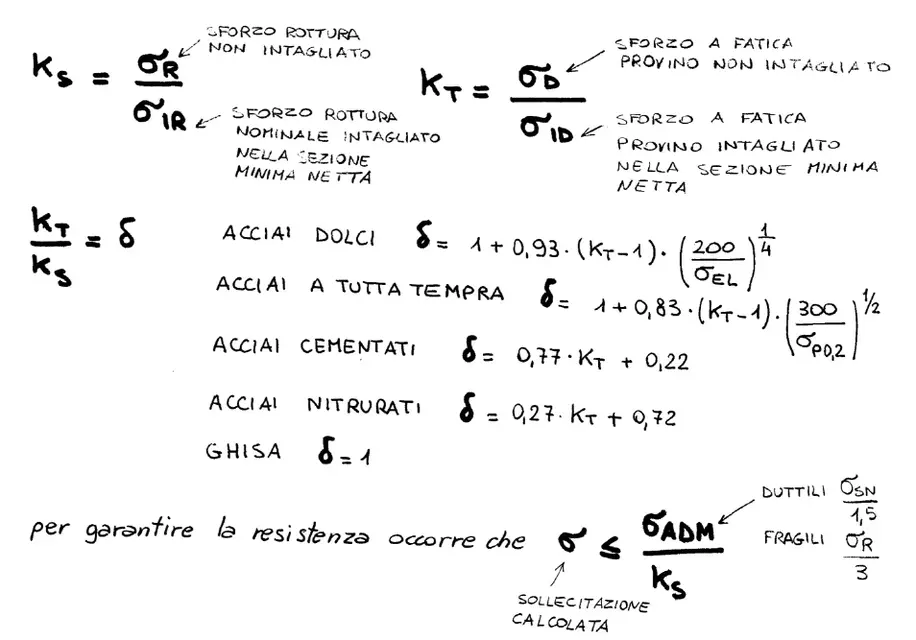
for the Intangible There are several static evaluation theories, where it can be understood that the area of verification is the net effective one after having removed the carving. statically it can also occur even better, according to the most precise formulas where stress is evaluated in the area must be less or equal to the admissible voltage divided the coefficient ks (deduced by formulation, according to materials.
fatigue testing
la fatigue testing should be done when there is a variable or non-variable load that somehow acts dynamically over time, perhaps changing only direction and/or direction.

first you need to determine the load cycle and determine the average stress and the alternating component. often you have not only the usual alternating bending. There is also torsion and traction. these three types of stresses can be alternated, constant etc.
the haigh diagram that everyone likes is used to calculate the limit voltage according to the average voltage.

with the method gough pollard do nothing but impose a formula like the von mises where you have a h^2 which is the relationship between the limit tension to fatigue and the tau limit to fatigue or static. the method is calculated with 10^7 cycles, i.e. unlimited life.

to get to evaluate the formula it is necessary to pass from the evaluation of the correct fatigue voltage from coefficients. evaluate carving, processing and surface finishing etc.

the method of more is practically the weave implemented previously, only that the number of life cycles is calculated (if you are looking on the forum I have spoken several times). to use it effectively you must keep in mind all coefficients of influence and follow the astm rules for the construction of the chart. so you will get the curve for hcf (high fatigue cycles) and the curve to low fatigue cycles. by analyzing his urge you will always know how many life cycles correspond to survival.

for welding and bolting, analog calculations are performed with miner rules always on wohler curves.
 

Attachments

  • fatica.webp
    fatica.webp
    22.3 KB · Views: 175
  • goughpollard.webp
    goughpollard.webp
    81.2 KB · Views: 159
  • haig.webp
    haig.webp
    44.4 KB · Views: 148
  • intaglio.webp
    intaglio.webp
    44.9 KB · Views: 143
Thank you, you were exhaustive! Unfortunately for personal reasons I did not follow the course and studying alone I wanted some clarification! Can I ask you if you can recommend some books where there are also exercises on fatigue?
Thanks again
Niche
 
Thank you, you were exhaustive! Unfortunately for personal reasons I did not follow the course and studying alone I wanted some clarification! Can I ask you if you can recommend some books where there are also exercises on fatigue?
Thanks again
Niche
books specifically there is the peterson’s stress concentration factors which is very valid for carvings or juvinall - basics of designing machinery organs for all general treatment
 

Forum statistics

Threads
44,997
Messages
339,767
Members
4
Latest member
ibt

Members online

No members online now.
Back
Top