
• This forum is the machine-generated translation of www.cad3d.it/forum1 - the Italian design community. Several terms are not translated correctly.

die-casting aid.

  • Thread starter Thread starter vale61
  • Start date Start date

vale61

Guest
Hello, everyone.
size 420x300x70, solid 114x70x22, solid b 60x30x11, thickness min. 3.
aluminium mat.

Question : What are the risks that I take on the 2 screeds?
The most worrying thing about me (besides feasibility) is the creation of bubbles within the screeds.
I also felt that these bubbles are difficult to predict the distribution and dimesion (also grossly) within the screeds, do you confirm this "unpredictable" of the bubbles?

The image is a section about half the piece.

Thank you 1000.
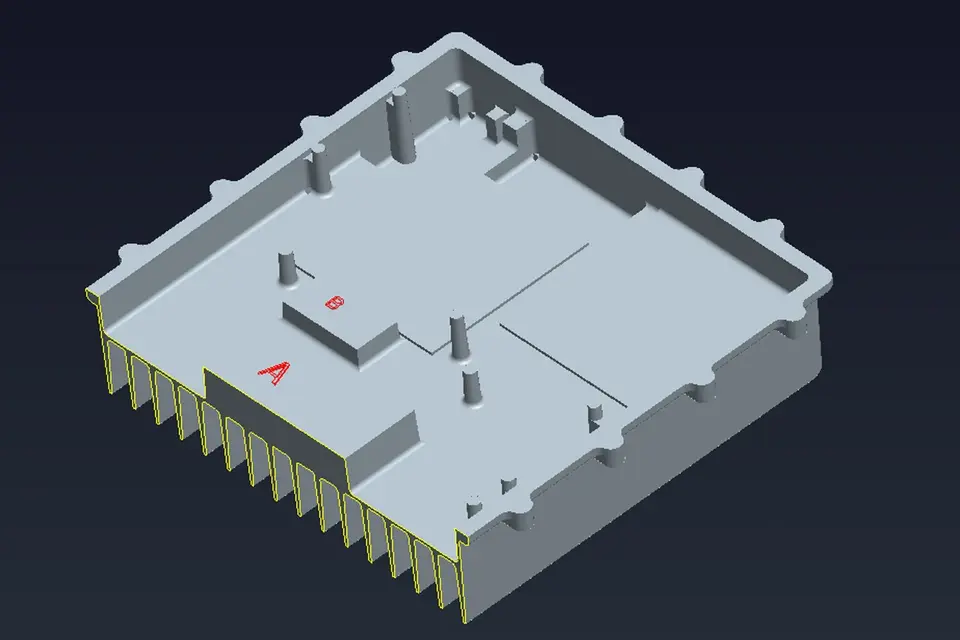
 

Attachments

  • casy_1.webp
    casy_1.webp
    51.6 KB · Views: 26
It seems to me that of these bubbles it is difficult to predict its distribution and dimesion (also grossly) within the masselli
Hello, I am not very experienced (I am a simple university student) but I am learning to use a software that allows me to study the various phases of solidifications of a piece, previewing "bolles", blows and cavities of withdrawal... quite precisely... setting some parameters allows me to instantly display the solidification process. . .
I don't know if it's your case, however the program is kiama solidcast.. .
 
Hello, everyone.
size 420x300x70, solid 114x70x22, solid b 60x30x11, thickness min. 3.
aluminium mat.

Question : What are the risks that I take on the 2 screeds?
The most worrying thing about me (besides feasibility) is the creation of bubbles within the screeds.
I also felt that these bubbles are difficult to predict the distribution and dimesion (also grossly) within the screeds, do you confirm this "unpredictable" of the bubbles?

The image is a section about half the piece.

Thank you 1000.
Hello, I am not very experienced (I am a simple university student) but I am learning to use a software that allows me to study the various phases of solidifications of a piece, previewing "bolles", blows and cavities of withdrawal... quite precisely... setting some parameters allows me to instantly display the solidification process. . .
I don't know if it's your case, however the program is kiama solidcast.. .
Hi.
in an empirical way
see the annex
the cooled nerves go in the lower bracket
what is obtained from the upper bracket on the smooth planes of the model in the relay phase you must insert steel matteaus
that remain in bracket after the extraction of the model
have the task of cooling the molten to avoid blowing
more or less the wings:mad::mad: I do not love them
it would be useful to see the process with solidcast
Thank you very much
 
I used it too. just that it amounts to a file in stl and then drop a bit with the parameters of the program to see the progress of solidification!
 
Hello, everyone.
size 420x300x70, solid 114x70x22, solid b 60x30x11, thickness min. 3.
aluminium mat.

Question : What are the risks that I take on the 2 screeds?
The most worrying thing about me (besides feasibility) is the creation of bubbles within the screeds.
I also felt that these bubbles are difficult to predict the distribution and dimesion (also grossly) within the screeds, do you confirm this "unpredictable" of the bubbles?

The image is a section about half the piece.

Thank you 1000.
Bye.
the two solids a and b have too large thicknesses for aluminum die casting. It would be a gravity casting piece, but it would go to the detriment of the cooling fins which should be enlarged.
I suggest you lighten the area of the screeds with pockets.
It is a good rule for all printed parts to have a constant thickness to avoid internal porosity and mechanical deformations due to thermal differences
I hope I've been helpful. Hi.
 
thanks for the answers.

I expect myself to disconnect the mass from the rest.

Bye-bye.
 
in the mass of the die-cast you will always have bubbles; If you need to avoid bubbles on the processed surfaces, you must predict an overmetal of about 0.5 mm, no more. in practice on the die-cast artifact you will have a kind of external crust, of a thickness of about 0.5 mm, on which you will hardly find bubbles (if not small). below it instead depends on the mold and the solid (and as mentioned above also on the variation of the thicknesses etc.)
 

Forum statistics

Threads
44,997
Messages
339,767
Members
4
Latest member
ibt

Members online

No members online now.
Back
Top