
Stefano Rufini
Guest
good morning to all and good start of weekend.
My name is stefano and I am at the last year of the master in mechanical ing.
I would like to compare with the forum about this project I am following during my internship.
This is a new case for me and outside the standards of teaching design.
to perform treatments in the workshop, it is necessary to rotate a body (orange in the image) of almost cylindrical form, positioned on a sloped plane of 30°. the rotation axis coincides with that of symmetry.
It is a body with a maximum diameter of 900 mm and a weight of almost 150 kg.
the rotation speed, after an initial acceleration, will be very low: it is estimated about 5 rpm.
This last design requirement has led me to neglect the inertia (first doubt) also because there is no need to have a sharp acceleration in the start.
this is the draft of the scheme of the rotation system.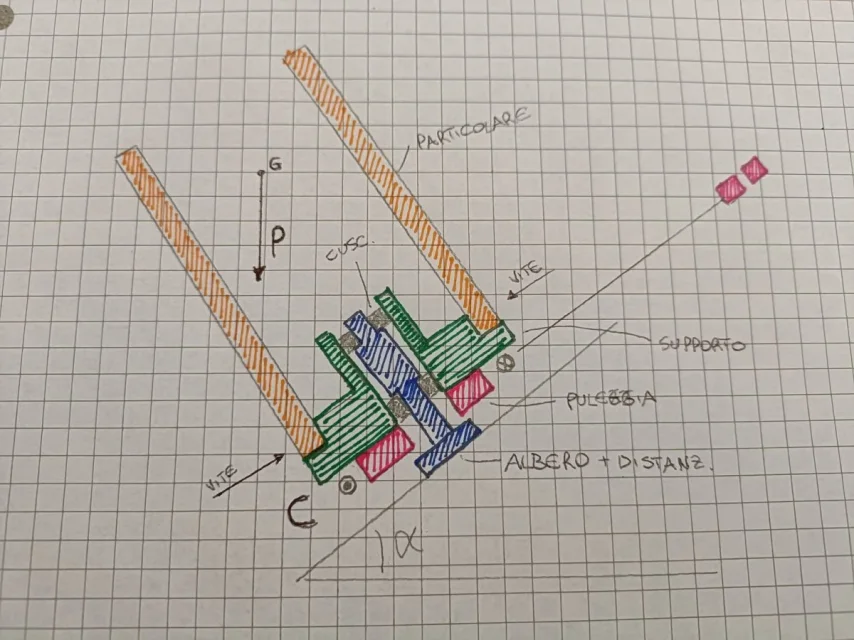 being in the preliminary phase I did not optimize the geometries, especially of the tree, and I did not insert some elements that will be fundamental for the positioning of the bearings (ghiera, distantial. . ).
my main doubt concerns how to place the forces (the two weight strength components, the couple at the pulley...) to be able to dimensional the central shaft and to choose properly the bearings.
the pink pulley would be fixed to the particular green, so it would be a case of fixed and external ring instead rotating.
I thought I'd treat the detail in green as a framed beam.
after which I would echo the axial and radial force components on the two bearings, considering a radial effort only on the lower and composite bearing on the second b.
My name is stefano and I am at the last year of the master in mechanical ing.
I would like to compare with the forum about this project I am following during my internship.
This is a new case for me and outside the standards of teaching design.
to perform treatments in the workshop, it is necessary to rotate a body (orange in the image) of almost cylindrical form, positioned on a sloped plane of 30°. the rotation axis coincides with that of symmetry.
It is a body with a maximum diameter of 900 mm and a weight of almost 150 kg.
the rotation speed, after an initial acceleration, will be very low: it is estimated about 5 rpm.
This last design requirement has led me to neglect the inertia (first doubt) also because there is no need to have a sharp acceleration in the start.
this is the draft of the scheme of the rotation system.
being in the preliminary phase I did not optimize the geometries, especially of the tree, and I did not insert some elements that will be fundamental for the positioning of the bearings (ghiera, distantial. . ).my main doubt concerns how to place the forces (the two weight strength components, the couple at the pulley...) to be able to dimensional the central shaft and to choose properly the bearings.
the pink pulley would be fixed to the particular green, so it would be a case of fixed and external ring instead rotating.
I thought I'd treat the detail in green as a framed beam.
after which I would echo the axial and radial force components on the two bearings, considering a radial effort only on the lower and composite bearing on the second b.

