• This forum is the machine-generated translation of www.cad3d.it/forum1 - the Italian design community. Several terms are not translated correctly.

dimensioning pinion rack and motor

  • Thread starter Thread starter ConfaMiky
  • Start date Start date

ConfaMiky

Guest
Bye to all,
I'm a "designer" in a technical office and I'm starting to follow some project. I'm gonna need a little straight.
I should make a translate device like pinion rack to which to couple the correct gear motor.

first of all someone could confirm me about the correct choice of pinion and racket.

data:
Loading 1111 n
stroke 300 mm
speed 3 mm/s

hypothesis:
3 m

with this data I chose from catalog gudel a pinion with z = 22 therefore d0 = 66 mm
the torque moment transmitted is 37 nm and therefore having the pinion fn 2370 n and tn 78 nm the pingone should be corrected.
the number of lazy turns is 0.86 rpm.

first question: according to you is correct the procedure I used.
second question: I should now switch to choice of gearbox and motor for handling everything; I tried to look on the net between the catalogs of the various suppliers but I can't get over it. Could someone please refer me to the procedure to follow?

Thank you very much
 
I think you calculated right, but you didn't compare what you need.
you have a force that multiplies a primitive radius by generating copy. calculate the number of turns considering the development of the pinion and here you have the number of turns to be multiplied by the reduction transport. Consider returns and find the required engine power with any service factors.
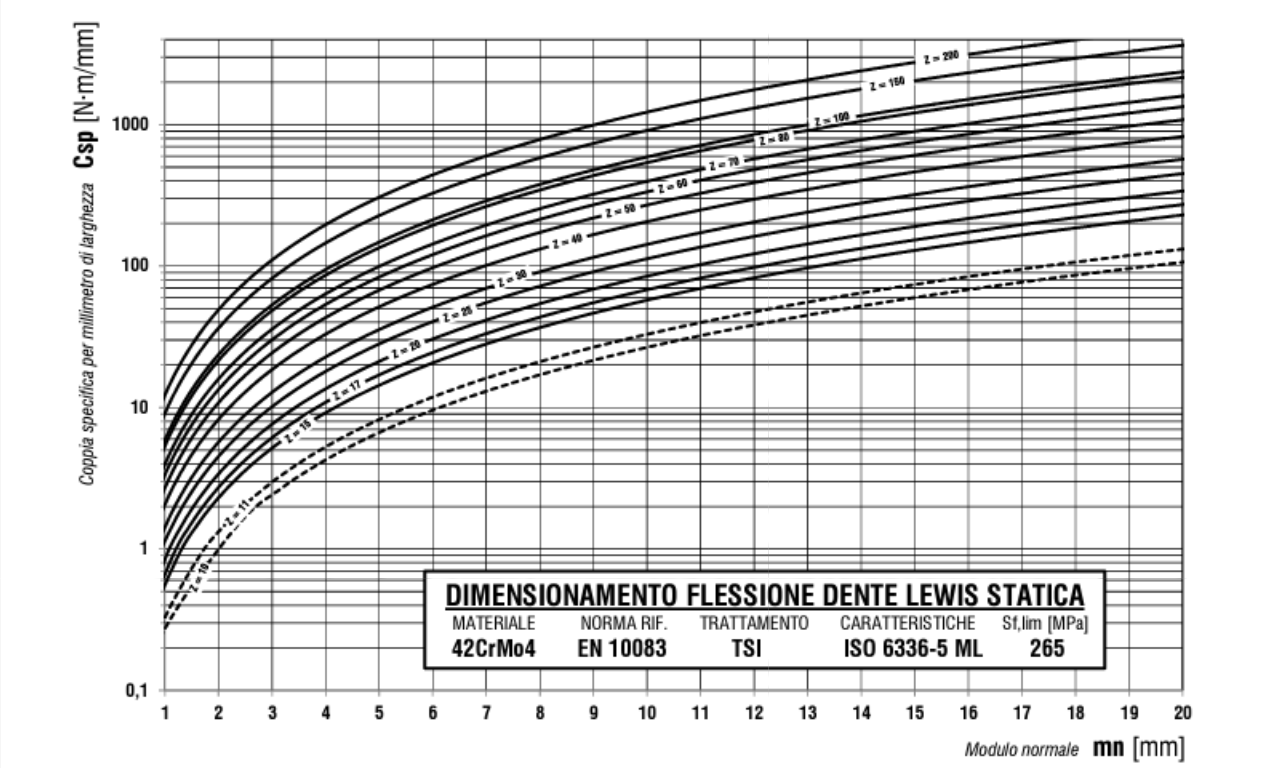
but to know if the pinion resists you have to check according to iso 6336 of the wheel. If you want to make it fast you must check at least with lewiss the bending of the tooth and you must know what material is made the wheel.... from which catalog you take it no matter.
for reducers if you want to make infected use sew with the configurator. It would be better that you take a catalog and understand how you choose correctly.
 
Bye to all,
I should make a translate device like pinion rack to which to couple the correct gear motor.
Thank you very much
Hi.
I move the discussion in a dedicated "area"
mechanical design - general forum
Thank you very much
 
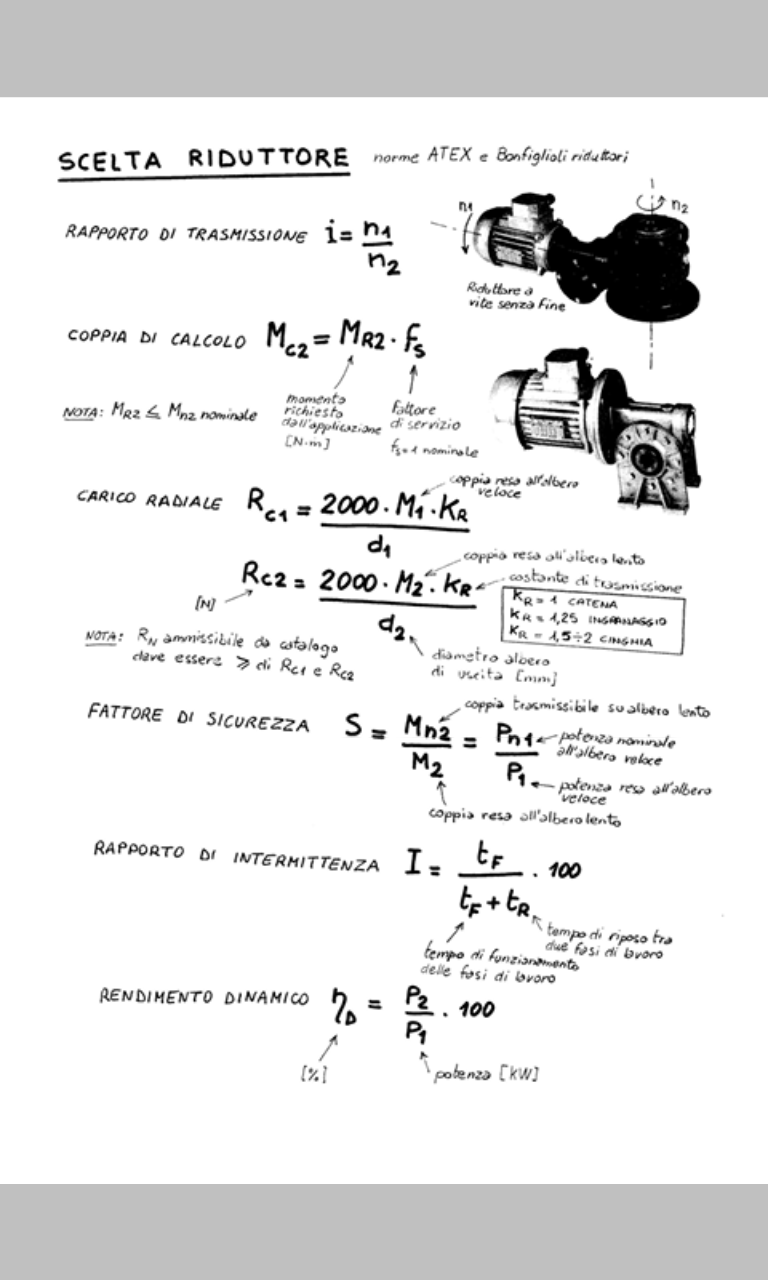
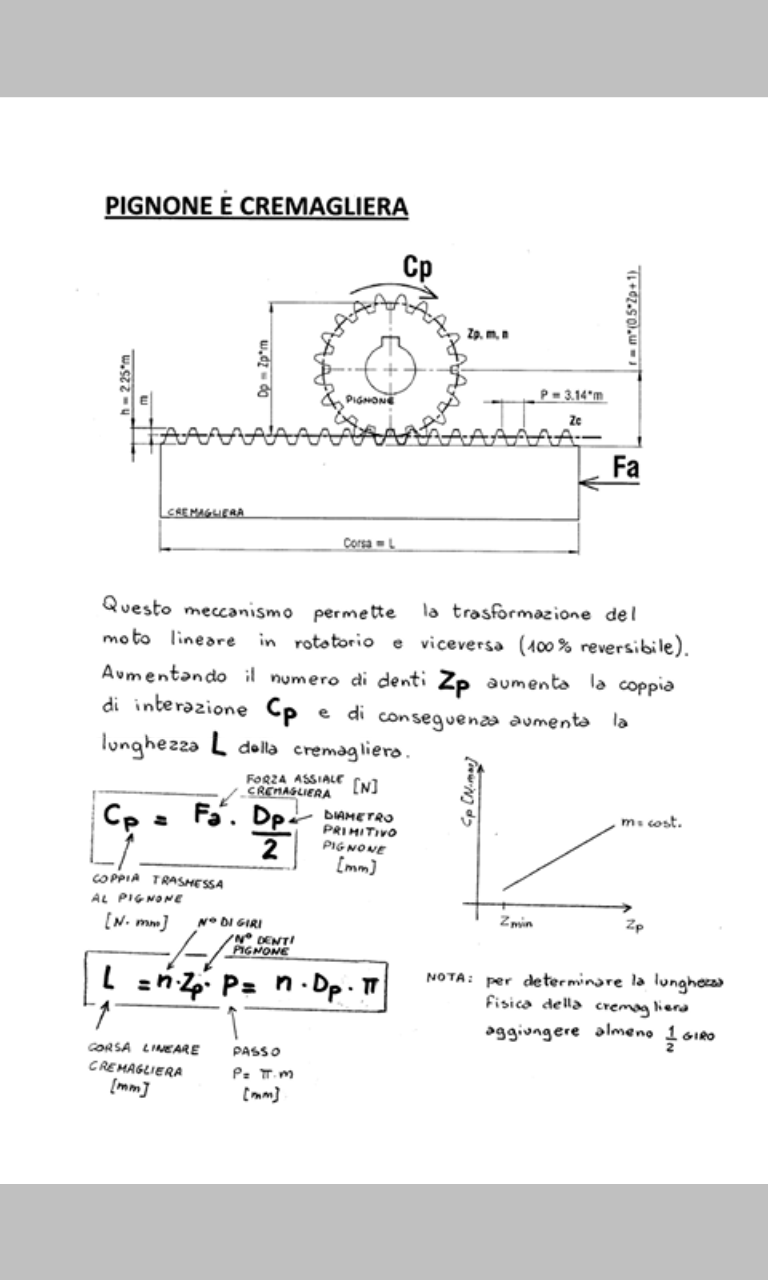
I attach the material I have already put in other discussions.

as you see you have the calculation of cinematism, a parameter for the curves of lewiss that you can still find in a classic way on the internet (because with mine you already find the transmissible copy according to the width), of the explanations that you also find on catalogs of reducers
pyma6a7u.png
ju4e4ehe.png
u5ejuny3.png
7ezequ3u.png
 

Attachments

  • wp_ss_20141003_0005.webp
    wp_ss_20141003_0005.webp
    47 KB · Views: 668
I don't know how you did the calculations and especially if you realize what size we're talking about. so fast I set some formulas to understand what we're talking about.
I'll draw you back. obvious that here lacks the evaluation of the resistance of the wheel/wheel that depends on the material and the width of the band.riduttorepignone.webpthe reasoning to do is as follows:
- use user data, then run, speed and force to calculate other backward sizes
- calculate the pinion by hypothesize and then verifying its characteristics of resistance (change z especially to find subsequently a reducer in the appropriate)
- compute torque and power required to load
- consider service factor
- choose a catalogue reducer
- verify all that is consistent and sufficient to ensure the operation of the application
 
I have calculated them as v/(dp/2)*60/(2*pigreco) and from 0.86 that I echo from v=omega*r. instead I see that you used the formula l = dp * n *pigreco; But this doesn't give you the laps to race?

Michael
 
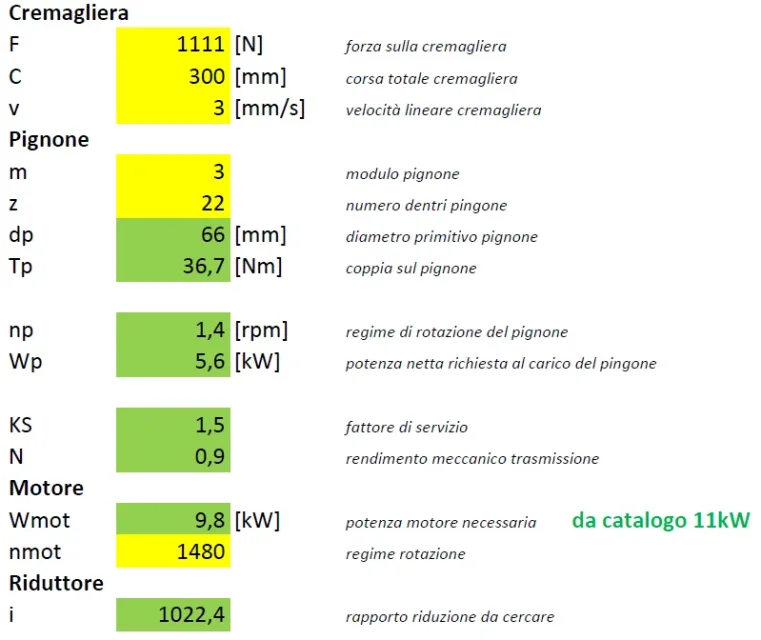
Immagine.webphi to all I tried to send an image with the screenshot of the excell sheet that I would implified for calculation with relative formulas used.
You might want to take a look at it and tell me if I'm wrong.
if I did not wrong in the accounts you have advice on the type of reducer to use to get such a low number of laps?

thanks michele
 
You're right. I lost a piece of it. speed is 3mm per cent multiplied 60 ...divid 66 divided lazy makes 0.86. You can see I was tired and I took the cow x the bales.

for the reducer you have to use those with prepair.
other solution is to use engines of 10 or 12 poles...however not 2 or 4 poles.
 
because the power is low uses a step-by-step motor
Hello, everyone.
I tried to move on with the development of my application. admitted to having properly dimensonated the pinion, I have some doubt about the choice of gearbox and engine. I tried to follow the points that indicated me mechanicsmg, but I can't figure out how to calculate the torque made to the slow shaft for checking the chosen engine.
below I send two pictures of the excell sheet that I created with relative formulas and yellow notes where I have doubts. If anyone wants to tell me if and what I'm wrong, I'd be very grateful.
Thank you very much.
Immagine1.webpImmagine2.webp
 
Let us respond to some notes... those yellow and red:
1) talk about cutting.... What? You mean you have a force to hide something and you're not taking it (maybe it)? perhaps your system should be sized or at least verified with inertia, masses and acceleration that I do not see. the frictions could affect especially on low powers.

2) What do you mean by tooth height? height rack or width gear band perhaps? ...but it is normalized to catalog. a gear occurs and dimensional according to ISO 6336.

3) the output of the reducer is to the catalog, for that of the rack/pignon it is to be calculated

4) the service factor must multiply the load power... i.e. 0.003kw * fs .... sure fs will be greater than 1....try that you find the table on all catalogs of gearboxes

5) the security factor could be a relationship between powers or couples between that supplied by the engine and that increased request with fs
 
Let us respond to some notes... those yellow and red:
1) talk about cutting.... What? You mean you have a force to hide something and you're not taking it (maybe it)? perhaps your system should be sized or at least verified with inertia, masses and acceleration that I do not see. the frictions could affect especially on low powers.

2) What do you mean by tooth height? height rack or width gear band perhaps? ...but it is normalized to catalog. a gear occurs and dimensional according to ISO 6336.

3) the output of the reducer is to the catalog, for that of the rack/pignon it is to be calculated

4) the service factor must multiply the load power... i.e. 0.003kw * fs .... sure fs will be greater than 1....try that you find the table on all catalogs of gearboxes

5) the security factor could be a relationship between powers or couples between that supplied by the engine and that increased request with fs
Hello mechanicalmg,
I reply to your points:
1) at the end of my calculations for now I consider the system as a mass to be moved equal to the sum of the weights m1 m2 m3 m4 to which I have to sum a resistant force fr. all gives me 1111.16 n that I use in formulas

2) with detachment height I mean l2 from catalog gudel which then use for calculation of sigma voltage. I think cmq that the calculation of the bending is not entirely necessary, is it not enough that the couple and the force of the project (tn_ref and ftot) are lower than the nominal ones in the catalog of the pinion?

3) Shouldn't the racket yield be in the manufacturer's catalog? cmq one 0.9 for transmission with toothed wheels is not cautionary? Isn't it usually 0.98?

4) OK Verify

5)ok

to complete the engine I should use is a brushless
 
1) ok. 2) could suffice but it is not a technically demonstrable procedure and is low-level.... maybe for the application can also go well but if you have to drag tons there is no catalog with admissible values. 3) lazy rack yield is usually not in the catalog because it depends on the finishing of surfaces, poor lubrication to fat and contamination. so it could be also 0.9 but it is not said.

motors without brushes turn to different regimes quietly and are regulated by inverter and never directed, so look on serious catalogs that you find the explanation of how you use and how you adjust.
 
Hello mechanics,
Sorry the question but often in the forums it is said that this or that mechanical part should be dimmed/verified according to specific iso. is there a way to know according to the type of mechanical organ that iso must be used? or what do you think is the best to follow?
Thanks again michele
 
Hi, Michael. we say that there are categories of objects that are dimensional according to norm. If you are looking for the site uni or iso or din and do research by subject you will find the reference rules.
if you use serious manuals you will find reference to regulations even if you Italian texts this thing leaves much to want.
As a rule for us mechanics there are Eurocodes for steel construction and bolting, ntc that are a collection of European standards approved by the Italian state for design.
in essence you have to look for a lot and stay informed to always have the right standards in addition to the theory that there is on classical books
 
the calculations are calculations for charity and I trust.. but how does it be that to move about 1111n about 115 kg there are 11 kw of motor power with gearbox having i=1022?until the calculation of the 5,6 kw I arrived too.. .
See you soon.
 
we are talking about the basics of mechanics and the choice of engines.

the net power of the load is about by previous calculations wc = 5,6kw.
the service factor according to certain shocks was considered ks= 1.5.
the performance of the mechanics was considered 90%.

the installed power to the engine is:
♪[ Wm=\frac{Wc•Ks}{\eta}=\frac{5,6kW•1,5}{0,9}≈9,3kW \]from catalog of red engines to 4 poles we have that the motor immediately available for excess is 11kw.
Screenshot_20200504_201955.jpgwe can opine on the value attributed to the service factor....that being not known where the application ends and how many cycles it does could take value 1 as much as 6.
reasoning, formulas and analysis are therefore correct.

these explanations are found on all catalogs of motors: sew, red, bonfiglioli etc.

all duly explanatory in the notes of my post number 4 ....read it well in all formulas. the procedure is decided clearly.
 
Last edited:
Then we realized some mistakes and therefore wrong things were changed. read the sequence of messages.

in fact the correct version is this:
Screenshot_20200504_204350.jpgand then just a 6w engine.

So if you've come to 5,6kw, too, you've made me miss the first round?
often the spreadsheets are made by the phone and at night....and sometimes something escapes if you do not recheck later.
 
from time to time, since I am using khk gear calculator, I wanted to check the pinion and rack with 0,86rpm and 6,6w. if we use untreated c45 material both for pinion and rack (m=3 and section rack 30x30mm) we obtain a positive bending resistance (factor safety bending over 10) but a very accentuated wear (factor safety wear 0,6). localized pressure is high and the erosion of the tooth side for high pressure at low turns is the component that will destroy the system.
must be expected at least the tempering on both pinion and rack and the use of a special grease with additives for high pressures. it would be advisable to use precision rectified toothing. alternatively increase module and band.
 
from time to time, since I am using khk gear calculator, I wanted to check the pinion and rack with 0,86rpm and 6,6w. if we use untreated c45 material both for pinion and rack (m=3 and section rack 30x30mm) we obtain a positive bending resistance (factor safety bending over 10) but a very accentuated wear (factor safety wear 0,6). localized pressure is high and the erosion of the tooth side for high pressure at low turns is the component that will destroy the system.
must be expected at least the tempering on both pinion and rack and the use of a special grease with additives for high pressures. it would be advisable to use precision rectified toothing. alternatively increase module and band.
I am doubtful about the 6 w... 1111 n strength and 3 mm/s speed give a value of about half, but it should be evaluated the system's start and stop transients take into account forces and pairs of inertia.
However, it must also indicate hardness and depth.
 

Forum statistics

Threads
44,997
Messages
339,767
Members
4
Latest member
ibt

Members online

No members online now.
Back
Top