• This forum is the machine-generated translation of www.cad3d.it/forum1 - the Italian design community. Several terms are not translated correctly.

distance bearings gear wheels

  • Thread starter Thread starter AntonioMlv
  • Start date Start date

AntonioMlv

Guest
Good morning to all,

are struggling with the design of a coaxial reducer with two-stage helical gears. the question I would like to ask is: do there exist specific norms or in any case rules that allow to determine the distance between the toothed wheels and the supports on the tree, known the axial, radial and tangential forces agents on the wheels? I tried to look for material, but I have not yet come to know the criteria well determined to size the length of a tree and its distances between wheels and supports. I'd be very grateful if anyone could give me directions.

I would also like to ask if for coaxial gearboxes to predict swing wheels is ideal, or if it is preferable to opt for other solutions.
 
ciao @antoniomlv, that I know there are no rules that indicate how to dimensional a reducer from the point of view of structural architecture.
generally the basic concepts are to have compact products, structurally suitable to withstand the stresses for which they are designed, with external surfaces as linear as possible to avoid the formation of receptacles for powder, liquid or other then, depending on the application if possible, pleasing aesthetically.
generally you start drawing the ingrams and relative trees appropriately sized according to the required performance, this, of course will determine obligate distances due to position gears, interassis, jokes, spacers, seeger rings, etc., then you can switch to the bearings trying to keep them as close as possible to the gears and this will determine the position of the bearings and lengths of the trees. the protrusions of the external trees will be dimensioned according to the type of connection: for these you can take inspiration from the catalogues of the various manufacturers as a kind of unification induced by competition has been created. other considerations to be made are those relating to lubrication, versatility, simplicity of assembly and easy maintenance.
in the coaxial gearboxes you will always have the inlet pinion (1a reduction) at a swing, while as for the first reduction coupled crown, in the standard industrial gearboxes with pairs indicatively up to 1000-1500 nm, many manufacturers prefer to have it at a stand because this facilitates them in the assembly of a three stages in the same structure of the two stages, in the reducers of size greater the crown 1a reduction falls within the two bearings, to 2 alternatively, the solution that supports pinion 2a reduction and its crown 1a reduction, with three bearings; everything depends, if it is a special reducer and of course, also on the type of application.
a This link find the explosions of the various coaxial gears of a well-known manufacturer with the various construction solutions depending on size.
If you are looking for in the forum, there are other discussions about the gearboxes where the drawings were attached in the section where you can see the placement of the various components.
 
Last edited:
As for the distances between bearings and gears there is no regulations. depending on the encumbrance you get physiological distances.
clearly you have to be able to calculate bearing reactions and understand that distances decrease or increase to improve bearing life.
for this I recommend the technical notebooks Skf.

But am I the one who does coaxial gears with non-swimming bearings? I do them all with the gear and externally the bearings, like a standard parallel axle.
I also make two-speed gearboxes, with coaxial pre-couple but nothing astounding, just to improve the reactions and stiffness of the tree, thus avoiding making the gear work worse.

We remember that for the duration of the gears we have different coefficients according to the positioning.
taken to the flight from one 8862 used in another post.1717620343514.png1717620208601.pngyou can deepen using the iso 6336-1 standard which is more up-to-date and more adhering to the use of these times.
 
just for record this below is the pattern of a two-speed industrial change with pre-pair. all coaxial and with bearings at the extremes of the trees and not to swing.Screenshot_20240605_230608_Sketchbook.jpgthat it is two stages with or without change does not exist for me tree to swing. even the contr shaft could also be supported by a third central bearing.
this allows me to replicate the usual calculation scheme that I use for parallel axes and to give a more performing product.
 
Last edited:
just for record this below is the pattern of a two-speed industrial change with pre-pair. all coaxial and with bearings at the extremes of the trees and not to swing.View attachment 71421that it is two stages with or without change does not exist for me tree to swing. even the contr shaft could also be supported by a third central bearing.
this allows me to replicate the usual calculation scheme that I use for parallel axes and to give a more performing product.
In fact, even to me it seems a more valid solution the positioning of the wheels included between the supports instead of swinging. that of the distances was my only request, of course it is already prepared everything, from pairs and forces agents on the wheels, to flexotorsion sizing in the most critical points, up to the bending and pitting of the wheels according to ISO 6336-1
 
But am I the one who does coaxial gears with non-swimming bearings?
:
If you design and build specific gearboxes for certain applications, you can do this, on the contrary, this allows you to focus mainly on the performance aspect to ensure extreme reliability as you are aware of all operational and final application conditions.
With regard to the standard coaxial gearboxes, instead, fifty years ago, some manufacturers began to predict pinion and crown 1a embossed reduction and then it was quite frequent to find noise problems due to the unperfect alignment of the case and the cover as they were worked together with bareers. Then there was red that began to propose on the market the concept of modularity of the components that was gradually adopted by others to optimize the processing and reduce the components to be managed.
at this point (1990-2000) there was a drastic revision of the projects trying to optimize both the architectures and the processing, as they were available of the working centers that ensured very tight tolerances in the alignments and finally the assembly; this to offer customers reduced delivery times and have more competitive prices.
it is to be considered that a series of coaxial gearboxes can be made up of thousands of variants (even more than 10000) that affect flexibility and costs, so many manufacturers have chosen to define simple modular kits to be mounted (also with automated assembly) to reduce the components in stock but. above all, to encourage retailers who, with a limited number of kits in stock, can perform final assembly and deliver in a few hours many configurations.
as you can see from the spare lists I mentioned in my previous post, the three main kits: exit, entrance (for 2 and 3 stages) and intermediate (3 stages) require the crown 1a drop-off to be able to carry out an easy assembly/disassembly with a minimum of equipment.
the need also comes from the fact that we have the same pinion (planned or calettato) both in the reducing version (protruding entry shaft, and motor (cable input shaft with holes of 4-5 different diameters) and even in this case, if it were all integral and supported at the ends we should manage a high number of components and give up the advantages of modularity.
manufacturers are aware that these solutions can reduce performance but it is also necessary to highlight that they have not only been designed on paper (at the time) or cad, but they have been extensively tested in the testing room before switching to serial production that provides hundreds of thousands of pieces each year, used in multiple applications.
It is obvious that if you were to design a mill reducer or another specific application, in limited quantities where you already know the type of assembly and the actual operating conditions, the considerations would be more similar to yours.
 
In fact, even to me it seems a more valid solution the positioning of the wheels included between the supports instead of swinging. that of the distances was my only request, of course it is already prepared everything, from pairs and forces agents on the wheels, to flexotorsion sizing in the most critical points, up to the bending and pitting of the wheels according to ISO 6336-1
distances vary the load to the bearings.
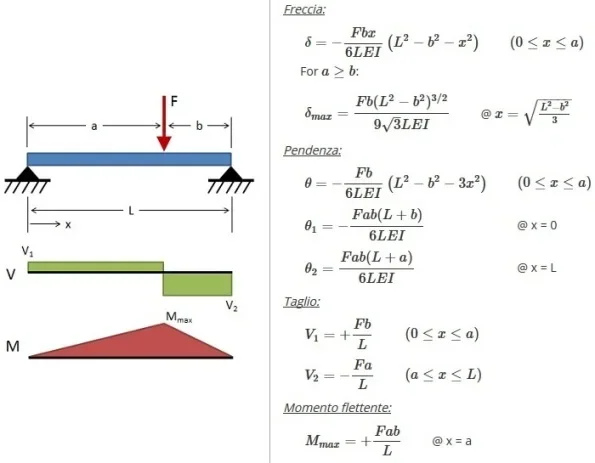
if we think we have the gear in the inner area to the bearing supports we will have this scheme:1717925599925.webpafter this schematization you have to decide whether to use a floating bearing system1717925677749.webpor use a zipper and a cart1717925728006.webpin the case of floats and reversible movement you have that they exchange function the two bearings, so if the gear is not in the center you may find overloads accentuated.
if you use the isostatic system instead choose which bearing is overloaded and even if reversible you will get medium smaller bearings.
varying the ratio between a and b you will gain greater forces on one or another bearing and then you will be able to make trees more or less streamlined than versions with floating bearing that needs more rigid trees flexionally.
 
Sorry, the first image of my post is still isostatic. ....
instead a floating assembly is this:1717928950699.webp
 

Attachments

  • 1717928767293.webp
    1717928767293.webp
    13.1 KB · Views: 2

Forum statistics

Threads
44,997
Messages
339,767
Members
4
Latest member
ibt

Members online

No members online now.
Back
Top