
• This forum is the machine-generated translation of www.cad3d.it/forum1 - the Italian design community. Several terms are not translated correctly.

does open mesh have press problems?

  • Thread starter Thread starter cadzenger
  • Start date Start date

cadzenger

Guest
Hello everyone
I have recently come down in the 3d printing world and noticed problems with open mesh,derive from sectional surfaces of models designed by me or with autocad or rhino, and I wanted to ask who knows more about me if precisely the surfaces of models designed in 3d then saved in stl give these problems and are therefore to be redesigned to have the possibility to print them.
Thank you very much
model photos and problem detected by printing softwareImmagine.webpImmagine2.webp
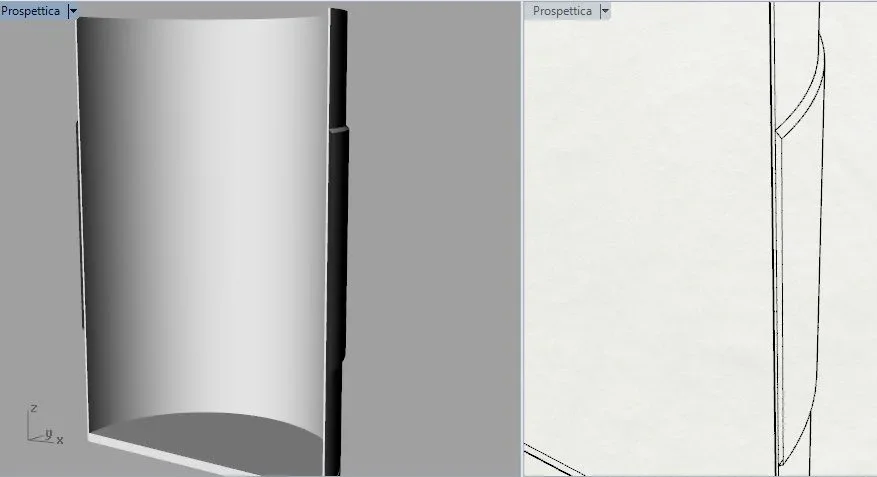
 
practically the model in question is formed by two simple parts, a cylinder (solid)obtained by an extrusion and emptied and a surface that would be the pocket that surrounds it at half height obtained by profile and revolution around a axis, the external service to which I gave to make the 3d printing provided the image2 ,practically it is impossible to print.
I sent other files and the only stl files that do not contest the external 3d printing service are those where models are drawn only by extrusion.
Do you have any advice?
 
a stl file for printing must define a single closed volume. not only therefore there should not be gap (holes), but also intersections and overlaps. there are no limits linked to how you create it but only to this rule of the final form. If for example you build two perpendicular extrusion cylinders between them and leave them as they are without removing interference, the object will not be printable. then how to remove interference will depend on the tool you use and how you built the cylinders, if they are 2 solids could for example come together with a boolean operation, if instead it is surfaces then you will use a trim command (cut, limit, break) of the central part of the cylindrical surfaces.
 
thanks for the answer
ok for the single volume closed
but regarding the sections of surfaces? are printable?
and models like thiscestello.webpAre you kidding? are printable, because if the section also cuts the holes in the outside service do not print it to me, it also depends on the material used for printing?
 
Hi.
excuse but from the image I can not understand it, the object has a thickness?

if you do not have it but it is only a skin without thickness, then it is not printable.
the 'bucherellatura' itself is not a problem, the problem is that if I only have the skin without thickness and I make a section perpendicular to the vertical axis of your object, I get so many broken open and not of the closed profiles, even if among them detached.

This slicement process (slicing) is what 3d printer programs do, for each layer to be deposited calculate the areas to be filled with the material by dissecting the model according to the layering step.

there are then programs able to take a volume-free stl and apply it a constant thickness, but they are typically another thing and it is not said that the press has it or does it without applying an increase to the realization price.

the material and other characteristics of the machine affect only the minimum thickness and the layering step, of course however that if model an object with thickness but this is 0.01 and my printer handles instead a minimum thickness of 0.1, then the printing program will easily interpret my object as a skin without thickness.
 
Hi.
excuse but from the image I can not understand it, the object has a thickness?

if you do not have it but it is only a skin without thickness, then it is not printable.
the 'bucherellatura' itself is not a problem, the problem is that if I only have the skin without thickness and I make a section perpendicular to the vertical axis of your object, I get so many broken open and not of the closed profiles, even if among them detached.

This slicement process (slicing) is what 3d printer programs do, for each layer to be deposited calculate the areas to be filled with the material by dissecting the model according to the layering step.

there are then programs able to take a volume-free stl and apply it a constant thickness, but they are typically another thing and it is not said that the press has it or does it without applying an increase to the realization price.

the material and other characteristics of the machine affect only the minimum thickness and the layering step, of course however that if model an object with thickness but this is 0.01 and my printer handles instead a minimum thickness of 0.1, then the printing program will easily interpret my object as a skin without thickness.
the object has thickness, but explained to me the service that they use a material that prints hot, so all that series of holes would make the model collapse.
As far as the single volume is closed, I had an indirect confirmation yesterday that does not influence, because the service has printed this to me.Immagine3.webpwhich consists of ten different objects built or by extrusion or loft
I have the most confusing ideas of before
thanks anyway for the answers
 
basically it is always a matter of minimum thickness, in this case concerning the fact that having all those holes, according to the material and type of printing it is insufficient to support the model itself that would collapse.
Consider that problems like this depend strictly on the characteristics of the material and the printer. the same model ie could be printed with a different material or maybe even with the same material but on a different machine.
There are, for example, units whose printing software is concerned with automatically creating a support structure (a kind of grid) that can be removed once the object is made; other that for example fill for each layer all the volume with the material, pasting or merging only the area of the object, such as those with deposition of metal or chalk powders, so the remaining inert material acts as support, etc.

there are today on the market machines from 1,500 euros up to machines from 250,000 and beyond, some difference will be, no?

As for the closed volume discourse, each object must be a single closed volume but printers can typically treat multiple items in print at the same time, usually it is considered the ability of a printer indicating the x,y,z print volume. can be distinct objects or even assemblies of multiple mounted components, even to realize together "impossible", I remember seeing once a print example where inside a cubic frame there was a spherical shape with inside in turn another cube with inside another sphere.

in the stl file can then be written the data of multiple closed volumes, depends on the software you use if you can do it or not.

as it depends on the 3d printer software to manage correctly or to go mad if it finds two perfectly coupled objects on a surface.

Maybe finally where you need to print this union operation they do before sending in the press.

I hope I haven't confused your ideas even more.

Bye.
 

Forum statistics

Threads
44,997
Messages
339,767
Members
4
Latest member
ibt

Members online

No members online now.
Back
Top