Domenapoletano
Guest
good year boys and good evening. I have a doubt about the exercise, for the calculation of the deviations.
I frequent mechanical ing, second year.
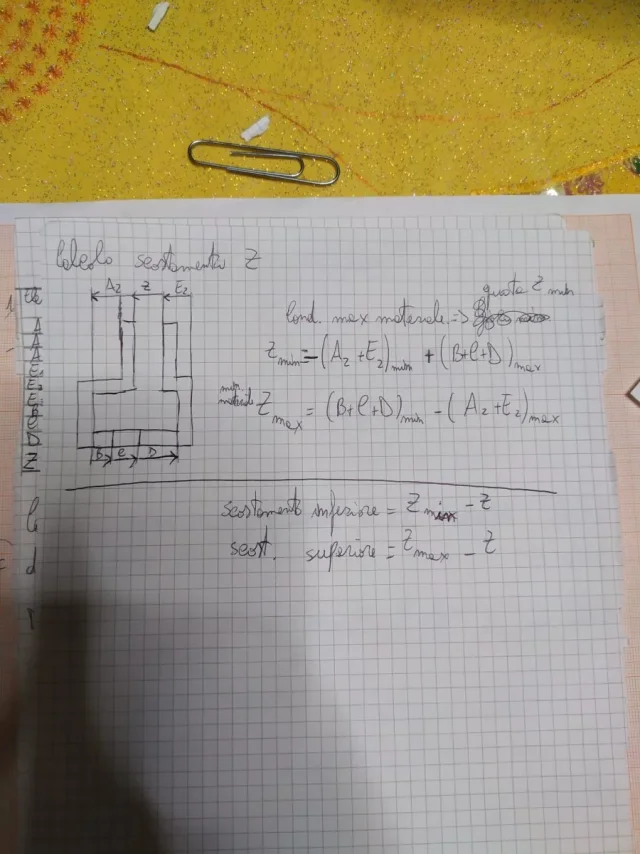
I would like to do this for the calculation of odds of quota z.
for calculation of zmax, I have it when bdc are manufactured with the lower scaffolding. while a2,e2 in higher shock
(b+d+c)min - (a2+e2)max
the opposite for zmin
zmin=(b+d+c)max - (a2+e2)min
the shock is just zmax-z and zmin-z
Is that right?
the doubt is. what prohibits me from considering instead quotas e1,a1,and their deviations?
I thought that at the functional level, if I want to have the space that crosses the two pieces that are at, I don't care to consider the auxiliary quota a1,e1,(also because then, I should consider a3,e3) but rather the only quota a2,e2.
Is reasoning in these terms correct?
the doubt arouses because obviously, if I calculate the deviations considering a1,e1, it comes a completely different result. . .
I frequent mechanical ing, second year.
I would like to do this for the calculation of odds of quota z.
for calculation of zmax, I have it when bdc are manufactured with the lower scaffolding. while a2,e2 in higher shock
(b+d+c)min - (a2+e2)max
the opposite for zmin
zmin=(b+d+c)max - (a2+e2)min
the shock is just zmax-z and zmin-z
Is that right?
the doubt is. what prohibits me from considering instead quotas e1,a1,and their deviations?
I thought that at the functional level, if I want to have the space that crosses the two pieces that are at, I don't care to consider the auxiliary quota a1,e1,(also because then, I should consider a3,e3) but rather the only quota a2,e2.
Is reasoning in these terms correct?
the doubt arouses because obviously, if I calculate the deviations considering a1,e1, it comes a completely different result. . .