• This forum is the machine-generated translation of www.cad3d.it/forum1 - the Italian design community. Several terms are not translated correctly.

durability ball recirculation skates

meccanicamg

Guest
often we do the calculation of the duration in hours on the bearings and depending on the application there is a table indicating the hours that should be reached....10000 hours....piuttosto than 30000 hours etc.

As for the ball recirculation skates I found nothing on the catalogs.

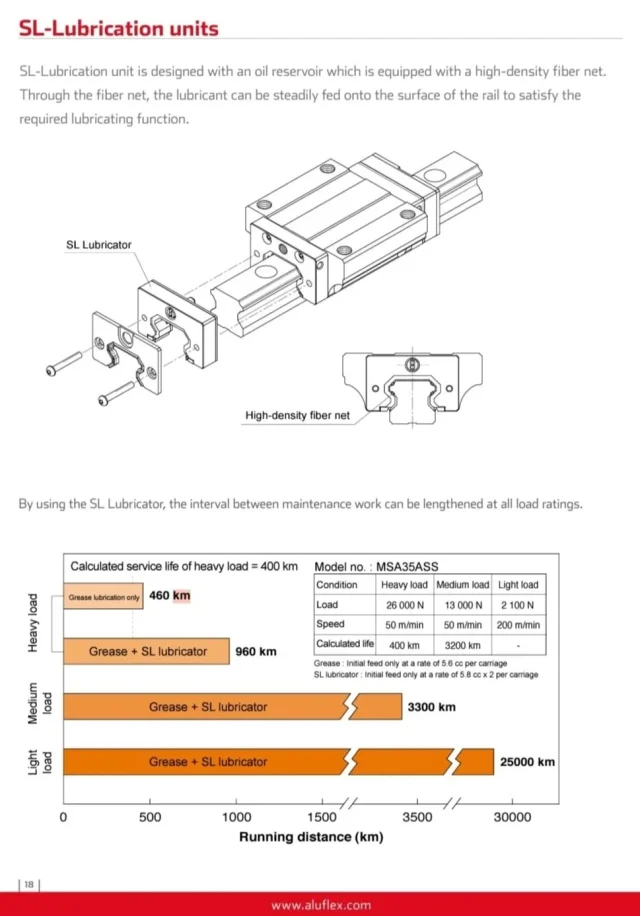
on a catalog of Roman constructions, regarding the lubrication kits I found, a bit synthetic and uncertain of the base duration limits without tanks:

- 600km heavy use
- 1300km normal use
- 3000km light use

do you have references? Thank you in advance.
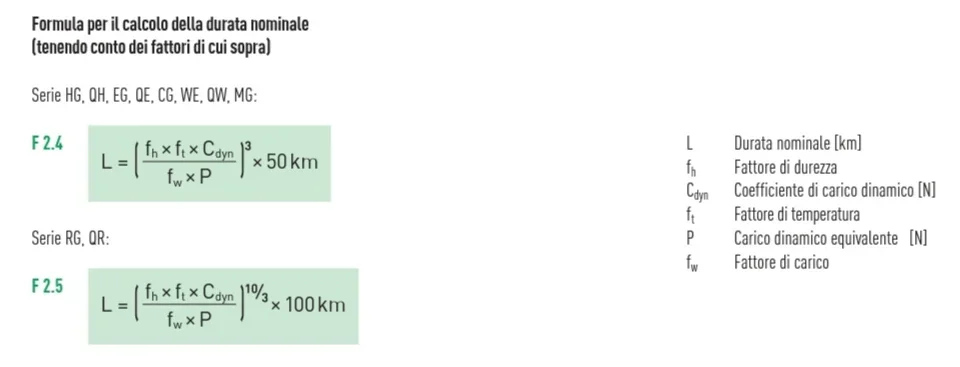
 
Well the classic formula l = (c/p)^n expresses the fatigue resistance of any component of “disappearance” constituted by desired elements. Now I do not remember exactly the theory, but the classic coefficients (n=3 for the balls, n = 10/3 for the rollers) come out from considerations on the contact pressures of hertz.

this to say that, in my opinion, is gross the procedure that is used for a bearing. then clearly your supplier should be able to tell you something extra depending on lubrication, tolerances, temperatures etc.

It is not something I personally do, but I am sure 99% that in the company we have a bosch form describing this thing. I'll get you a couple of screens tomorrow.
 
thanks stan, but my problem is not how to calculate the duration. I use very hiwin and therefore formulas are these:
Screenshot_20220216_051608.webpformulas are always the same for all manufacturers.

what I'm looking for is a table of recommended durations depending on the application.... especially expressed in km.

I tell you this because I have applications with micro movements and high loads that at calculation last 500km and in practice last 20 years so I need to understand if 500km is little or so according to theory.
 
the table of nominal duration to which I referred is what I found on Roman components....but only do they mention it?Screenshot_20220216_055334~2.webpis the criterion km and weight universal?
 
often we do the calculation of the duration in hours on the bearings and depending on the application there is a table indicating the hours that should be reached....10000 hours....piuttosto than 30000 hours etc.

As for the ball recirculation skates I found nothing on the catalogs.
Whereas the basic dynamic load coefficient is defined as a constant load in terms of weight and direction that can reach a distance of 50 km on the linear system, assuming that the load is applied from above as a normal radial load, the problems arise considering that in the real application there are numerous variable factors such as the accuracy of the guide/shaft track, mounting conditions, operating conditions, vibrations and impacts, etc.
Therefore, precisely calculating the actual load applied is extremely difficult, so I think no manufacturer wants to expose himself by indicating values that a user might challenge him.
in general, always theoretically, the calculation is simplified using coefficients that represent the factors: hardness coefficient (fh), temperature coefficient (ft), contact coefficient (fc) and applied load coefficient (fw).
In particular the latter (fw) is generally tabled with few coefficients according to specific operating conditions that each designer will have to estimate according to his application and the required duration.
Tables c and d are examples of two different manufacturers and that others also use.
on a catalog of Roman constructions, regarding the lubrication kits I found, a bit synthetic and uncertain of the base duration limits without tanks:

- 600km heavy use
- 1300km normal use
- 3000km light use
refer to the table you mentioned and that I carry (a), I think it refers specifically to a test carried out on a self-lubricated container mf, size sbg20sl (c=22.2 kn, see tab. b) that wants to show that by applying a default speed and three types of load (very lower than the one indicated in the catalog), the duration of the lubricant in the self-lubricated container, exceeds the theoretical one of the guide, therefore it is not necessary to scrap the fat thus highlighting the advantage of not requiring maintenance.
what I'm looking for is a table of recommended durations depending on the application.... especially expressed in km.

I tell you this because I have applications with micro movements and high loads that at calculation last 500km and in practice last 20 years so I need to understand if 500km is little or so according to theory.
based on the above, I think it will be difficult to find a manufacturer who comes out of the generic and wants to expose himself with data that cannot guarantee.
in your specific case (if I have understood correctly), I think that the evaluation is to be done according to the type of application as generally you do with other components, i.e. if it is an important component from the point of view reliability and cost, it will be calculated for a high theoretical duration; for a linear guide perhaps it would also be enough "only" 10 years while, for example, for a large reducer of a mill or wind farm, it is preferable to go on 15-20 years; it is also a matter of understanding the expectations of the customer.
 

Attachments

  • fw guide lineari.webp
    fw guide lineari.webp
    48.6 KB · Views: 9
Whereas the basic dynamic load coefficient is defined as a constant load in terms of weight and direction that can reach a distance of 50 km on the linear system, assuming that the load is applied from above as a normal radial load, the problems arise considering that in the real application there are numerous variable factors such as the accuracy of the guide/shaft track, mounting conditions, operating conditions, vibrations and impacts, etc.
Therefore, precisely calculating the actual load applied is extremely difficult, so I think no manufacturer wants to expose himself by indicating values that a user might challenge him.
in general, always theoretically, the calculation is simplified using coefficients that represent the factors: hardness coefficient (fh), temperature coefficient (ft), contact coefficient (fc) and applied load coefficient (fw).
In particular the latter (fw) is generally tabled with few coefficients according to specific operating conditions that each designer will have to estimate according to his application and the required duration.
Tables c and d are examples of two different manufacturers and that others also use.

refer to the table you mentioned and that I carry (a), I think it refers specifically to a test carried out on a self-lubricated container mf, size sbg20sl (c=22.2 kn, see tab. b) that wants to show that by applying a default speed and three types of load (very lower than the one indicated in the catalog), the duration of the lubricant in the self-lubricated container, exceeds the theoretical one of the guide, therefore it is not necessary to scrap the fat thus highlighting the advantage of not requiring maintenance.

based on the above, I think it will be difficult to find a manufacturer who comes out of the generic and wants to expose himself with data that cannot guarantee.
in your specific case (if I have understood correctly), I think that the evaluation is to be done according to the type of application as generally you do with other components, i.e. if it is an important component from the point of view reliability and cost, it will be calculated for a high theoretical duration; for a linear guide perhaps it would also be enough "only" 10 years while, for example, for a large reducer of a mill or wind farm, it is preferable to go on 15-20 years; it is also a matter of understanding the expectations of the customer.
on the skates do not expose itself on the bearings yes.... why?
My problem specifically is that I can't quantify the hours because it's true that it can move to 10mm/s but if you don't need it can also make you about ten centimeters a day....so it can last from a handful of hours to a life.
but I see that even here in terms of hours there is no table .. for bearings yes.
 
if you do not know exactly the cycle of operation I would do the calculation for a certain duration by declaring it to the customer, in this case it will be he who will know that in the worst case in continuous service will last for example 20000 hours (or a longer duration if it requires), it is obvious that if you then use it, as you rightly said, it will last a life; is a little the case of the lady who buys a 6 litre kerokee and uses it to go shopping :-) .
It is obvious that the economic and dimensional aspect will also be evaluated.
 
One thing to pay attention to the formulas of duration in hours, reported on the hiwin manual is that the basic duration is expressed in meters and not in km.
Screenshot_20220216_230645.webpso you need to multiply the result by 1000...I now discovered the error on my spreadsheet....and actually with 500km to 10mm/s I get more than 10000 hours....so we are.
we can therefore, summing up, keep valid the values indicated in the first post on the duration/intervals of lubrication.
I think I closed the circle.
 
Sorry
I read the discussion, but for 100 or 50 what are they for? and how have you been from miles in hours?
 
He's in hours.
However on all catalogs it is written as it is calculated.
here in km
Screenshot_20240409_182451_Samsung Notes.webp
 
ok, but on the nsk catalog I have this formulas, and I don't understand what you mean for 50 and 100km

no difference on the exponent, spheres and rollers are treated equal

I do not understand sti 100 km if from that same formula you get the duration in km, how do I say 50 or 100?
 

Attachments

  • vita pattino.webp
    vita pattino.webp
    30.2 KB · Views: 12
Among other things, I remember a configurator, maybe iko, who helped you to do all the necessary accounts. but I can't find it anymore
 
each catalogue tells you if the basic values are 50 or 100km. Don't get upset. take your catalogue and look for the reference. are obliged to write it.
you find it by browsing the catalog and normally you do not find it in the tables of c and c0....but from all over. a nice "search" in pdf and you will see.

if the manufacturer provides c and co for 100km you will use the formula with 100.
If the builder says 50 you will use 50.
certainly in the explanations there are both because then it gives you the formula to pass from one to another.
then maybe some series are calculating with 50 and another 100. read calmly on the catalog.
 
on the skates there is some consideration also on the length of the movement: Sometimes very small races can create problems because the balls can't spin in recirculation channels and therefore can't renew the lubricant.
 
I don't understand what you mean by 50 and 100km
on the first page this document is clearly explained; In practice the calculation according to the norms provides a duration of 100 km but many builders report in the tables also the values referred to 50 km because this allows them to indicate load values greater than 20%. I initially think that the first ones did it to have an advantage on the competitors then, of course, the other manufacturers have also adjusted. the same happened in the past on the gearboxes where some manufacturer indicated pairs greater than those of the competitors while guaranteeing the same duration; By reading the catalogue, it was clear that those values could be applied to 80% (sf=0.8) so that the practical act was equivalent to those of others.
and in this case how do you do it?
in the same document that I indicated above page 2 you will find some indications regarding short runs. the various manufacturers, for their products, have various solutions for applications with short runs such as hiwin, which for the cg series studied a new lubrication path that conveys the lube directly to the spheres of the working area allowing to stretch the lubrication intervals and making it more effective the application, or the integrated tank and special coatings of schneeberger as well as the adoption of homogeneous fat to short fibers as recommended for
in any case however, always worth the advice of @cacciatorino; for new projects with these issues it is better to talk to producers first.
 
here is another source where a length mileage is indicated depending on the load.Screenshot_20240506_184414_Photos.webp
 
I usually define the duration of ball skates according to what I consider an acceptable replacement interval for the application, often driven by more delicate components or requiring calibration after a defined time interval. the working cycle considered. I know that bosch for example considers it acceptable to calculate on a duration of 4 years, after which the skates must be replaced. clearly, as already mentioned by @cacciatorino the formulas on the duration of the skates take into account a uniform wear of the spheres (and of the seats), which is not in the case of very short races regarding the length of the skate itself. in cases of uneven wear, as well as of a too reduced installation distance, the real life is reduced compared to the theoretical one.
 
in fact @deresix in my sector after calculating the length of the km/h we use a corrective factor for the mounting position in groups that sometimes goes well beyond normal service factors.
it is unthinkable to disassemble after 5 years two sides of machine that run one on the other only for the break of a skate, always however returning to the available spaces that are sometimes really relocated.
 

Forum statistics

Threads
44,997
Messages
339,767
Members
4
Latest member
ibt

Members online

No members online now.
Back
Top