• This forum is the machine-generated translation of www.cad3d.it/forum1 - the Italian design community. Several terms are not translated correctly.

element scorrevole

  • Thread starter Thread starter Beth
  • Start date Start date

Beth

Guest
hello to all a question,

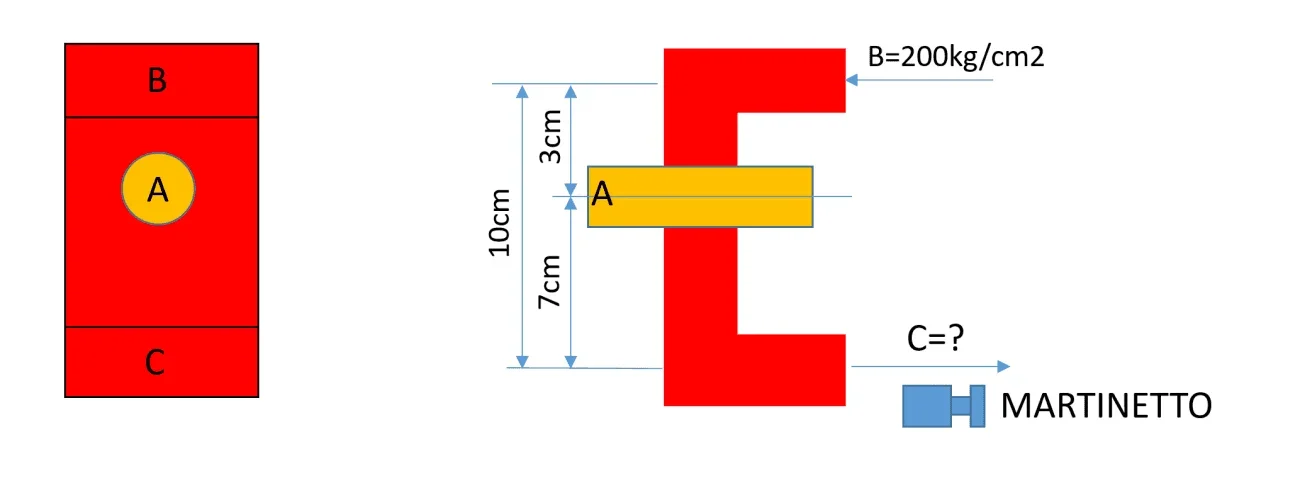
I have to apply a force of c of how many kilos to oppose a force b of 200kg distant 10cm from my point of action of the hydraulic jack c?

Can anyone please write to me the calculation?

Is this the simple moment that is 200x10 = 2000kg ?

the fact that having a cylindrical guide between the two points saves something by virtue of the pencil?

allego summary scheme

thanks in advance to those who want to help me
 

Attachments

  • 1582897515043.webp
    1582897515043.webp
    11.9 KB · Views: 88
Hi, I don't think I fully understand the problem, anyway. If you apply a force c with the pencil equal to and contrary to force b you have a moment equal to 2000 n x 0.1 m = 200 nm. Who contrasts it? depends on how the real system is made (as the pencil is fixed, if there are other slides besides etc.), from the image it is difficult to give an answer. Otherwise the system is hyperstatic and the moment is distributed on the various elements - guide.
 
ok the rule of the lever but I think that working so could be easy that you bet and you cross the red bar if not sufficiently guided on the candle.
would need more information to be able to assess this
if you apply 200kg on your 0.03m arm you have a pair of 60nm. to do not cross on a 0.07m arm you must contrast with about 86kg.
sin that if you have to contrast 200kg you have to make sure that the structure is not subject to rotation and you have to push with 200kg in the opposite way.

lever rule: f1•b1 = f2•b2
Reaction rule: f1 = f2
of course the verses of f1 are opposites of f2.
 
I'm not as good as you with formulas.

"To avoid crossing on an arm of 0.07m you must fight with about 86kg."How do you get to 86 kg?
 
lever rule: f1•b1 = f2•b2 from which the reverse formula ....
200•3=x•7....x=200•3/7=85,7...
 
thank you very much for the explanation and patience.

a small final summary.

the force to be applied to the pencil would be 286 kg theoretical right?

I thought the force to be applied was 200kg*10cm=2000kg.
 
My mom that confusion however .. forces in kg: I know that years ago it was common use and vague steps ... but forces multiplied by arms that remain forces, you can not read!

then I see no hinge from the design, but a cylindrical guide that binds the vertical movement (allowing the left view to be a view from above); Ergo, nothing rotates around a fulcrum! if the movement is rigid vertically and is given by a force of 2000n (~= 200 kg), on the other hand you will have to contrast it with another 2000n. the fact that the point of application of force is 10 cm away from the point on which the pencil works has nothing to do with it. no levers, no balance of moments and, please, no kg*cm that always remain kg.
 
Hello,

I'll never talk again in my life as promised.

As far as the formulas are concerned, I accept my limits and apologize, I am here not by chance to ask for lumen.

you understand the left view well indicates a cylindrical guide placed at 3 cm from my point of thrust.
so you say to counter the thrust I have to have a force simply >= and opposite of the pencil .

In essence the moment 2000nx10cm is canceled by the guide and does not center anything right?
If I didn't have a guide, should I consider 2000nx10cm?
 
“if you don’t have the guide” ... I don’t know. Your object would probably be in the void. always depends on the constraints. a balance of moments is necessary only if a rotation around a fulcrum is allowed.
also in your linear guide case for example, I am considering it ideal (game “zero” between red object and yellow cylinder)... It is clear that if between the guide and the “carrellino” there is a mm of play, that decentralized force will tend to make the cart unclean against the cylinder.
we say that you should clarify why the red object is running on a central guide, driven by a lateral force. It is not a good condition, it is clear that if the bond is not perfect, moments will be created.
 
between guide and trolley confirm zero game , tolerance h7 .
I also clarify that I am obliged to push out axis of 10cm due to the problems of encumbrance in which I am projected.
The scheme I attached at first is purely theoretical to understand my question, I was interested in understanding "just" how to oppose a force with a guide component in the middle.
you understand that an account is to oppose me with a pencil that gives me 2000n an account is to put one for 20000n
 
Sorry if I interfere, but in the design there is a pressure and not a force
b=200 kg/cmq to have the force you have to multiply this pressure by a surface

However, apart from this, to counter this force (according to your scheme) you must apply another of the same intensity but contrary.
Stop!

the moments you need for the stress of the guide cylinder.
 
excellent (further) note.
Sorry if I interfere, but in the design there is a pressure and not a force

Thank you for coming in

b=200 kg/cmq to have the force you have to multiply this pressure by a surface

You're right. It was 200kg.

However, apart from this, to counter this force (according to your scheme) you must apply another of the same intensity but contrary.
Stop!

the moments you need for the stress of the guide cylinder.

thanks to all for the explanations you have provided me
 
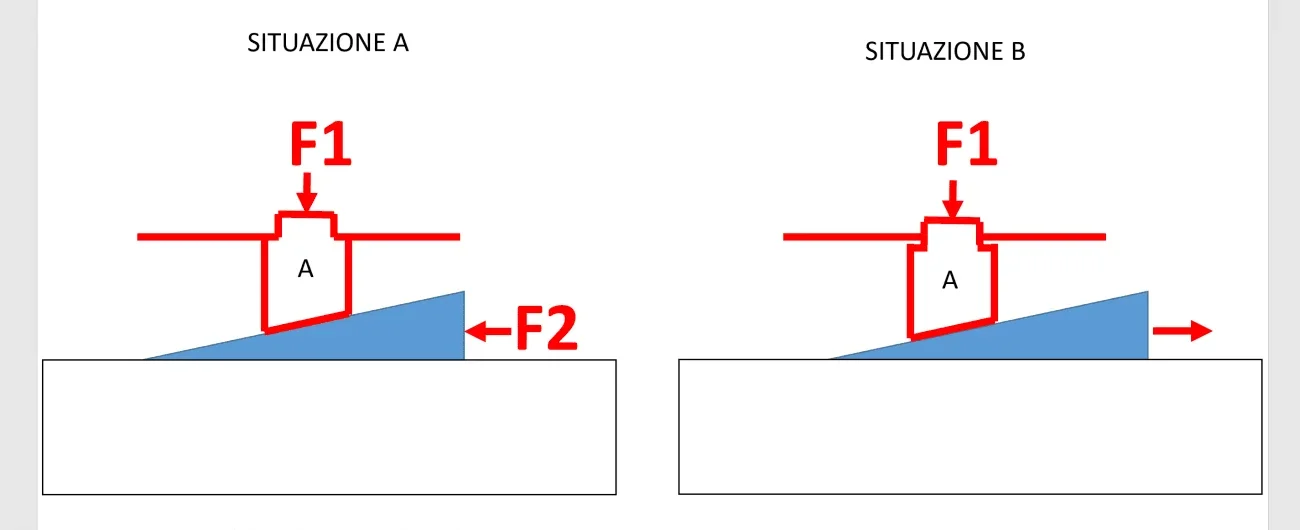
I enter again for a question still seen vs competence, allego schema .
I am in the situation where a body to is pushed f1 that tends to make it back.
the wedge connected to the pencil must ensure the position of the component to not yield and
end in situation b.
what is the concept formula to quantify force f2

thanks in advance to those who want to help me
 

Attachments

  • 1584950301096.webp
    1584950301096.webp
    12.4 KB · Views: 40
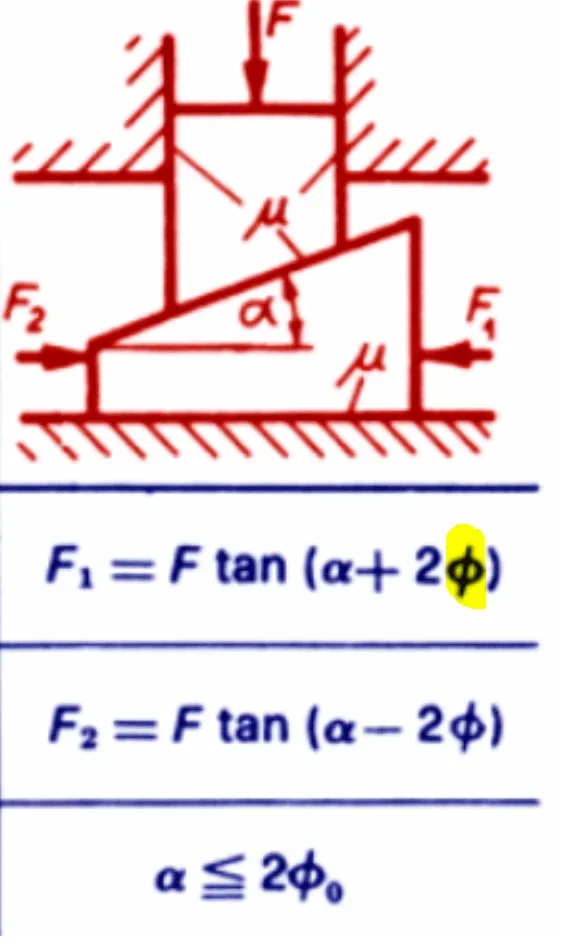
topic already discussed on the forum several times. qui Summary... .qui deepening.
hi I was interested in both sections where the subject was dealt with.
If I admit my gaps, can I ask you how to mathematically get the part under it?
considering a 0.2 friction coefficient?
I'd be very grateful
 

Attachments

  • 1585128600984.webp
    1585128600984.webp
    27.6 KB · Views: 24
hi I was interested in both sections where the subject was dealt with.
If I admit my gaps, can I ask you how to mathematically get the part under it?
considering a 0.2 friction coefficient?
I'd be very grateful
It's written in the second post I told you. there is equal lactate of coefficient of friction.
 

Forum statistics

Threads
44,997
Messages
339,767
Members
4
Latest member
ibt

Members online

No members online now.
Back
Top