• This forum is the machine-generated translation of www.cad3d.it/forum1 - the Italian design community. Several terms are not translated correctly.

end-step screws and big step

  • Thread starter Thread starter antoniopf
  • Start date Start date

antoniopf

Guest
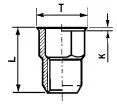
Hi, guys. I have this semi-hexagonal thread insert. when I try to screw a screw, I know there is a lot of game. probably the thread is big step. how could you overcome to be able to use a fine step screw that also guarantees more grip?
 

Attachments

  • Inserto filettato semiesagonale.webp
    Inserto filettato semiesagonale.webp
    1.9 KB · Views: 32
What does a lot of play mean? Radial? Axial?
how could you overcome to be able to use a fine step screw that also guarantees more grip?
it will be trivial, but of course buying a dice at the end
end-by-step screw on fine-step nut and big-step screw on big-step nut, there are no middle ways.
 
Very wrong.
the insert is to be mounted in the holes in the plates and is pulled with a gun not to let it go again making the first cylindrical tract compact.
There's no end.
the fine step, despite having more threads in hold has the triangle of the smaller propeller and therefore any fine step bears less load than a big step.
Let's face it I'm mito.... fine pass keeps the liquid, adagio rule and fine... but it doesn't hold so much load, it gets shot first.
 
seemingly evaluating a nominal metric value, we have for a large step screw a slightly less resistant area than the fine step.
it would be true if the tolerances of the hole became very narrow, instead they remain the same. being that the techniques of realization of the threads is almost always scarce, it turns out a triangle that has the closest base if it is to fine step. Therefore, despite having a larger and therefore more resistant hazelnut, it has a less effective behaviour of the propeller that is smaller and therefore with less contact surface than the metric to large pitch.

therefore the end screw is with an increasingly larger hazelnut at equal nominal diameter. therefore resists more.

sin that then to make the holes before rowing are always +0,1 and therefore dance. Moreover having fine step they knead if not lubricated and not mounted in well-made holes.

It's absurd, we're extinguishing that a m16 screw we're taking him from 0.2mm... he doesn't care why he's venting the propeller.

normally the end step is born for:
- have fine adjustment
- have a smaller helical angle to increase the anti-savory effect since the geometric angle is proportional to the friction angle
- to make fillets on the trees and induce a carving effect as little as possible. trees often cement themselves and the wreaths in c45 so they spread or their
- to make better precision adjustment screws having for each turn a lower axial step

If it were true that the final steps, at the present average manufacturing parity, would no longer exist the metrics at a large rate.

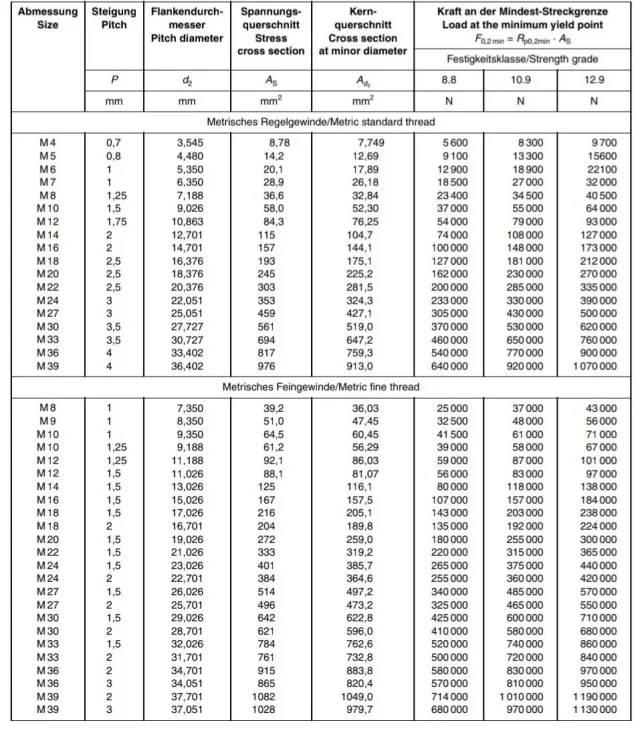
However I attach what the norms report in an ideal condition... but almost never real.
IMG_20190128_214102.webpthe number of intake threads, on the fine metric are so many in equal length....but the force on n threads is not transferred....so once 3 or 4 work the rest grows.
 
Sorry, maybe I didn't explain myself well: I find interesting your disquisition and worthy of deepening.

what I asked you, however, was whether this statement is your personal, or if there is any documentation (we call it "official": texts, laboratory tests, part studies, etc.) that affirm the same thing.

not because of lack of trust, but because it would be interesting to find official statements contrasting the reference texts.
 
Actually, no official source indicates that a thread holds more or less than the other. simply show that at greater diameter of hazelnut there is a greater tensile strength...but this anyone knows that a large diameter holds more strength than a small to equal strength.

Here was the practical demonstration, with the formulas that also vdi 2230 and other books report on the media pressure of thread.IMG_20190128_231016.webpwe start from the fact that we apply the same force that could be the application we want to contain with the exercise of screw or nut.

we have equal physical nominal diameter with same dimensional tolerance.

we have different steps.

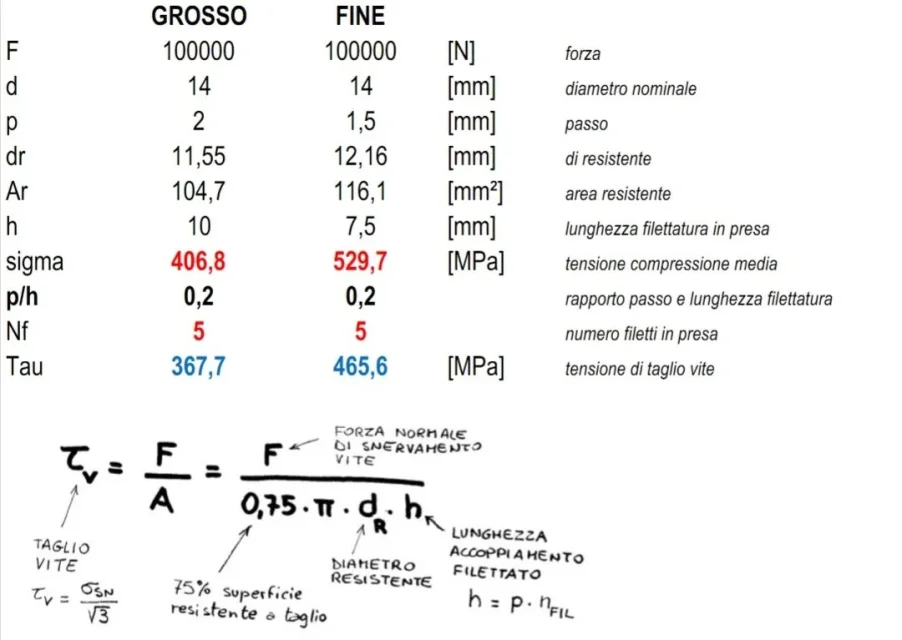
if it is true that everyone says that the numbers of threads are those that carry the load, we can impose a low number of threads (for a semi uniform load distribution) both for the big step and for the fine step pairs to 5 threads in socket, therefore remains constant the p/h ratio.
calculating the specific pressure you have that the fine step is more stressed than the big step. in fact the thread is first spread at the end step. Are you going? !

same with the cut on the threads.IMG_20190128_233711.webpon the trees you can mount a metric nut at a big step or a fine step but who knows why the wreaths are thinner than the dice? if a large-step nut had the same thin thickness of the wreath would have many less fillets and by force it holds less.the tables that also vdi 2230 reports are at the same length of thread, therefore, although not proportionally, worth somehow that more threads hold more load.

from nieman - design of mechanical organs 1 you see very well that the type of nut does work one or all threads.IMG_20190128_231946.webpa normal nut has utopian me fillets in socket as many as there are....but there will be a reason why normally it is said that 3 threads carry all the load.
so also this thing makes it clear that the load comparison between metrics at a big step and at a fine pace should be done with the same number of threads in the grip....ergo.... fine pass keeps less.
 
Last edited:
evidently the reason is to consider the same number of threads in socket instead of the same screwing height.

I am personally convinced that, under the same conditions, the number of threads in the grip is greater than those in the case of the big step (for greater elastic deformability of the first).

anyway, clarified the ark.
 
if instead of the same number of threads in grip we considered equal screwing height instead of results would you get?
 
if instead of the same number of threads in grip we considered equal screwing height instead of results would you get?
if I have well understood, same screw height means more threads in grip for the screw at the end...but since the first threads get all the load this makes sure that the fine step thread is not competitive for big thicknesses (in fact, if I don't remember badly, from where I read that is often used when the thickness of the piece in which the thread is practiced is small. . )
 
to me it turns out that at the same depth of tightening, the fine step holds more than the big step.

I speak not by direct experience, but for what I read in the texts of mechanics.
I have never found the opposite written anywhere, and that is why I find interesting how exposed by mechanicalmg.

I do not think it has been mentioned before, but it is worth remembering that the fine step tends much less to unscrew in conditions of great vibrations. an example is the fixing of brake calipers in cars, where the fine step is often used.
 
it would be interesting to see the calculation made by meccanimg considering equal screwing height.
 
here, we considered equal h height for both threads of 10mm.IMG_20190129_204138.webpWe obtain that the fine step has a lower sigma and tau equal load, demonstrating a higher capacity due to the theoretical collaboration of an extra and a half thread.

the speech is very simple because in section, see a thread or a straight teeth gear is the same comparison system.

a gear with module 3 has a small tooth and the base section has a lower lewis bending resistance than module 10 that has a tooth with a large base section.

This is another case where one can understand that a fine step is a triangle with the base of the isoscele triangle smaller than a triangle with the largest base.

so much if we take a screw m14 step 0.25 I want to see if it holds more than one m14 step 2 equal length of thread. the diameter of hazel grows yes.... carrying more traction ability, but the triangle with height two hair....how do you hold? I'd say little or nothing, and he'll be uprooted by his mother-in-law.

Unfortunately, there are components that intervene that limit pure theory.

that the wind angle of the fine step is narrower and makes greater anti-savory resistance I indicated it in the posts above.
 
I'm looking for no use for any document to claim that a large-scale link holds more than one at a fine pace, but all the documentation, whether formal university, or that of the producers, always states and only the opposite.

here is an interesting page of one of the top-names in the threaded links.
comparison step threadsdoes not spare certain words about the defects and problems that the threads narrowly take you back, but it states without doubt that their hold is greater.
size for size a fine thread is stronger than a coarse thread.
interesting also the fact that you indicate between the defects the fact that a fine-step screw must be screwed for a greater number of rotations, implicitly stating that the number of threads in socket is greater.
 
as I am not contenting myself, I tried with kisssoft to make traction calculation according to vdi 2230:2015.

We assume that h=10 mm for both cases and f=10kn.
m14x2 thick stepyield limit = 1,16
pressure limit = 1.54
m14x1.5 fine stepyield limit = 1,15
pressure limit = 1,41
the morality of the fable the most solicited vine, with less margin between the real tensions and the limit values of the vine/dado material is that fine spread, so the fine step does not hold more load of the big step.
 
I have always felt more interest in voices outside the choir than for those who follow the establishment pedissequamente.

In this case, however, the situation is somewhat abnormal: the whole world of mechanics states that a>b, while a single publishes that b>a. That's interesting, as I said before. the problem is that there is nothing that supports this statement. is it possible that no one else has noticed such a macroscopic error and that in critical applications is followed the common idea and not that of the individual? I think it's weird.

in an American forum, a user expressed the same concept in the form of demand, instead of affirmation, asking how it is possible that a smaller filet hold more than one of larger dimensions. more than one user responded by making clear that reality is in this case counter-intuitive, but both calculations, and practical evidence show that things are like everyone has always claimed.

a fine-step threaded connection offers a stronger section for both the screw core and the threaded area. already, even for what has in fact a lower measure, thanks to the greater number of threads in socket. this makes a fine-step screw more resistant not only to the break of the stem, but also to the tear of the thread (very counter-intuitive, but it is the reality of the facts).

in the light of what has been said by all the manufacturers of screws and in all the mechanical texts that I wanted to consult just to search for at least another voice outside the choir, it can be assumed that the simulation referred to in the previous post has something wrong, since it gets results clearly opposite to those published by dozens and dozens of other experts in the field. if things were really in these terms and just a simple simulation of a few minutes to turn a concept so rooted, is it ever possible that none of the millions of engineers who daily work on these details is ever encapsulated, even by chance, in the exact solution? I don't think so.
@meccanicamgcan you publish the details of the simulation so that it can be repeated by others?
 
Here is a beautiful publication that compares fine and big pitch with notes in favor of the big step.
of qualitative publications that deceive the absolute goodness of the fine step there are different, this is a little more detailed.
We will continue to analyze.
 

Attachments

returning to simulation data with kisssoft it is worth noting that the goal is to do prevarica according to regulations and apply the load.

In addition, for application rules, the normal dado fin en 24032:1992 in class 8, has for the fine step hardness 250hv and a breaking load of 800mpa, while for the big step has 200hv hardness and breaking load 640mpa.As I said before, the theory does that the end step holds more....the reality no! but already the theory is visible that it is so.... because the parameters are not constant.

see the previous post article.
 

Forum statistics

Threads
44,997
Messages
339,767
Members
4
Latest member
ibt

Members online

No members online now.
ciao
Back
Top