• This forum is the machine-generated translation of www.cad3d.it/forum1 - the Italian design community. Several terms are not translated correctly.

epicyclidal reducer

curiously, I went to see your two sheets that you had attached, where did you find module 1.5, and it seems to me that you included the pair of 36 nm, I missed something? I didn't find the number of satellites on those calculations.
those were the first calculations then if left between the messages you will see meccamicamg that suggests the helical teeth then I made the calculations both to helical teeth and to straight teeth and I returned the new results (with the pair divided).(y)
 
version with 4 satellites that collaborate, beautiful rectified and lapped with background radius that copy the radius from tool.

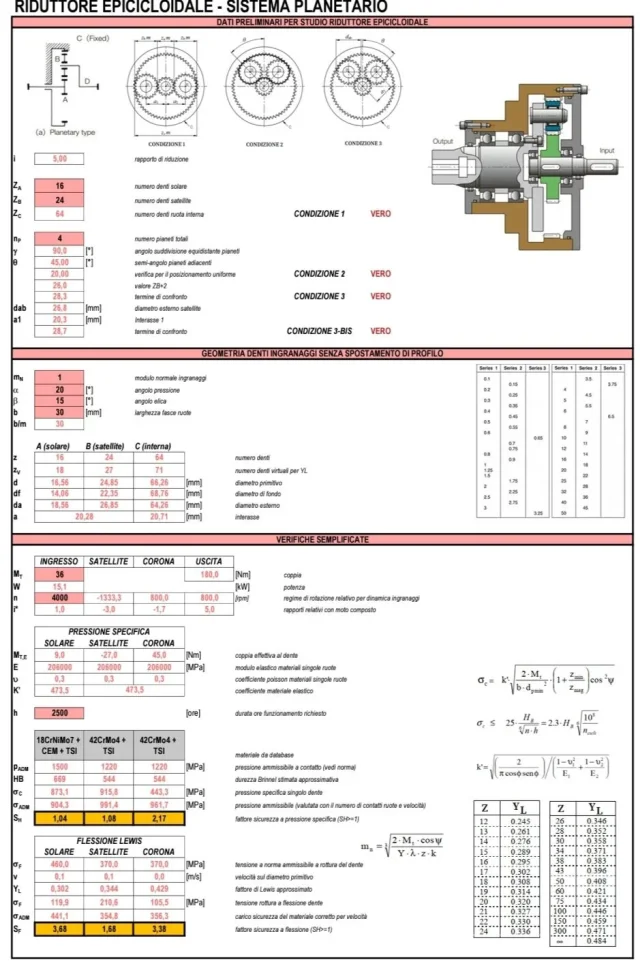
rotation system: 4000rpm
power in transit: 15,1≈/43,8kw
straight teeth
View attachment 58159you can proceed in this direction.
to understand better.., now we split the incoming couple for the 4 satellites. but the number of cycles, which the gear z14 bears, are 4 times a lot, so the calculated duration is 5000 hours / 4 = 1250. Am I wrong?
 
to understand better.., now we split the incoming couple for the 4 satellites. but the number of cycles, which the gear z14 bears, are 4 times a lot, so the calculated duration is 5000 hours / 4 = 1250. Am I wrong?
You have to see how many wheels are in contact.
the solar has 4 wheels in contact and therefore its wear is greater or however the duration is less.
Instead, satellites last each its duration because each gear sees a quarter of a pair.
 
our boy will have to control the conditions 1 2 and 3 well because it is not said that he can put 4 satellites and in phase equidistantly.
 
You have to see how many wheels are in contact.
the solar has 4 wheels in contact and therefore its wear is greater or however the duration is less.
Instead, satellites last each its duration because each gear sees a quarter of a pair.
the satellites have 1/4 of the pair, but in their gear cycle both with the solar and with the outer crown, so the hypothetical wear duration should be divided for two: 5000 hours / 2 = 2500 hours to make me understand. Am I right?
 
the satellites have 1/4 of the pair, but in their gear cycle both with the solar and with the outer crown, so the hypothetical wear duration should be divided for two: 5000 hours / 2 = 2500 hours to make me understand. Am I right?
But you can't split for two like that. the multi contact follows a rule a little his and I don't use it much, so it's hard to tell you exactly.
indicating however having to deal with two gears you have a life reduction of about 30% from what I remember.
 
if our student is using the simplified formulas that are found qui on page 44-46 is seen as the wear tension, with a small touch (verified on iso 6336) valley:
♪[ p_0=\frac{25•HB}{\sqrt[6]{n•h•n_c}} \]
con hb the brinnel hardness of the gear to be evaluated, n the rotation regime, h hours of operation and nc the number of contacts on the wheel in the studio.
therefore with this simple formula you get the recalculated limit on the actual multi contact situation.
 
one of the ways to block the dentate crown internally, if you do not want to put screws and thorns, is to make a sort of millerighe that locks torsionally and the axial rod cover, as shown by the sonia bonfiglioli in a photo of repertoire with a split of epicycloidal reducer.182030148-4a3cc9af-bb44-48c8-a775-5cf1daf4710c.webp
 
Given the size of the gearbox object of the exercise (max diam 100), the inner toothing of the crown could be integral, realized directly on the case of the gearbox itself.
 
with the various conditions to be respected, including the engraving of all satellites in an equispaced way it is not possible to realize the reducer with module 1,25 and z1 from 14 teeth.
a possible solution is this annex that respects all constraints.
Screenshot_20200612_222622.webpHow'd the story end?
 
on the other hand, he also saw on his own that by using module 1.5 he remains the internal toothed gear with little flesh and therefore he will not be able to hold the required torque. but he also sees this with his formula.

he could try to use module 1.25 and a lambda ratio b / m towards 40 and maybe even with his formula he is able to get closer to feasibility.
it is good that he knows that there are regulations and since he uses inventor he also has the calculation module and can play with it ....

it's a bit like lego ... there is no real age but if you have a passion you explore various worlds.
 
Good morning @meccanicamg.
I am a mechanical engineer and I am involved in the design of small mechanical components.
I've been taking over the topic of epicloid gearboxes lately, left at university times.
I have read very gladly all this discussion.
I have to congratulate those who intervened and especially you.
definitely this theme is part of your work and you perceive knowledge and passion.
I will also read the other discussions on the subject.

to test me I took one of your excel sheets and tried to create my sheet with the formulas indicated on "formulario_2017" and "khk".

I wanted to ask you some information about the parameters you indicate in your sheet and that I was not able to calculate:

1. zv virtual teeth number for yl
2. relative rotation regime for dynamics (satellite and crown)
3. i* relative relationships with composite motion
4. mt, and actual torque to the tooth
5. sigma_adm safety load to the correct material with v

on the internet I found everything and each one boasts the right formulas.
I'd like to know what you used in the points above.

I based on your sheet with i=7,5 za20, zb55, zc130, np3, m1, mt13, n1500.

thanks for the availability.
Hello.
 
the number of virtual teeth for helical wheels is always found with the usual formula that takes the normal module and divides it by the cube of the helix angle. lewiss has the correspondence between ylw and z where z is number of teeth if straight teeth or virtual teeth number if beta is different from zero.

regarding the number of teeth and reduction reports you find it explained on khk gear. keep in mind that there is the explanation of the relative motion of the speeds that subtracts.... from there you will understand.

the calculation of the torque according to the power and number of laps and vice versa is managed by the fact that the angular speed is given twice lazy for the number of split turns 60 because you work in turns/minute.

As for tensions, everything is explained in the dispenses you mentioned and use those basic formulas for calculation. if you use khk gear is in-depth and there is also some extra term.

Do not believe....it takes time, tests and crossroads of sources to understand well what to calculate and how.
 

Forum statistics

Threads
44,997
Messages
339,767
Members
4
Latest member
ibt

Members online

No members online now.
Back
Top