• This forum is the machine-generated translation of www.cad3d.it/forum1 - the Italian design community. Several terms are not translated correctly.

exercises towards the industrial technical drawing examination

  • Thread starter Thread starter joe93
  • Start date Start date

joe93

Guest
Hello everyone,
I would like to show you some exercise I have solved to have (many) corrections and an opinion.
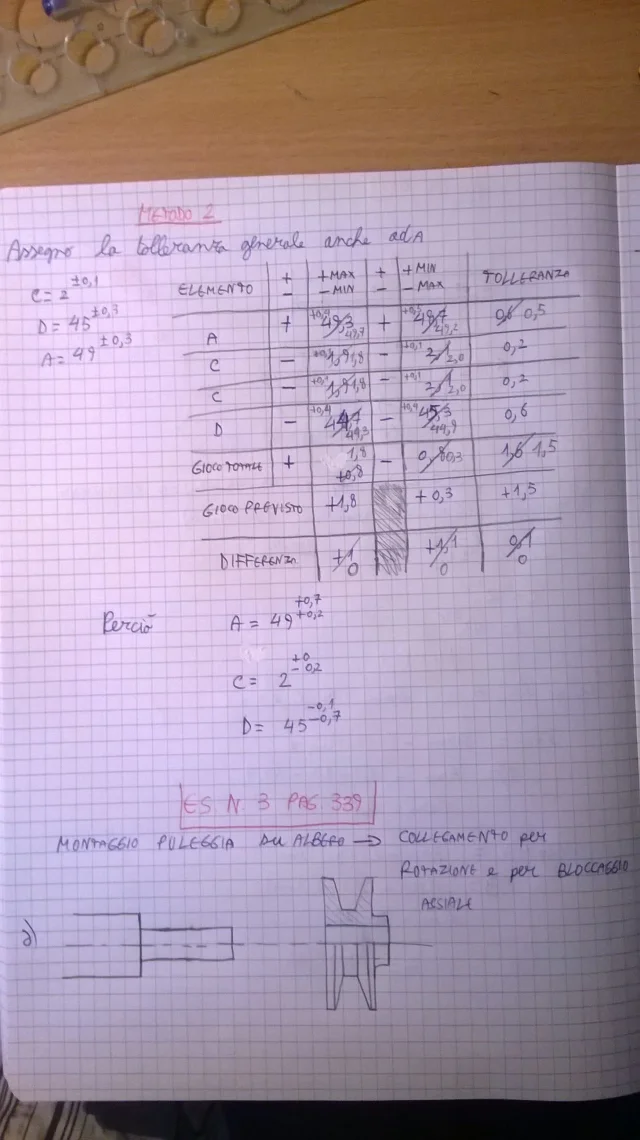
es1 given the overall (attached) predict a game of the pulley group between 1.8 and 0.3. I have done it in two ways, and I think the second is better. what I am not sure are the odds that affect the game.
es2 predispose the installation of the pulley on two trees (one cylindrical and one conical) to allow connection both for rotation and for axial stop.
Thank you for any kind of help you can give me.
 

Attachments

  • WP_20130827_001.webp
    WP_20130827_001.webp
    401.3 KB · Views: 159
  • WP_20130827_002.webp
    WP_20130827_002.webp
    334.8 KB · Views: 148
  • WP_20130827_003.webp
    WP_20130827_003.webp
    346.3 KB · Views: 111
  • WP_20130827_004.webp
    WP_20130827_004.webp
    288.5 KB · Views: 119
es2: the American language on the right selection would avoid: I'd rather use that straight one.
as to "what's going on here?" ask the question: "if I close the dice the pulley will go where?"... towards the shoulder!!! So the alternatives are two: either put it on the shoulder or put a spacer (a solution that honestly could make sense to there if you design the shouldering in relation to the pulley positioning requirement).
 
Hello everyone,
I would like to show you some exercise I have solved to have (many) corrections and an opinion.
es1 given the overall (attached) predict a game of the pulley group between 1.8 and 0.3. I have done it in two ways, and I think the second is better. what I am not sure are the odds that affect the game.
es2 predispose the installation of the pulley on two trees (one cylindrical and one conical) to allow connection both for rotation and for axial stop.
Thank you for any kind of help you can give me.
it seems quite clear that:

- if you want a game between the various axial elements between +0.3/+1.8 I would say that the tolerances to be assigned to the various pieces will be that: in the condition of the minimum of the true male pieces added between them and subtracted the female will be -0.3. same thing between the maximum of the various male pieces added between them and subtracted the female a value of -1.8.
all combinations are valid as long as they are so.

are not the odds that affect the game but their tolerances. This is an exercise that they have done in recent years after they have understood that it is necessary to know if you mount more pieces together with different tolerances if you have to use the hammer, or do it by hand or if you have to go from the technical office to make the design change because you do not mount. On the other hand they are things I fight every day and it really seems that tolerances are such a useless thing.... sin that the bale breaks from the workshop prove the opposite.

- pulleys on a cylindrical tree if I want the pulley to be stopped against the shouldering of the tree and there must not be the vacuum as you have marked (among other things if I had purchased or the vademecum for designers and technicians of the hoepli or had drawing books of the superiors or manual rules uni m1 m2 you would see that these exercise requests are precisely the things that are explained of the regulations. . example "tree end is a board where you indicate just things and how to draw. ... "
 
Thank you for your help. I also have an urgent question if I don't bother.
in an exercise between two "floors" with two holes of different diameter but coaxial I must predict that there is no axial movement (and that I do it with nut screw and anti-savory device) and a cylindrical centering. How do I get the cylindrical centering? I had thought of pins or cylindrical spines. ..thanks in advance
 
It is clearly necessary to evaluate in case, but I would say that the use of trusted cylindrical thorns is more than ever recommended. clearly: place in places where they do not go to problems with the stress state of the two plates!
 
the axial centering do it with two properly inserted thorns. if you do not want to use the thorns you can use two rectified collar screws or normal screws with compass if the centring order is 0.1 mm
 
I thank you for the help... very kind and helpful...I have a problem with understanding the tolerance to give to a hole in which a unified pin is inserted "for half the length". the pin enters half into the hole passing and then is free. my reasoning:
the nominal size of the hole I take it from the pin. the pin being a unified element has its tolerance for which I do not give the tolerance of coupling as I normally do (e.g. h7/g6) but I will only remove the hole.
I thought of an interference since the hole is passing and in case of play the pin would slide into the hole.
the tolerance therefore that I have given is p6 but I am not at all sure of it. . .
If you can solve my doubt I would be grateful... thank you in advance
 
always applies the rule: what is the need for that pin?
Moreover if the pin enters half length (of the pin or hole) means that it has a shouldering?
Can the pin be locked axially with other system (seeger, washer and screw in the case of shouldering, wreath)?
Tolerance is not only needed to keep the pin moving
 
Unfortunately I don't have the total because it was an examination text...however the pin was threaded for half of its length in half the length of the hole.
He had no shoulders and there was nothing else like rings to block it (if I remember well).
the big doubt I had is:
the pin being unified already has its tolerance? so to put us interference it is good in the hole p6 or, since it seems to me to have read that the tolerance of the pin should be m6 then it was enough that I put h7 at the hole?
 
assembly I don't understand, but I don't discuss.
the pins unified according to the norm (what is it and what specific about it?) can have different tolerances.
a similar coupling serves to transmit a bike, not sure to hold a pin in place. for that purpose methods are others. consider that with such interference you have to use specific equipment, which can go from the barrel and hammer to the press, to make the assembly.

in my opinion go to the teacher and tell him that without knowing the function of the assembled you cannot establish the appropriate coupling. because an account is building a shopping cart, another is building an atomic clock

in table 10 of the link you will find some types of couplings and their applicationhttp://www.larapedia.com/ingegneria/tolleranze-dimensionali.html
 

Forum statistics

Threads
44,997
Messages
339,767
Members
4
Latest member
ibt

Members online

No members online now.
ciao
Back
Top