
• This forum is the machine-generated translation of www.cad3d.it/forum1 - the Italian design community. Several terms are not translated correctly.

extremity crank

  • Thread starter Thread starter danny1204
  • Start date Start date

danny1204

Guest
I have to dimension this handle of a slow motion that transmits a power of 50 kw, rotation regimen of 500 g/min, beam of the crank 180mm.
I've already started solving it, after I send you the photos. This topic has never been dealt with so I don't even know what I have to dimension effectively (seeking on the internet I found something). I can't understand where the forces are concentrated that give the torque moment (i.e. on which plane ), and then for the dimensionalization of the counter pin that moment flenching use (what is the force that from the bending).
 
Hi.
I recommend you to dispel the force that the rod transmits to the crank pin in radial and tangential component to the crank itself. the tangential component is obviously what "generates" the torque moment to the tree. both stress the bending shaft on different planes.
to calculate the bending efforts on the tree, solve the beam system of the latter on two perpendicular planes: that content the radial component and that containing the tangential component. with the overlap you can then calculate both binding reactions and stresses at each point.
Of course all about excel, degree by degree!
 
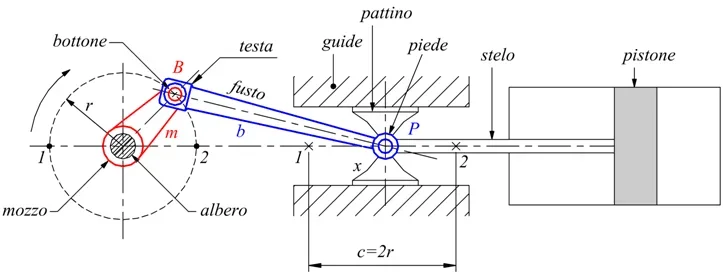
the biella manovella mechanism is a mechanical way to transform straight motion into a rotary motion if you use a combustion or assimilate engine.

the crank is practically the radius connecting the rotating shaft with the biella (organ connecting the piston to the crank).

in the scheme below is the red one.1.pngtherefore we proceed with the sizing that previews both the capacity of the handle itself and the pins.

I attach my step-by-step notes to the subject which provides for a proportionality of geometry and true verifications, as well as choice of materials.
Screenshot_20200602_163915.jpg
Screenshot_20200602_163944.jpg
Screenshot_20200602_163959.jpg
Screenshot_20200602_164017.jpgif you follow all the steps you will get a complete analysis that is what is required even in the state exam.
In this case we put 50kw on the counter pin shaft.
 
if I put a tab on the counter pin, the torque moment is the same one used to calculate the force or is it different?? torque moment that acts on the tab, which I would need to find the minimum length.
 
if I put a tab on the counter pin, the torque moment is the same one used to calculate the force or is it different?? torque moment that acts on the tab, which I would need to find the minimum length.
the torque moment, the only one that exists in the mechanism is the one placed on the axis of the tree that is the foot of the crank.
that then the force is analyzed not at 90° with the distance between the eye and the foot of the crank is another story and serves to determine the stresses in the particular conditions described above.
50kw at 500rpm are 955nm that you take the tab of the counter pin.
 
the torque moment, the only one that exists in the mechanism is the one placed on the axis of the tree that is the foot of the crank.
that then the force is analyzed not at 90° with the distance between the eye and the foot of the crank is another story and serves to determine the stresses in the particular conditions described above.
50kw at 500rpm are 955nm that you take the tab of the counter pin.
ok thanks, then it is also equal for the plug that I put for the button of the crank. because I calculated the torque moment taking the force and half diameter and it comes out barely verified. If I put that twisting moment I can't use the plug. I'll make you a quick sketch
 

Attachments

  • image.webp
    image.webp
    126.5 KB · Views: 26
The plug you're using is a normal cylindrical plug. what I have in my scheme is a conical tab with oval section and holds much more.
the crank eye tree is conical and already only the conic holds axially and torsionally.
the cranking eye tree which is the biella foot certainly does not see the torque moment of the main axis that is on the crank foot....my turns.
there are the forces that the biella contrasts and the only moment on the crank eye tree is the moment of friction of the bronzine that planted in the biella....so small mooolto.

However if you want to check a radial plug between tree and hub, these are the formulas for calculation.
IMG_20200604_212047.webp
 
Last edited:
The plug you're using is a normal cylindrical plug. what I have in my scheme is a conical tab with oval section and holds much more.
the crank eye tree is conical and already only the conic holds axially and torsionally.
the cranking eye tree which is the biella foot certainly does not see the torque moment of the main axis that is on the crank foot....my turns.
there are the forces that the biella contrasts and the only moment on the crank eye tree is the moment of friction of the bronzine that planted in the biella....so small mooolto.

However if you want to check a radial plug between tree and hub, these are the formulas for calculation.
View attachment 58254Hi, I am a mechanic student and during the study of tacticalism I was wondering how this type of thorns were, from this message I think I understood quite well, however wishing to deepen the question I was wondering if someone had a normative reference or could give further explanations to better understand how it is done, thank you in advance.
 
Hi, I am a mechanic student and during the study of tacticalism I was wondering how this type of thorns were, from this message I think I understood quite well, however wishing to deepen the question I was wondering if someone had a normative reference or could give further explanations to better understand how it is done, thank you in advance.
is a trivial cylindrical plug.
this type of thorns differs for the type of end that can be conical, convex, threaded, etc. each type has a different legislation, but the specifications of tolerance and materials are the same.
you just write in cylindrical google and in image search you will surely find one that matches.
other source is a supplier of mechanical organs like swallows that also offers pages of consultation.
the best thing is to consult the vademecum baldassini that every student should have.
 
Thank you very much for the prompt response, I have already consulted the site of the swallows and I think I will buy the suggested manual, however I remain a doubt, @meccanicamg spoke of conical tab with oval section unlike the cylindrical plug designed by @danny1204. therefore the component of which I do not understand the shape is this, in particular I do not understand if the section to the asola is constant or conical and still the system with which this component manages to push the cone of the crank button in the crank.
 

Attachments

  • BA3600EA-A772-47BC-8222-FB9D5F68FEAA.webp
    BA3600EA-A772-47BC-8222-FB9D5F68FEAA.webp
    38.4 KB · Views: 28
Thank you very much for the prompt response, I have already consulted the site of the swallows and I think I will buy the suggested manual, however I remain a doubt, @meccanicamg spoke of conical tab with oval section unlike the cylindrical plug designed by @danny1204. therefore the component of which I do not understand the shape is this, in particular I do not understand if the section to the asola is constant or conical and still the system with which this component manages to push the cone of the crank button in the crank.
that tab thus represents on that book is a rod that could be cylindrical then parallel or slightly conical as its seat and mounted at pressure (as is done with the conical thorns with circular section).
surely it is a particular piece not to norm but to specific of the manufacturer.
 
after some research on an old manual, I managed to find the particular of interest, I only have a doubt, the realization of the sloped hole on the tree how it is made?
 

Attachments

  • tempImageWYkrl4.webp
    tempImageWYkrl4.webp
    135.5 KB · Views: 21
after some research on an old manual, I managed to find the particular of interest, I only have a doubt, the realization of the sloped hole on the tree how it is made?
in modern times it can be made of milling or electro-erosion. I think they used to be broached, because 50 years ago it was one of the most used tools to make hollow shapes.
 

Forum statistics

Threads
44,997
Messages
339,767
Members
4
Latest member
ibt

Members online

No members online now.
Back
Top