
• This forum is the machine-generated translation of www.cad3d.it/forum1 - the Italian design community. Several terms are not translated correctly.

file nativo

  • Thread starter Thread starter ulio82
  • Start date Start date

ulio82

Guest
Good morning to all,
I have this problem: a customer has provided a file of a set using of course a cad different from the cad. this file is a .step that we can certainly import to then save it in .catproduct but of course we are not able to recover native geometry. Now you think you can do it? Is there a program that allows you to do what I ask?
the alternative is redesigning the model but as you can imagine it is rather laborious. I've heard of the Ironcad translator, is there any of you who's ever heard of him?

Thank you in advance for your answers
 
Good morning to all,
I have this problem: a customer has provided a file of a set using of course a cad different from the cad. this file is a .step that we can certainly import to then save it in .catproduct but of course we are not able to recover native geometry. Now you think you can do it? Is there a program that allows you to do what I ask?
the alternative is redesigning the model but as you can imagine it is rather laborious. I've heard of the Ironcad translator, is there any of you who's ever heard of him?

Thank you in advance for your answers
native geometry can't recover it, because in the step file there isn't written inside. in the step file you will find only and only the definition of surfaces (a cylinder with radius z, height h, xyz center, a plane from here to there, a line for two points a and b, etc), but not the story of how those surfaces were obtained. what the "translator" try to do is to reconstruct a plausible story that can then lead to the final result, but it is only an interpretation and not the true story made by the original designer.

I make an example:

they send you a book translated into Italian but you would like the original in German. What can you do? You can go to who sent it to you and ask that you give the book in German, or you can ask someone to bring it back to German. It is obvious that in the second case you will never get the original, but at the limit something that remotely resembles him.
 
He's a hunter. You can't!

but to help you I would like to understand better why you need to recover history in caty format and what needs you have!

Does conversion have problems?

I have received many files from customers in different formats from catia or neutri, and many times also native catia models, but shotmetrized and therefore devoid of history: I have never had any problems related to transformations (if conversions are made with appropriate programs and correct parameters), nor problems changing files or using them to build equipment or other elements.

if the format is native catia, it can be more convenient to make changes, but these can be made anyway.

Usually the bond to work in a specific format is the client who imposes it, but in this case it is he who gave you the step, so...
Indeed, sometimes the customer sends it neutral just to avoid divulging construction technology.

Let me know.

Hi.

years ago
 
to all of you,
First of all I thank you for your concern and for your answers. As for the subject of course, I was expecting it, and so I am here to describe the detail of my "problem" :
1) a company x built a machine on our request for which he designed various components.
2) part of these components we have to build them ourselves for this reason we asked that they send us suitable files.
3) and here comes two .step files of two assemblies, one of 40 parts approximately and the other 56.
4) we tried to ask more details (e.g. boards;drawing etc.etc.) but nothing to do.
5) so what I have to do : these two assemblies contain parts that repeat both within the file itself and in the other. I should extrapolate those that are common elements, rename them (to eventually obtain the distinct according to our standards) and reassemble them on the existing model.

What do you think is the fastest and easiest system?
 
Hi.

we proceed by degrees, try to answer these questions:

1) If you open the first step with catechism and save everything in a folder, do you get a catproduct, with catparts?

2) the first step catparts are all different from each other and their quantity is managed by the occurrence in the catproduct or are there abnormal doubles? (i.e. there are too many catparts as if some of these that are clearly the same object, instead of resorting several times in the product was cloned? )

3) if you open the second step and save everything in another folder, clearly recognize a catpart already present in the first step?, does this have the same (identical) name?

after the answers, we look for the strategy to rename the files.

Hi.

years ago
 
Hi, gianni,
below the answers... .
(1)
2) no there are no abnormal doubles
3) yes in the second step once "composed" in catpart and a catproduct I recognize common files that are also in the first with identical denomination
 
Well,
as you know catia does not tolerate to load in the same session two files that have equal names even if they are actually the same thing, so you have to make sure to put everything in the same folder avoiding the doubles.

I would do like this:

Eye: always make security copies!

1) I open the first product and with file "Send to:" except the first product and parts in a new folder (e.g. new01)
2) I open the second product and send it to: except for the second product and parts in the same folder (new01) when it tells me that some files are already present, I tell him to overwrite them.
3) I create a new product where I load the first and second product present in the new01 folder

at this point you have to start renameing files according to your standards, and here if you have never done so, you have to be careful:

on a sheet of paper take note of old file names and beside write new ones you want to put them.

in rescue management files, select the file, and then "save by name", rename it and save it, unfortunately at this point you still have to force the system to change the number part and the name anniversary.
then select in the tree a part with the old name and from the properties change the number part with the new name.
made this all the details in the products will change name.
remains to be changed the name anniversary from the properties (which you will have to do for each particular, leaving unchanged the number of the occurrence, or do so with a macro).

do not rush, do it for a particular at a time, check with properties that: file name, number part, name anniversary are equal (except for number)

perform these (noious) operations for details to edit, you will find in the new01 folder a pile of files, of course to clean everything you just need to send a new folder to transport only valid files.

from there continue for table harvests, distinct base etc.

Let me know.

Bye-bye
 
Thank you so much for your support. I'll try this method tomorrow, then I'll let you know the results.

Thank you very much
 
Good morning to all,
I have this problem: a customer has provided a file of a set using of course a cad different from the cad. this file is a .step that we can certainly import to then save it in .catproduct but of course we are not able to recover native geometry. Now you think you can do it? Is there a program that allows you to do what I ask?
the alternative is redesigning the model but as you can imagine it is rather laborious. I've heard of the Ironcad translator, is there any of you who's ever heard of him?

Thank you in advance for your answers
Hi.

".... recover native geometry. Now you think you can do it? "

if by "native geometry" you mean geometry with all parameters, depends on the type of geometry .
In some cases, simple, it is possible, starting from the solid "dead", reconstruct a parametric tree by hand.
The command is feature recognition.

http://catia2015.sellfile.ir/prod-images/233378.jpg
 
I didn't remember that command anymore.

instead for ulio82, I wanted to suggest another method:

1) open each part and save it by name and number part (modified according to your standards)

2) open the product and apply the replace component command (replaced so old ones with new ones)

3) change the name recurrence of each (hand or macro)

4) save everything and send to: to have the clean folder

Hi.

years ago
 
Good morning to all,
thanks for your competent and valuable answers. gianni55 I basically followed your last advice and I would say that the work proceeds pretty well not without "discussion" of course.
In your opinion (gianni55) if I send you a drawing in which I put on the table 4 details that I'm sure for you turn out simple would you give me your opinion on how you would quote them? .
Please note that for example one of the four is a simple plug whose quotation is simple but my purpose would be to make the result as clean as possible.

thanks in advance for the answers
Jury
 
Hi.

".... recover native geometry. Now you think you can do it? "

if by "native geometry" you mean geometry with all parameters, depends on the type of geometry .
In some cases, simple, it is possible, starting from the solid "dead", reconstruct a parametric tree by hand.
The command is feature recognition.

http://catia2015.sellfile.ir/prod-images/233378.jpg
It's interesting, but you give me a simple definition....that's a cylinder... a cube... or even a particular profile?
 
It's interesting, but you give me a simple definition....that's a cylinder... a cube... or even a particular profile?
no, by simple, in general, I mean that you do not use profiles or complex surfaces. could also be a complex piece, but consisting of many extrusions or elementary holes.
 
Good morning to all,
Well, I'm good. Now, once you set the nomenclatures in the axieme, I would like to pass before drawing the components to make the ball to have the distinct base. I wonder how catia decides the numbering sequence of the balls? can I decide which numbers to allocate to the various components? once I transport the axieme to the table how can I tell him to catia what balls to see and in what views?

Thank you in advance for your answers
 
no, by simple, in general, I mean that you do not use profiles or complex surfaces. could also be a complex piece, but consisting of many extrusions or elementary holes.
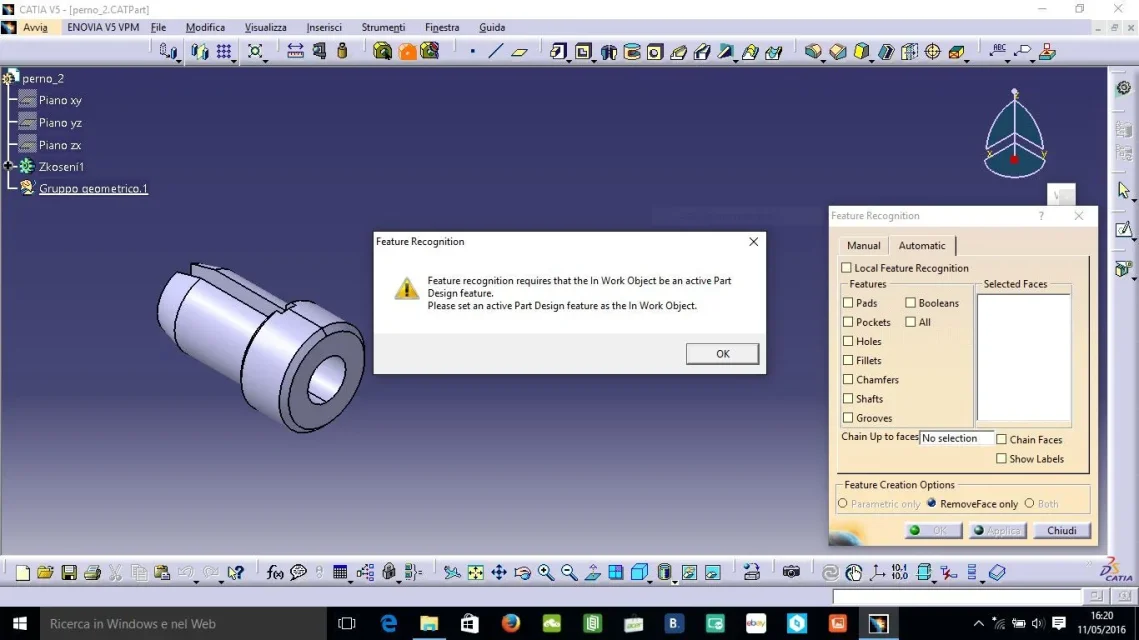
Okay. I tried to open any file I should redesign (see photo). When I click on automatic feature recognition, the message you see appears to me. Can you help me understand? .
 

Attachments

  • Cattura5.webp
    Cattura5.webp
    86.3 KB · Views: 10
you have activated the geometric group............ Do you see the sub-injection? ?
dx button on the part and then click on "define in work object" ... or something like that I have it in Italian :)
 
how does catia decide the numbering sequence of the balls?
according to the sequence of the parts in the product (if you want to change the sequence use the icon "record of the logical tree")
can I decide which numbers to allocate to the various components?
if you have not assigned the numbering to the product, you can do it and every ball you create will take on a progressive number, but then you have to do all the table by hand!
once I transport the axieme to the table how can I tell him to catia what balls to see and in what views?
instead of using automatic balling (which sometimes creates casinos), use the "pallining" menu/insert/annotation/text/pallining icon, when selecting a curve of the particular, indicates which capart refers and puts the number already assigned.

Hi.

years ago
 
Okay. I tried to open any file I should redesign (see photo). When I click on automatic feature recognition, the message you see appears to me. Can you help me understand? .
You must be active on the solid you want to rebuild.
then you have to "trace backwards" the path you usually do to build the piece.
warnings if you want a parametric piece:
1) Below leaves only the parametric only option.
2) try with both but I have always found myself better to use the non-automatic option and one step at a time. It allows to better control logical reconstruction.
 
according to the sequence of the parts in the product (if you want to change the sequence use the icon "record of the logical tree")


if you have not assigned the numbering to the product, you can do it and every ball you create will take on a progressive number, but then you have to do all the table by hand!


instead of using automatic balling (which sometimes creates casinos), use the "pallining" menu/insert/annotation/text/pallining icon, when selecting a curve of the particular, indicates which capart refers and puts the number already assigned.

Hi.

years ago
Hi, gianni,
The problem is basically that, as I said earlier, I have two assemblies in which there are elements that are repeated in both. Now if I open the first assembly and tell him to run the numbering ball I need the elements "pallinated" in the first assembly that repeat also in the second have the same "pallino" otherwise in the workshop at the time of construction comes out a mess.
is there someone who has already clashed on this problem?
 

Forum statistics

Threads
44,997
Messages
339,767
Members
4
Latest member
ibt

Members online

No members online now.
ciao
Back
Top