Marcus990
Guest
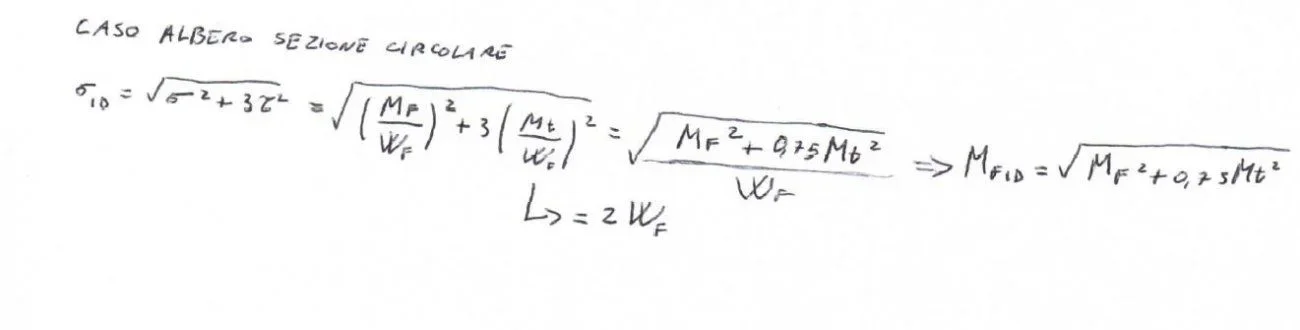
I know, I'm very theoretical here.for calculation of the compound bending moment, obtained from bending and twisting the poncelet formula is used.
♪[ Mf_{id}=\frac{3}{8}Mf+\frac{5}{8}\sqrt{Mf²+Mt²}≈\sqrt{Mf²+0,75•Mt²} \]mf = flender moment
mt = torque moment
it is applied to beam elements with high flexional and torque loads. if there are pulsing stresses torsion fatigue and it has constant bending then 0.75 becomes 0.25.
being known the urge will use the reverse formula to determine what is missing:
♪[ \sigma_f=\frac{Mf_{id}}{Wf} \]with wf the form of the section.
Unfortunately, the fact that we are not up to date is true. consider that at perugia they are very theoretical and many things I have learned independently. only recently introduced a 3d design course. However, still far from the levels of polytechnics and the world of work.First I would like to make you known that the ex cnr uni 10011 has been suppressed and therefore cannot be used for several years now. has been replaced by eurocode 3 uni en iso 1993-1-8, so what you are doing can only have academic value....but then let's not complain that students are not up to date. Alternatively you can use the technical standards ntc 2018 that are in auge in Italy and recalculate Eurocodes.
with regard to your beam, subject to bending/tortion that is a beam to catalog or that it is a welded compound does not change anything and in the post #10 there is the pattern taken from my dispensers that explains the use of the geometry of the areas, which is the basis of analysis a section composed with the use of the inertia section.
the problem may be of a different nature if you are studying the attack of the base of the pins because you start from the fact that you have a beam and calculations the macro reactions and macro internal actions but you are now working localized and therefore in a portion of material so small loses by definition the concept of beams and of all its accounts (trave: slender element with known section and almost constant).View attachment 61561as you can see, the structure was built with a boxed beam for all the slender and on that they did the bending accounts, twisting, cutting. then added a lower structural appendix to realize the bond and then to download the bending that turns into two horizontal forces for the attack of the pins.
View attachment 61562you may have as an alternative that to consider the h portion as a vertical beam even if it is actually a section far from something calculable by hand. definitely a fem analysis is ideal for studying that area that is too tough to follow laws of type beams.
certainly your tutor side university should support you and help you in these things, which is why it is called tutor.