• This forum is the machine-generated translation of www.cad3d.it/forum1 - the Italian design community. Several terms are not translated correctly.

forces or pressures and parabolic or triangular trend

  • Thread starter Thread starter mirko088
  • Start date Start date
you need to check how much the total force applied and then apply a scale factor. I suggest you write the formula in excel, plot it, to verify it, then apply it and verify how much the sum is.
the rbe method has these advantages:
- apply forces to all knots, so you have no local effects of force having applied it to a few knots.
- you are very precise as a point of application of force, being released from elements
- It's a discreet system, so it can be controlled.
On the contrary, it is not easy to make all the rbes without interlacing between them.

See you..
to verify the summary is there a command?
 
in patran you... in hypermesh I don't know, otherwise you throw the solutor and watch the oload inside f06 or as it is called the output file of your solutor.
 
in patran you... in hypermesh I don't know, otherwise you throw the solutor and watch the oload inside f06 or as it is called the output file of your solutor.
hi I followed your advice is I applied the rbe elements to apply the loads by dividing the shovel in section and thus distributing the load according to the desired distribution. However, I get enormous moves, what could be the problem? I have already checked all the characteristics of the materials and are correct. the centrifugal force applied along the axis of the shovel should create traction giving me greater resistance to the shovel what does not happen.
 
to see the effect of stiffening stress you have to turn a non-linear. with a static you don't see it.
anyway you have to open the text output file and check the applied total load and the binding reactions to see that there are no errors
 
Therefore through a static analysis I would not see the effect linked to the traction ? I have a load of 7786 n long z (plan perpendicular to the plant in the shovel) while a load of 135572 n long y (direction of the alare extension) and get a movement of 7 meters long z (linear static analysis). I checked the total load applied and it is correct.
 
stiffening stress involves a recalculation of the rigidity matrix that does not occur in a static analysis.
try to turn a non-linear
 
to turn a nonlinear I should have data of the material that I do not possess and that I do not know if it is possible to find .
 
? ......? ...... ?
if I were too professor I would put 2
there are so many non-linearities. a non-linear geometric doesn't need a non-linear material.
example: check instability of an auction. typical not geometric linear.
pressure load on a membrane.
fishing rod
 
In order to be able to perform the analysis, I am based on the guides and tutorials that I have seen that I use the program for the first time and in all the analyses go to reclaim the material using different images card, so I assumed I had the need to do it.
 
as said there are so many types of non-linearity.
you refer to non-linear materials. while the effect of stiffening stress is geometric . in practice when a structure is placed in compression goes into buckling because its stiffness subtracts the stress stiffening matrix. while if the load is in traction is added.
here a clearer explanation of mine:
 
thank you very much, I will see to read the file and see if I can perform this type of analysis
 
as said there are so many types of non-linearity.
you refer to non-linear materials. while the effect of stiffening stress is geometric . in practice when a structure is placed in compression goes into buckling because its stiffness subtracts the stress stiffening matrix. while if the load is in traction is added.
here a clearer explanation of mine:
Hello excuse me, but I saw that on hypermesh(opistruct) this type of analysis is not possible to do it as you should use a different solutor ( hypermesh- radioss block 110) . in case you want to recreate the model on patran/nastran since you use these software could give me a hand?
 
Hello excuse me, but I saw that on hypermesh(opistruct) this type of analysis is not possible to do it as you should use a different solutor ( hypermesh- radioss block 110) . in case you want to recreate the model on patran/nastran since you use these software could give me a hand?
I don't understand. Can't you use a non-linear solutor? Don't you have a license? Are you licensed for nastran's sol106?
Why do you want to recreate the model in patran? from hypermesh you can export directly to nastran. save bdf and then turn it with nastran, then you can post processing both in hypermesh and patran.
Anyway, one thing at a time:
- try to understand why you can't turn a "standard" nonlinear with the suite of Altair that seems very strange to me.
- in case you have no license or anything, and instead you have it for 106 nastran, then you have to set hypermesh out for nastran, and create the bdf file. If you're having trouble loading him here and watching him.
- nastran launches and create the file op2 (in bdf there must be param,post,-1)
- load op2 in hypermesh
- if you want to do post processing in patran, open a new file, import the bdf and then attack the op2
 
for nastran/patran I have the student license that provides me with the polytechnic in which there should be sol106. with the suite Altair you can turn 3 non-linear analyses :two implied non-linear analysis (material and contact) , an explicit nonlinear analysis (geometria) . the first two analyses are made by the optistruct solutor or radioss bulk data , while the third analysis that is what has recommended me to do is made by the radioss block 110 solutore. the management of each solutor is different compared to the other, so all the creation of the model is different. I in the suite Altair use the solutor optistruct while I am not able to use the radioss block 110 which is completely different and of which I do not find material to which I can lean to recreate my model . can therefore export the model with mesh , materials, properties and loads directly to nastran only, or
 
you should be able to export everything for nastran, directly like sol 106, but I don't know how to help with hypermesh, I used it and also much but only for meshare, then I always used patran for constraints and loads. be careful that the student versions of nastran may have a limitation on the number of nodes.
Still try to pull out a bdf and post it here. .

Anyway, I'm not with what you say. An explicit analysis normally comes up only if there are dynamic effects, you have to do an implied nonlinear analysis. here, for example, clarify the differences between the two: so I think you can turn with optistruct, looking quickly on the net:
 
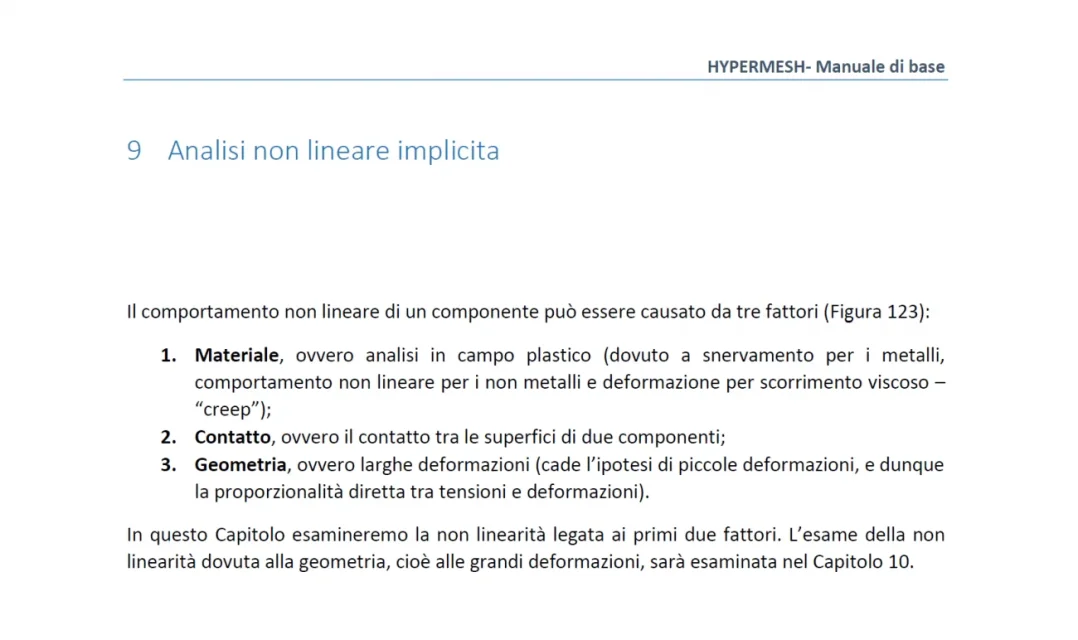
I am based on the optistruct manual that I have in possession of which place an image where I mentioned what I told you, Chapter 10 is that on explicit nonlinear analysis. I read now the files that sent me and then try to convert the file to bdf. thanks
 

Attachments

  • 10.webp
    10.webp
    66.1 KB · Views: 4
I was already downloading that e-book from the previous link you provided me. Thank you.
 

Forum statistics

Threads
44,997
Messages
339,767
Members
4
Latest member
ibt

Members online

No members online now.
Back
Top