• This forum is the machine-generated translation of www.cad3d.it/forum1 - the Italian design community. Several terms are not translated correctly.

gorge and retreat rule

  • Thread starter Thread starter Shelby
  • Start date Start date

Shelby

Guest
Hello.
on a drawing a few years ago I find myself a carving "c2,5 pn-58/m-02043", which refers to an old Polish rule now withdrawn.
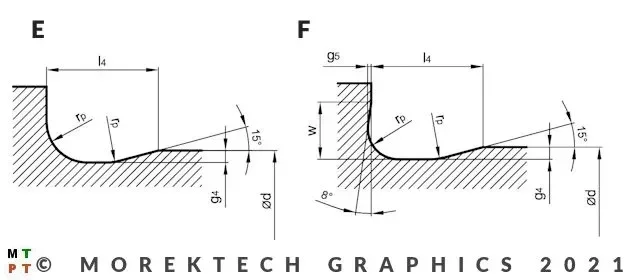
I should design the particular and replace this rule with an in force (I had thought of iso 18388) but I have some doubts about the "compatibility" between the different throat "types".
on the design calls a type c, while on the new iso are proposed other solutions (e, g, ...).

some sources: machining, technological - morektech cuttingsThank you in advance!! !
 
I think no one's gonna challenge you. Is it a rectification throat? only diameter or even shouldering?
also in Italy have been withdrawn....so fans all to feeling with the tool they have and does the same. if you have to make finished piece hardened and rectified, see with the rectifier how much overmetal you have to leave and then go down to rounded tip finish.

otherwise ask the Polish unifier to give you the reference....so much is a withdrawn rule. . .
 
That's enough. Close....... probably your same link....I did google search.

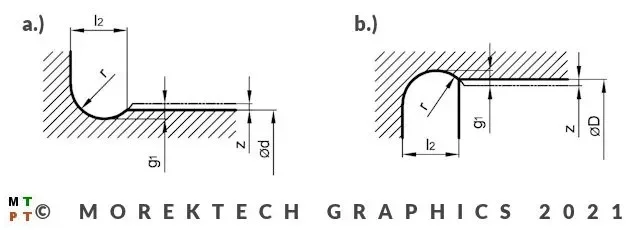
gole images type c....shaped rounded.
a=external... tree
b= inside....hole1719944953209.png
Screenshot_20240702_203002_Chrome.jpgYou have all the measures.
However it is replaceable with iso 18388 type e.1719945311143.png
 
Last edited:
to honor the truth my doubt was this:
"the relief groove type e, see figure 1, shall be applied to workpieces where the planar surface is not subjected to high fatigue loads and where the cylindrical surface will be subsequently machined if necessary. "while on the type c of the link it was explicitly spoken of applications with loads to high phatics.
even if in the extract we talk about fatigue loads with reference to the "planar surface". .
 
to honor the truth my doubt was this:
"the relief groove type e, see figure 1, shall be applied to workpieces where the planar surface is not subjected to high fatigue loads and where the cylindrical surface will be subsequently machined if necessary. "while on the type c of the link it was explicitly spoken of applications with loads to high phatics.
even if in the extract we talk about fatigue loads with reference to the "planar surface". .
if the signature and is made for the best applications resistant to alternating fatigue....if the original wears a simple throat, not suitable to bring great forces of fatigue....the things are two:
- do as original.
- You're strong and it's better.
 
if the signature and is made for the best applications resistant to alternating fatigue....if the original wears a simple throat, not suitable to bring great forces of fatigue....the things are two:
- do as original.
- You're strong and it's better.
the fact is that in the extract says "it should be applied where the surface flat It is not subject to high fatigue loads... "...

but with "flat surface" means the "split" seems to me to understand.. .

but to use a withdrawn rule for a design that problems can entail? should not be the designer (or, in general, the author of the drawing) to possibly update it?
 
a withdrawn rule....you can use it.
if a product structurally is ok....continue to be ok. certainly a bridge has to be recalculated to new regulations....a throat in a tree does not make a difference.
If you take a 30 year old design that is a spare....so it was designed and so it remains. who the factory can do exactly drawing or ask the client if he can do on his own initiative.

are things that we face every day in the technical office. .. between wrong pieces to save, impossible processing, meaningless notes etc.

If you don't work for the nasa or for the ferrari....son you quisquiglie.....and the foul is rounded like there is on the old drawing that's okay.
 

Forum statistics

Threads
44,997
Messages
339,767
Members
4
Latest member
ibt

Members online

No members online now.
Back
Top