• This forum is the machine-generated translation of www.cad3d.it/forum1 - the Italian design community. Several terms are not translated correctly.

gradient thermal femap 10.3

  • Thread starter Thread starter insight1400
  • Start date Start date

insight1400

Guest
Hello everyone,I try to get the trend of the heat gradient in a polycarbonate sheet using femap.
after defining mesh and property material (solid type) I applied a heat on surface heat on a sup. of solid type generation heat (I also tried flux heat) but launching the analysis (steady-state heat transfer) instead of getting a gradient I get a solid all with the same temperature.
What's wrong? ? ?
Thank you.
 
welcome (please read the regulation and consequently a presentation in the special section).

for your problem: Are you sure the thermal bond conditions are all correct?
 
presented... I had not read sorry.
returning to my problem I have not put any bonds, even because in constraint I have not read anything about thermal constraints.
excuse ignorance but I used femap only to solve static and vibrations of structures,
Could you explain to me what kind of constraints I have to put or where I can find some examples? ?
Thank you.
 
Bye.

Unfortunately I do not have femp 10.3 (but I used it until release 7 or 8...) so I cannot ask you to send me the model for a verification.

you can do this type of "physical" control: if the thermal flow is only incoming and you have no outflow or at least one point with a fixed tempering (not initial: I mean "fix in time") it is clear that the problem cannot lead to a gradient.

may help screenshots where you see load/win conditions.
 
I try to explain better while waiting for screenshots.
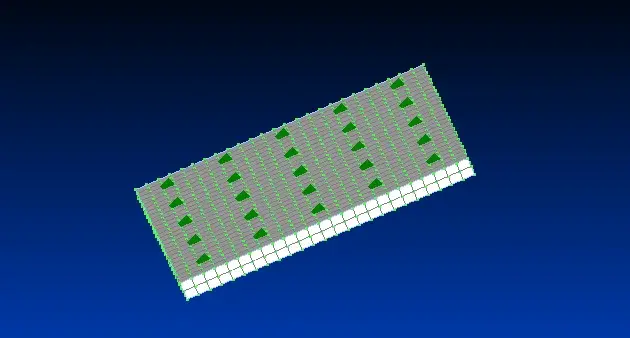
I have a plate with a thickness and I loaded with a thermal surface load the upper face. (with this load I would like to simulate the heating of an infrared lamp).
At this point I would like to get a gradient similar to what you would get with the eq diff of fourier... My problem basically is to tie temp flow and time in one relationship.
 
I hope they're helpful
 

Attachments

  • Cattura1.webp
    Cattura1.webp
    31.6 KB · Views: 5
  • Cattura2.webp
    Cattura2.webp
    19.8 KB · Views: 5
if you have not forgotten anything in your description, you are with a body isolated in the empty space (which does not transmit heat unlike the real case air) that receives a power (in the form of heat flow) through a surface: You should even have infinite! On the contrary, you will never reach a stationary regime (the temperature you read is only that of the last calculation performed).
 
So how can I bring the model to the real case? What are the thermal constraints I have to impose?
I'm sorry, but I don't know where to go and see why I didn't find any tutorials.
 
Then: in principle you must simulate heat dissipation due to the convective effect of the air that laps the piece (usually in a first phase is negligible, but I do not see any other possible "ways" for the transmission of heat observing the cad model you have published).

I don't remember how femap defines this condition: it certainly allows you to specify an environmental t, but I don't know how it handles the "h" parameter for the heat exchange of this type.

Unfortunately, I cannot help you more precisely, not having the software available to give you "operative" information of detail. we hope you pass here some "current" user of femap :)
 
I solved the problem with a transient analysis as I had been suggested using ansys, if it were to serve I can send you the txt.
 

Forum statistics

Threads
44,997
Messages
339,767
Members
4
Latest member
ibt

Members online

No members online now.
ciao
Back
Top