• This forum is the machine-generated translation of www.cad3d.it/forum1 - the Italian design community. Several terms are not translated correctly.

heat transmission

  • Thread starter Thread starter stef_design
  • Start date Start date

stef_design

Guest
Hey, guys, I'm trying to do a thermal analysis with wb.
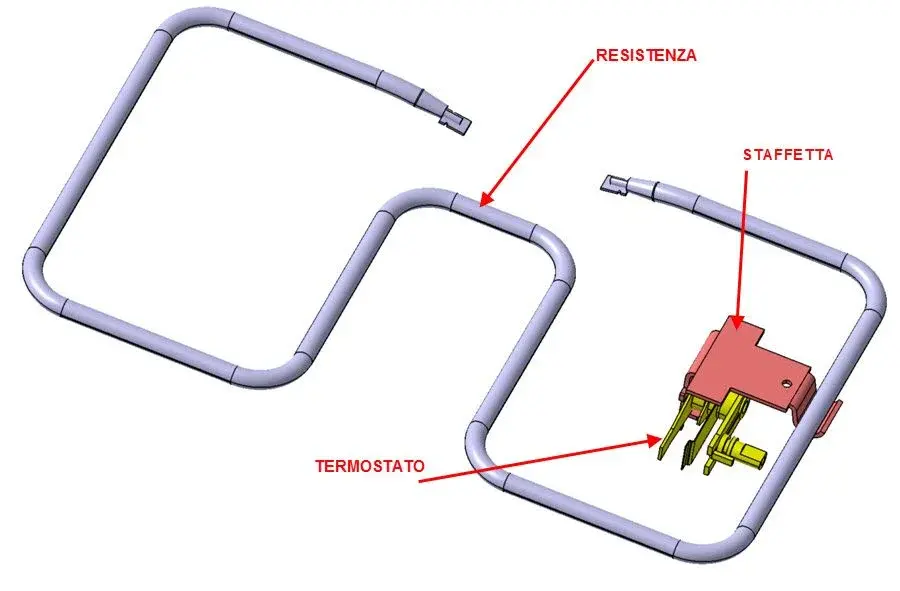
in practice I have a resistance ranging from 0 to 450°c.
near the resistance I have a bracket that supports a thermostat. the thermostat snaps at 220°c.
I wanted to know how long the 220°c is transmitted to the thermostat.
So I ask you for help?

In this way I wanted to change the geometry of the bracket to see how it affects the distribution of heat.
Thank you.
 

Attachments

  • assieme.webp
    assieme.webp
    30.2 KB · Views: 21
I tried to prove it.
So, I chose a transitional thermal analysis.
the procedure I followed is this:
proceed as follows:1-I went to "analysis settings";2-in "numero fasi" ho inserito 2 (2 loadstep)3-in the "current phase number" 1 I entered a final time of step number one of 1 second and "self time stepping" on off;
4-then I entered 2 in "current phase number". as final time I put 420 s (7minutes) and "automatic time stepping" as it is;
5-I clicked on the temperature condition that I gave to the resistance: at the bottom right of the screen in the tabellina with the analysis steps I assigned to phase 1 the temp of 0°c and phase 2 450°c.

At this point I launched the analysis.
I see, however, that the relay after 7 min it arrives at the temperature of 6°c while in reality it reaches about 200°c.
How come this difference?

I thank everyone who gives me a hand:redface:
 

Attachments

  • Ansys 11 WB.webp
    Ansys 11 WB.webp
    82.6 KB · Views: 15
mah, without having the model is that you can understand very much however your approach seems to me in a very correct line.... try to check the materials you are using and let us know.

Hi.

 
mah, without having the model is that you can understand very much however your approach seems to me in a very correct line.... try to check the materials you are using and let us know.

Hi.

If you place the file of ansys wb v.11 can you take a look at it?
 
If you put the file I try to take a look at us next week.
hi guys, I attach the model to ansys wb 11 and some pictures.
Thank you very much for your help.

materials are:
bracket: at 3003
resistance: aisi 304
resistance support: sheet metal
food plate: al

resistance starts from 0°c to 450°c
after about 7 min the thermostat, placed in the lower hole of the bracket (as from image), snaps at the temperature 220°c.

the goal is to simulate the heat transfer between resistance and bracket (termostat) and then, at a later time, act on the size of the thermostat door bracket to see how the heat transmission varies.

Thanks again.
stefano :smile:

this is the link where you can download the model wb11http://hotfile.com/dl/85535377/421bf75/assiemebasamento_tutto_03.rar.htmlthe images instead are attached in pdf
 

Attachments

Hello, stef.
I think the problem is in modeling, the analysis could also go even if I would put a constant temperature at first. Try to remove the shell...

Make us know,

 
Hello, stef.
I think the problem is in modeling, the analysis could also go even if I would put a constant temperature at first. Try to remove the shell...

Make us know,

to remove the shell what do you mean?
but why do you think the temperature stops at 20°C?
It's just a model problem. .you don't have to set another bond apart from temperature?
Thank you:
 
no according to me you have a problem on the model, try using a solid instead of the shell, you may have problems with contact. I haven't had a chance to look into the model. Let me know.

 
no according to me you have a problem on the model, try using a solid instead of the shell, you may have problems with contact. I haven't had a chance to look into the model. Let me know.

Sorry zaxx, but by shell what do you mean?
 
no according to me you have a problem on the model, try using a solid instead of the shell, you may have problems with contact. I haven't had a chance to look into the model. Let me know.

Okay, I get it. I withdraw the previous question.
but the shell is only the stamina support sheet, everything else is solid.
to this however I had given a value of the thickness (as from image).
 

Attachments

  • supporto resistenza.webp
    supporto resistenza.webp
    70.5 KB · Views: 4
I tried to do an analysis by suppressing the body with shell and the other large solid body (the food plate).
but the result does not change.
the temperature of the bracket is always around 20°c.
What I do not understand is that never increases from 0s to 420s. remains constant. :confused::confused
 

Attachments

  • temperatura.webp
    temperatura.webp
    67.5 KB · Views: 3
the speech is this, you in the properties of the various parts have a reference temperature that by default is 22°c, therefore in transitory regime all the bodies start from this temperature and change it according to the thermal loads. say that you test, put the convection coefficient for e.g. over the cooking plate and replace the temperature heat load with an internal heat generation. Let me know.

 
the speech is this, you in the properties of the various parts have a reference temperature that by default is 22°c, therefore in transitory regime all the bodies start from this temperature and change it according to the thermal loads. say that you test, put the convection coefficient for e.g. over the cooking plate and replace the temperature heat load with an internal heat generation. Let me know.

then, I first remodeled the shell and turned into solid. Now all parts are solid.
then:
1-I set a stationary thermal analysis (instead of transitory)
2-I entered a constraint by selecting the top face of the cooking plate. as a convention coefficient I selected simplified tin-case air (otherwise I don't know what to choose):redface:
3-I replaced the temperature load with a "generated internal thermal power". as module I selected tabular (time).
4-I launched the analysis, no error:confused:
I'll attach your pictures

a zaxx thing, did you get my e-mail on Wednesday 1?
If I send you the model you can quickly set me the correct parameters?
Thank you.
 

Attachments

  • 01.webp
    01.webp
    88.5 KB · Views: 4
  • 02.webp
    02.webp
    85.3 KB · Views: 3
  • 03.webp
    03.webp
    23.4 KB · Views: 5
perfect,
I'd say we found the solution!
in your model we found that in the thermal path there is a discontinuity.... the heat generated does not find a way of escape and therefore the temperature value rises infinitely and the sw stops....on what you do it! :

I would gladly give you a hand but over the time that scarcely me I also have a higher version of the sw and so I couldn't give you back the model.

 
perfect,
I'd say we found the solution!
in your model we found that in the thermal path there is a discontinuity.... the heat generated does not find a way of escape and therefore the temperature value rises infinitely and the sw stops....on what you do it! :
But excuse the way out is not on the sides? on the sides the model is open...it is not a closed box with the resistance inside.:confused:
So if I do an analysis with only resistance and bracket and nothing above,under,dx and sx, I come to convergence. .
otherwise how can I do it?
I would gladly give you a hand but over the time that scarcely me I also have a higher version of the sw and so I couldn't give you back the model.
What are you doing, 12.1?
 
stef,
we speak in terms of mathematical model and not of geometry....in practice there is a path between the generation of heat and the well (convection coefficient). In practice heat is generated somewhere, heat flows towards the convection coefficient through a series of thermal resistances that increase thermal gradients and achieve convergence. if this path is interrupted (e.g. there is a link between generator and convection coefficient) the temperature rises to the infinite and the problem does not converge. check the axieme and contacts (maybe delete them and do a unique part) you will see that the problems jump out.


p.s. I have 12.1, I am waiting for 13.
 
I made progress zaxx... I'm coming:finger:
I checked the contacts (as you advised me) and now the analysis converges:wink:

I made some changes though:
1 - I have always inserted a load of convection selecting the food plate and as "convective coefficient"I put on "simplified waterfall" (I hope it goes well);
2 - instead of an internal generation of heat I inserted a load of "temperature" applying it to resistance (from 0 to 450°C);
3 - I launched the analysis;
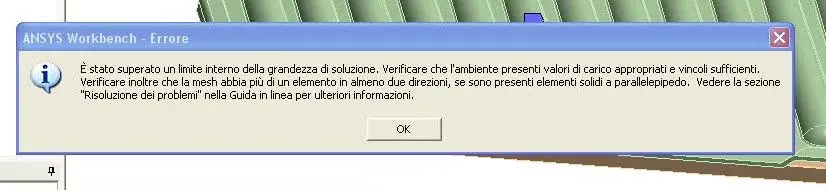
4 - now the solution converges with a error error (see image).

now the values are + close to reality. What do you think?
But I have a doubt. Shouldn't the resistance "sir" heat to the whole food plate homogeneously? because from the analysis it seems that the heat starts from a precise point (i.e. the count between bracket and plate).
Thank you:
 

Attachments

  • 1_convenzione.webp
    1_convenzione.webp
    133.6 KB · Views: 4
  • 2_temperatura.webp
    2_temperatura.webp
    126.6 KB · Views: 4
  • 4_ERRORE.webp
    4_ERRORE.webp
    12.5 KB · Views: 2
  • IMMAGINI TUTTE.pdf
    IMMAGINI TUTTE.pdf
    755.4 KB · Views: 2
  • 3_temperatura staffa.webp
    3_temperatura staffa.webp
    94.5 KB · Views: 5
This happens to you because the only contact you have is between the serpentine and the relay, and you obviously have no contact between the coil and the plate... check...

When you finish, I expect a Christmas present. :


Forum statistics

Threads
44,997
Messages
339,767
Members
4
Latest member
ibt

Members online

No members online now.
Back
Top