Polymar
Guest
Good evening,
are at grips with a reducer on which gears turn for cylindrical precision with parallel axles. and so far everything ok, if it was not for some uncertainty due to the correct, indeed better to say working, calculation of the interassis. I have had to apply the correction of interaxes with annexed the variation of the head and primitive diameters, and apart from this on numerous books, especially school books, I read that even in the case of the gears of this type, the calculation of the dilasse is equal to that with straight teeth, i=(z1+z2)*m/2.
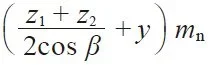
on the internet, downloading "academic" docs, it is written that in the helical i=m(z1+z2)/(2*cos(beta)), with beta that is obviously the angle of inclination of the helix. In my case, the entirety would pass from 81 to 82.5 mm, and being a detachment with m=3.75 (yes exactly, who preceded me years and years ago chose the modules later "vited"), this could be translated into an excessive game, synonymous with noise and early wear.
Would anyone advise me about this? I realize once again that school books say one thing, but then "to do well" things is another story. Thank you! ;-)
are at grips with a reducer on which gears turn for cylindrical precision with parallel axles. and so far everything ok, if it was not for some uncertainty due to the correct, indeed better to say working, calculation of the interassis. I have had to apply the correction of interaxes with annexed the variation of the head and primitive diameters, and apart from this on numerous books, especially school books, I read that even in the case of the gears of this type, the calculation of the dilasse is equal to that with straight teeth, i=(z1+z2)*m/2.
on the internet, downloading "academic" docs, it is written that in the helical i=m(z1+z2)/(2*cos(beta)), with beta that is obviously the angle of inclination of the helix. In my case, the entirety would pass from 81 to 82.5 mm, and being a detachment with m=3.75 (yes exactly, who preceded me years and years ago chose the modules later "vited"), this could be translated into an excessive game, synonymous with noise and early wear.
Would anyone advise me about this? I realize once again that school books say one thing, but then "to do well" things is another story. Thank you! ;-)