• This forum is the machine-generated translation of www.cad3d.it/forum1 - the Italian design community. Several terms are not translated correctly.

helical otium wheel

  • Thread starter Thread starter cacciatorino
  • Start date Start date
date the attached image:

the oziosa wheel sees a tooth of the wheel that tries to lift it (ft1), then tries to vent on the wheel driven by pushing it down. the wheel then reacts with a direct force upwards (ft2). It turns out we have both fts heading up or not?
It makes no sense to put two forces in the count points. each wheel will have an action and a reaction. The crazy wheel is acting as a motor in turn so if I want you to turn, I think there must be a couple. if you have ft concords turns nothing and the engaged teeth are forced to break.
 
It makes no sense to put two forces in the count points. each wheel will have an action and a reaction. The crazy wheel is acting as a motor in turn so if I want you to turn, I think there must be a couple. if you have ft concords turns nothing and the engaged teeth are forced to break.
If the two fts are "lightly different", you have rotation.
Hi.
 
Last edited:
It makes no sense to put two forces in the count points. each wheel will have an action and a reaction. The crazy wheel is acting as a motor in turn so if I want you to turn, I think there must be a couple. if you have ft concords turns nothing and the engaged teeth are forced to break.
No.
If the fts are equal and agree you have no acceleration. speed can be there, and it is independent from the forces in play.
to explain myself better, in a real case ft1 will be slightly greater than ft2, so also fa1 will be greater than fa2, but "greatly" speaking to me they cancel.

Hi.
Of course, because ft1 must compensate for the friction losses of the otium wheel. But let's talk about bazzecole.
 
No.
If the fts are equal and agree you have no acceleration. speed can be there, and it is independent from the forces in play.

Of course, because ft1 must compensate for the friction losses of the otium wheel. But let's talk about bazzecole.
In fact, if we ignore friction and acceleration the wheel turns without absorbing energy.....then rotation can also exist with the direct force in the opposite direction.
 
If the two fts are slightly different, you have rotation.

Hi.
which means engineeringically speaking "lightly different"?
I continue to reiterate that, regardless of the fact that the wheels have helical teeth, I can handle the wheels for simplicity as if they were straight teeth. I only take into consideration the wheel and the crazy wheel. the madman reacts to the motor with a direct force according to a certain direction (see the theory of toothed wheels...) and opposite to the one that solicits it. when it is the wheel system mad wheel led, always considering the reaction on the mad wheel, I find a force that is directed in the opposite direction to the previous one. if then the two forces have towards opposite. greetings
 
as I see it. in practice I agree with those who claim that the forces are agreed (but they create an opposite couple) and almost equal (unless the frictions to turn the mad wheel)
the forces I applied to the "fianchi" of the teeth are those that hear every single wheel
 

Attachments

  • schema.webp
    schema.webp
    15.5 KB · Views: 28
which means engineeringically speaking "lightly different"?
I continue to reiterate that, regardless of the fact that the wheels have helical teeth, I can handle the wheels for simplicity as if they were straight teeth. I only take into consideration the wheel and the crazy wheel. the madman reacts to the motor with a direct force according to a certain direction (see the theory of toothed wheels...) and opposite to the one that solicits it. when it is the wheel system mad wheel led, always considering the reaction on the mad wheel, I find a force that is directed in the opposite direction to the previous one. if then the two forces have towards opposite. greetings
When you isolate the second system, you also have to take into account that the wheel that has become a driving wheel, turns in the opposite direction.

Hi.
 
the usual problem of contact forces.
when so, the free body diagram is the solution!

as mentioned before, forces are agreed.

and we find ourselves, as mentioned before, that the wheels have speed and torque discords, those instead concords.
(in fact the work carried out by the driving wheel is positive (see the strength exercised by a su b), that of the conduct is negative)
 

Attachments

  • ruote.webp
    ruote.webp
    20.5 KB · Views: 34
For record, I'm not an engineer, I'm not even a expert, I'm just a "technical of the mechanical industry" that has been done in the field, so I'm not able to speak "engineering". :tongue:

Hi.
 
I'm sorry. all reactions (in pairs) are added.
I imagined the crazy wheel engaged before on the wheel and get reactions to the tooth.
then I rated the mad wheel engaged with the load wheel: I rotated the 180° load wheel on the axis of the crazy wheel leading it to the position that was of the wheel.
reactions overlap. I will have shot a minch...a:confused::tongue:
thinking about the only axial components I said a nice boiata, yes!
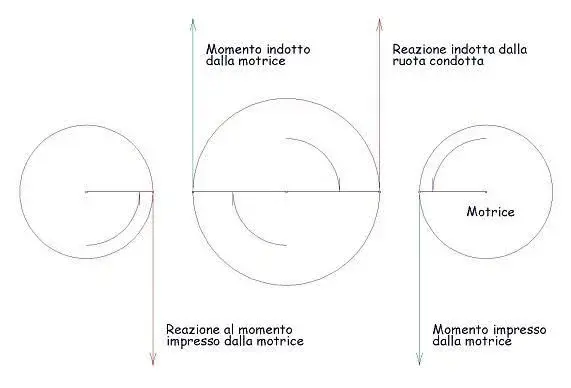
macroscopically if mm=mr the crazy wheel stands nice stop then ft1 and ft2 generate opposite pairs.
I've been misled by your little scheme:
 
I thank my colleagues for the interesting debate.

Next!
Hunting, don't do it anymore!
I joke of course, some rings always do well to keep the mind in training.


separating the bodies I find myself in agreement with your last approach and with that of lightning.
attachment.php
 

Attachments

  • AzioniReazioniOziosa.webp
    AzioniReazioniOziosa.webp
    13.6 KB · Views: 43

Forum statistics

Threads
44,997
Messages
339,767
Members
4
Latest member
ibt

Members online

No members online now.
Back
Top