
• This forum is the machine-generated translation of www.cad3d.it/forum1 - the Italian design community. Several terms are not translated correctly.

help for "calibration" solidworks with bending machine

Chryses

Guest
Good morning to all, I hope not to miss section.

for our company it is now time to realize developments in sheet metal as precisely as possible, but I do not think I can be able to reach us by myself, I therefore ask advice to those who have certainly already passed, to have straight or perhaps to address something "practical" and feasible.

We assume that something I know, just terms and a minimum of theory. in company we have an old bending machine and a 3d program (solidworks 2016), and as I said, now we begin to need more correct developments, not the classic 2 times thick!

I have a list of the thicknesses we normally use combined with the matrices to useMatrici.webpwhere
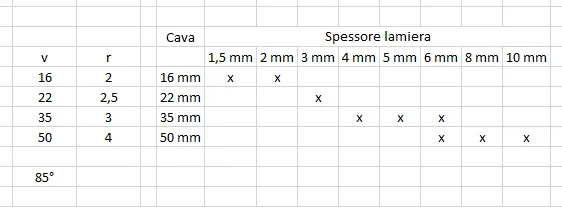
"v" is the available space of the matrix
"r" is the matrix background radius
85° is the angle between the 2 walls of the matrix

How should I proceed to "instruct" solidworks to the best and generate developments in line with our bending machine?
Perhaps the same solidworks, among its tables already has something that helps me, maybe instead it is better to create from 0 everything, I ask who is more experienced than me.

I thought I would use a bending deduction, making "coppers" of sheet (3 for each thickness and material we use) of a known size, then bend them to a x distance and measure directly the results, in this example "a" "b" "c"Deduzione.webpideas, opinions, advice?
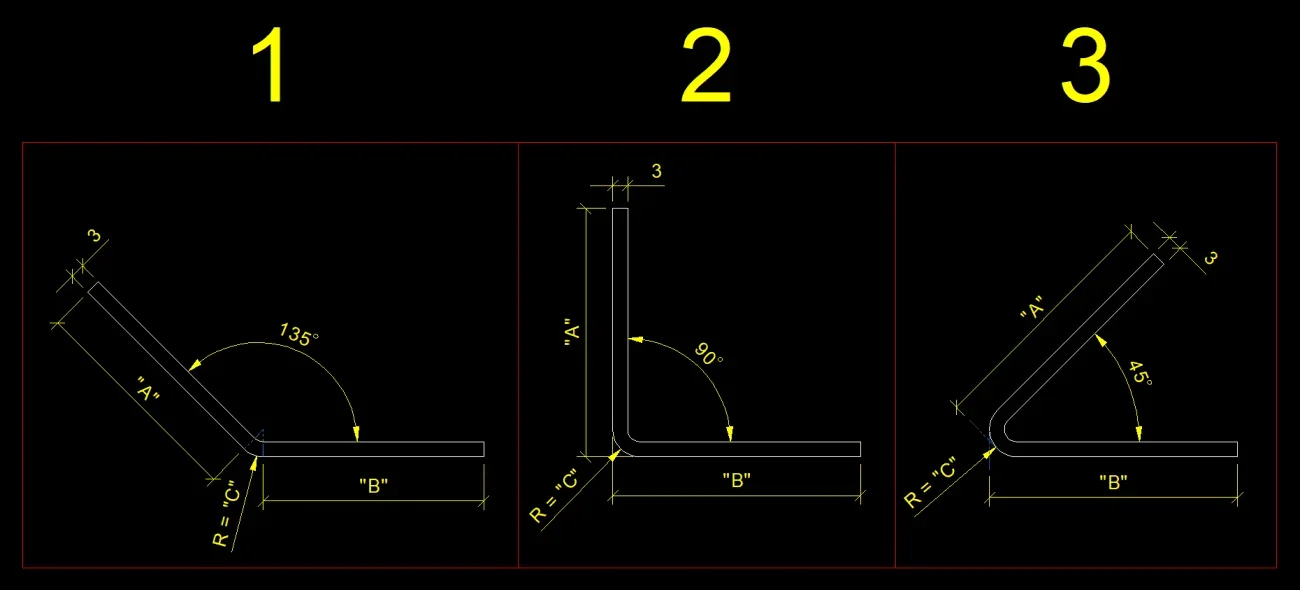
 
samples must be made to verify the withdrawal according to: material, fold radius, equipment
There is no different method to know the retreats because changing according to the above parameters. already the type of sheet of the same material changes the withdrawal even if slightly.
a piece in s275jr bent with quarry 35 ray 2 will have different development of the same piece bent at radius 3
a piece the bent with quarry 35 ray 2 in s275jr will have different development of the same piece in s£%jr or aisi204

found the development parameters then you can manage solidworks.
for folds at 90° can be used as a bending tolerance limit the bending deduction parameter in which the sp+sp-ritiro value is inserted or sp+sp+ extension; in this case the fold radius of the model is influential
for the folds different from 90° it is advisable to use the factor k keeping in mind that the bending radius of the model is very important
the other methods of bending tolerance I have never tried them
 
I now realize some typing errors and unclear passages.
correct them in red for better understanding
there is no different method to know the retreats e allungamenti because change depending on the parameters
a piece bent with quarry 35 ray 2 in s275jr will have different development of the same piece in s355jr o aisi304
for 90° folds can be used in the sheet function in the option bending tolerance limit the bending deduction parameter
for the folds different from 90° it is advisable to use the factor k keeping in mind that the fold radius of the model is very important; the factor k is obtained by making a bend to 90,° of which is easily deducible development, and setting the value k until reaching the ideal development
 
Hello, thank you for the answer.
in what little I know, I knew that different materials and different thicknesses, generate different ks, and to be lazy, even different material matches can generate different k values, just for the various differences ...
Let us say that in my case, having correct developments in the order of 1mm would already be a good conquest, given the method by which they were made until now!

you write to me that for the folds to 90° you can use the parameter of deduction of fold, while for the other folds I recommend to get k, where k itself is obtained starting from a fold to 90°.
so my question is, do you not want to calculate k directly, or risk making some mistakes?

I found material around explaining how to get k based on the equipment used, do you recommend any article/guide in particular? I don't want to influence the answers by putting what I found.

 
you can also always use factor k.
I prefer to use it only on the folds different from 90° because I often work on external files that typically have rays=thickness and modify the rays is a peeling, both because the deduction is more precise since the factor k inevitably carries values with very decimal and I like to have a more precise control possible.
If your accuracy range is +/-1 then always use the k factor; make samples with different angles and check that it is correct.
attentive to the closed folds and to the rolling. in the first k factor is not good while in the second k factor is always 0.5

I have no documentation on these things because they are the result of internal specifications, which I cannot and would not make sense to attach here, and oral knowledge of colleagues and bendingrs.
if you have material available share
 
Of course, recovery and I can share what I have, it's files found here and which explain some theory and practice.
as you say too, in the folds at 90° is "easy" the deduction of fold, which I hope will lead to a correct k, even in case of different folds, is precisely the need to have folds different from the classic 90° that pushing to a calibration.
having a k with so many decimals, would not be a problem, once set the cad.
so you recommend using k as a final method? always take into account that if I have to test and configure everything, so much it is worth doing it with the most correct and precise method, at least this is my thinking.
with closed folds what do you suggest? by memory I did not find discriminating for such folds on factor k, what do you know about it?
 
My needs arise from the fact that I work in a tertiary company that produces projects made by others; this means that the designs or models do not reflect our equipment and the folded elements almost always have the classic internal radius equal to the thickness.
If I have a particular with 3/4 folds at 90° it is more convenient to use bending deduction, which does not take into account the radius, instead of changing all rays.
if instead I have folds different from 90° I modify the rays and use the factor k; in this case the final result need of the defeat of the modification.
So I don't recommend anything because I don't know your needs. If you do internal design and production you can already model with the correct parameters and then you could always use the k factor.
 
You're right, I didn't specify the industry.
we do not do third-party processing, we produce all of us with our equipment.
the simplest developments are made by the plasma operator using logitrace, while the slightly more complex ones are managed by the technical office, directly by the particular 3d.

 
premise; for withdrawal and elongation I mean deformation during the fold therefore a particular that withdraws will have to have a longer development of the sum of the internal sides and one that stretches will have to have the shorter development (eg: if I have a particular with internal side of 97 and withdrawal of 0.5 on the fold my development will have to be longer than 97+97+0.5 and that is 194.5)

Now it comes to mind that the k factor creates problems when in the bending phase you have stretching instead of retiring. stupidly I thought, I think I also asserted it in the forum, which considering that the factor k 0.5 is understood in half sheet thickness a lower value was worth for the withdrawal and a higher for the stretching... bhé I thought/write a colossal boiata. you have a little stretch approaching to k=0
at the moment I have not found a solution; what blocks me in the research is to know the correct terms for the collection and extension of the sheet, in the mechanical field of course, in English.
 
from what I found and am using, I am able to get the k factor relative to the equipment present in company. just bend to 90° a piece of sheet of which is known the length, to obtain k.
k, however, from the formula I am using, depends only on the thickness and measurements obtained from the folded piece, therefore I am not sure on folds different from 90°.
definitely k changes, being the relationship between the thickness and the neutral axis, in a fold of 10° it is not possible to think that the deformation, then the shift of the neutral axis is equal in a fold to 90° and to 10°
I keep looking for information about how to "calibrate" our equipment with the 3d program
 
I do carpentry and have a bending machine with a sw on board for the calculation of development.
as much as it helps, if you want precision you will always have to check with a sheet of sheet taken from the sheet you use, and that the fiber is turned in the same direction both for the test and for the piece to be done. It is enough to change the production lot (and for sheets of poor quality, also the sheet area) to have different results. It's always a bit of a lot tern.
 

Forum statistics

Threads
44,997
Messages
339,767
Members
4
Latest member
ibt

Members online

No members online now.
Back
Top