• This forum is the machine-generated translation of www.cad3d.it/forum1 - the Italian design community. Several terms are not translated correctly.

his surface

  • Thread starter Thread starter IronMike87
  • Start date Start date

IronMike87

Guest
Good morning to all,
due to failure of a machine in the control room I find in the need to find a way to control the location of a hole filling profile.
generally this is not a big problem: a nominal ø ball rests on the hole, and the top of the ball is controlled compared to a reference on the same axis.

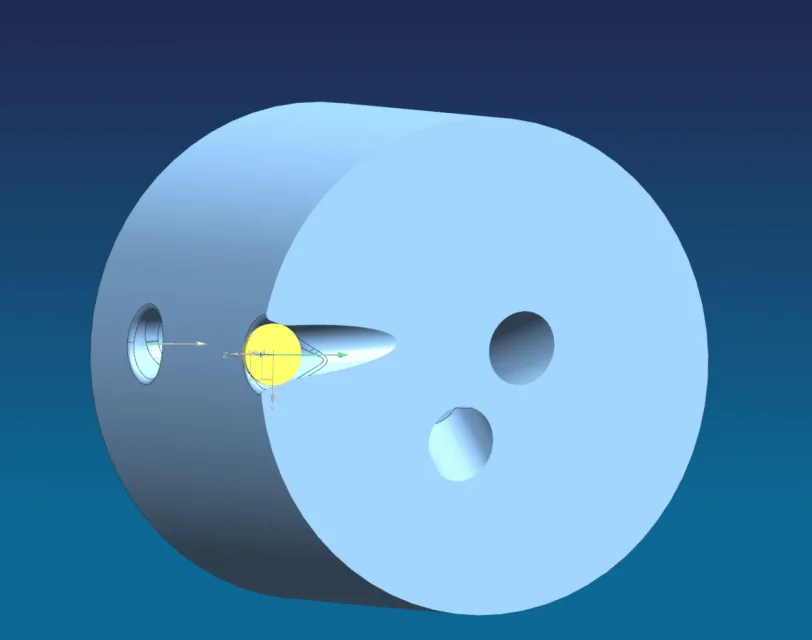
the problem in this case is the shape of the hole (image attached below).
There is a conical part that is worked on a sloping axis other than that of the cylindrical hole.
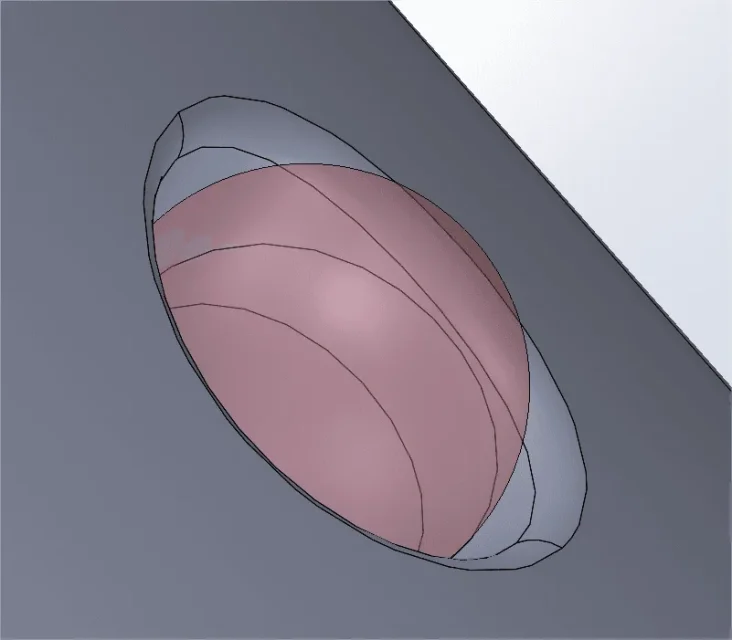
I tried to "insert" a ø4 sphere but I can't make sure to put it in contact on the whole surface. I always find myself in terms of interconnection or contact in only 2 points.

Any idea? I hope I've been quite clear. . .

attached also a model extract

1542870408208.webp
 

Attachments

is quite clear, but can you do a section to make the speech more understandable?
which would be the second reference to be used to obtain the measure?
 
Let's say that I solved ... abandoning all ties to rebuild geometry as a customer design. I just acted on 3d


I created spheres ø4.5 mm
selecting the conical surface I generated the axis of the same
I put the axis of the sphere and the surface of the hills, and then I set the tangence of the surface of the sphere to that of the conical tract

I see an interconnection of the "uniform" parts on the whole sphere profile... so I expect it to be just a graphic bug. I am comforted that in the field 2d all odds combine and are equal among themselves
@massi: I should post a greater section of the component and I have "fear" given the confidentiality of the component
1542900451320.webp
1542900325178.webp
 
Let's say that I solved ... abandoning all ties to rebuild geometry as a customer design. I just acted on 3d


I created spheres ø4.5 mm
selecting the conical surface I generated the axis of the same
I put the axis of the sphere and the surface of the hills, and then I set the tangence of the surface of the sphere to that of the conical tract

I see an interconnection of the "uniform" parts on the whole sphere profile... so I expect it to be just a graphic bug. I am comforted that in the field 2d all odds combine and are equal among themselves
@massi: I should post a greater section of the component and I have "fear" given the confidentiality of the component
View attachment 51638
View attachment 51637
I did the same thing while you posted your answer. Why the 4.5 ball? Wasn't it four?
coni.webp
 
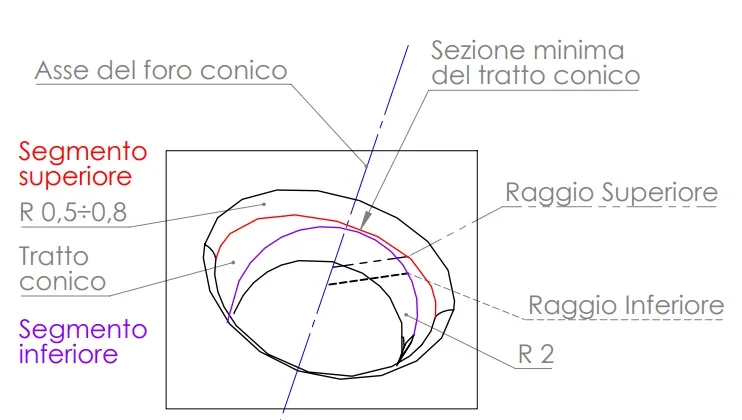
I realized that the 4 ball doesn't touch the whole surface. so I fear it can "fall" on one side, touch the ray part r2 below and fake reading ...
:

while "theoretically" the bigger ball should intercept all the conical tract


below ø4 ball placed in the same hole of the previous image

1542901720970.webp
 
but why don't you all use online autodesk viewers?
because at work I can't download anything, or a file or a program (of which I wouldn't deny anything since I open iges with solidworks)
 
I try to say the evening mouthpiece (in attachment the file with my proof).
If you put, in reality, a 4.5 ball in each case will be tangent to the bevel and will always have that position. measuring with the caliber from the tangency of the ball to the opposite tangency you will have your feedback value.
if it is so in solid you create a plan that cuts in two the bevel and create your sphere. if it is not so I go back mooring in the rear
 

Attachments

In the end, as I did not come to a solution that would really convince me I gave myself to empirism.

the conical section intersecting with that cylindrical hole, obviously has a variable section. the problem is in fact to intercept the "minimum" section with a nominal ø sphere.
I am armed with patience, sketch 3d and convert profile

as from image below I converted the 2 curves that border to the conical surface. I created the conical hole axis, set 2 parallel straights between them, lying on the same floor and perpendicular to the axis. Then I made sure that the ends of the same lay one on the axis of the hole and the other on the delimitation profile of the conical part.
then, in manina, I reduced the distance of the two straights until I arrived at a distance below which the program generated error and geometry impossible to recreate.
at that point, simply by clicking on the 2 straights you can get the distance axis-profile of delimitation that in fact gives me, as information, what is the minimum/maximum range of the sphere able to intercept the conical profile in its section minimum, and therefore in fact on all its profile.
moral of the fairy tale, in the worst condition I have a radius ball rmin 2,158mm and rmax 2,184mm.... and all the thousandths I'm not numbering.

These calculations, which to think about well perhaps were the thing to do in the first instance, have blown out as in fact the controls that we carried out with the ø4 and ø4,5 spheres were wrong.
the ball ø4 Falls in to the conical hole without ever fully intercepting all to its surface. in the section minor I expect, therefore, to contact the radius r2 below
the ball ø4,5 is too big Stay outside and therefore I expect that in the lower section contact the r0.5 radius on the surface

as a dicon of Americans: the more you knowthis obviously without taking into account all the accumulable errors in processing :unsures:


also to feel the assistance of sw does not exist in fact a function that automatically generates/calculates the minimum distance between 2 straights built as I described
or that allows me to calculate the min/max size of a solid that goes into contact on a surface without intermingling it.

If anyone has any solution, I would be very curious about it.

In fact, I would need a command "gravity"that I fall into the hole, let it be laid in a position where it blocks itself, and let me quote it:
1543182432548.webp
 
In the end, as I did not come to a solution that would really convince me I gave myself to empirism.

the conical section intersecting with that cylindrical hole, obviously has a variable section. the problem is in fact to intercept the "minimum" section with a nominal ø sphere.
I am armed with patience, sketch 3d and convert profile

as from image below I converted the 2 curves that border to the conical surface. I created the conical hole axis, set 2 parallel straights between them, lying on the same floor and perpendicular to the axis. Then I made sure that the ends of the same lay one on the axis of the hole and the other on the delimitation profile of the conical part.
then, in manina, I reduced the distance of the two straights until I arrived at a distance below which the program generated error and geometry impossible to recreate.
at that point, simply by clicking on the 2 straights you can get the distance axis-profile of delimitation that in fact gives me, as information, what is the minimum/maximum range of the sphere able to intercept the conical profile in its section minimum, and therefore in fact on all its profile.
moral of the fairy tale, in the worst condition I have a radius ball rmin 2,158mm and rmax 2,184mm.... and all the thousandths I'm not numbering.

These calculations, which to think about well perhaps were the thing to do in the first instance, have blown out as in fact the controls that we carried out with the ø4 and ø4,5 spheres were wrong.
the ball ø4 Falls in to the conical hole without ever fully intercepting all to its surface. in the section minor I expect, therefore, to contact the radius r2 below
the ball ø4,5 is too big Stay outside and therefore I expect that in the lower section contact the r0.5 radius on the surface

as a dicon of Americans: the more you knowthis obviously without taking into account all the accumulable errors in processing :unsures:


also to feel the assistance of sw does not exist in fact a function that automatically generates/calculates the minimum distance between 2 straights built as I described
or that allows me to calculate the min/max size of a solid that goes into contact on a surface without intermingling it.

If anyone has any solution, I would be very curious about it.

In fact, I would need a command "gravity"that I fall into the hole, let it be laid in a position where it blocks itself, and let me quote it:
View attachment 51676
I attach step files with solids, strings, segments and solution points I had described in my first post.
It is true that the sphere d=4mm does not touch the whole surface but it is equally true that the intersection of the two surfaces is constituted by an arc of amplitude greater than the 180° for which the sphere can never fall inside.
Hi.fori.webp
 

Attachments

If I understand correctly, you want to find the diameter of a ball that pores along a closed path inside the conical workmanship in the piece you attached.

to me it seems that this sphere does not exist. I have proceeded in this way:

I first found the axis of conical processing, then I built an ordinary plan that contained this axis.

on this floor I projected the closed profile of the upper edge of conical processing. I then traced a straight perpendicular to the axis of processing and tangent to the curve projected at its lower point. the sphere must necessarily be tangent on a plane containing this last straight, or on any other floor more internal in the piece.

on the same floor as before I projected the closed profile of the lower edge of conical processing. I then traced a straight perpendicular to the axis of processing and tangent to the curve projected at its top point. the sphere must necessarily be tangent on a plane containing this last straight, or on any other plane outside the piece.

to me it turns out that the second straight is more external than the first and that consequently there is no complete tangency plan of a sphere to that surface.
Fori.webp
 
Last edited by a moderator:

Forum statistics

Threads
44,997
Messages
339,767
Members
4
Latest member
ibt

Members online

No members online now.
Back
Top