• This forum is the machine-generated translation of www.cad3d.it/forum1 - the Italian design community. Several terms are not translated correctly.

hydraulic question

  • Thread starter Thread starter czar
  • Start date Start date

czar

Guest
hi, I ask you how you would solve this type of problem:
I have a tub in which it works immersed a pump that lifts the liquid, the tub has three depths, one on which the pump is rested and its aspiration, a slightly higher than the bottom on which the pump is rested and a much lower.
at the level of the liquid, the most basic part remains isolated and the liquid is obviously not lifted.
assuming that I can't move the suction of the pump into the deepest part of the tank, is there a physical principle that allows to "connect" the most basic part to that where the pump works and then completely empty the tank?
 
hi, I ask you how you would solve this type of problem:
I have a tub in which it works immersed a pump that lifts the liquid, the tub has three depths, one on which the pump is rested and its aspiration, a slightly higher than the bottom on which the pump is rested and a much lower.
at the level of the liquid, the most basic part remains isolated and the liquid is obviously not lifted.
assuming that I can't move the suction of the pump into the deepest part of the tank, is there a physical principle that allows to "connect" the most basic part to that where the pump works and then completely empty the tank?
It depends on how deep the tub is and what liquid you're treating. If you prolong the suction tube to the bottom of the tank, you could do it, while leaving the pump lifted, provided that when you turn on the pump this tube is already full of liquid.
 
you do not understand where the pump is located, compared to the three bottoms of the tank.
your assumption then, eliminate your question, unless you can turn the tub.
to make sure that by starting the pump, start the fishing, it is necessary to insert immediately after the fishing filter, in vertical position, a non-return valve, which at pump off blocks the liquid inside the tube and allows the repair.
 
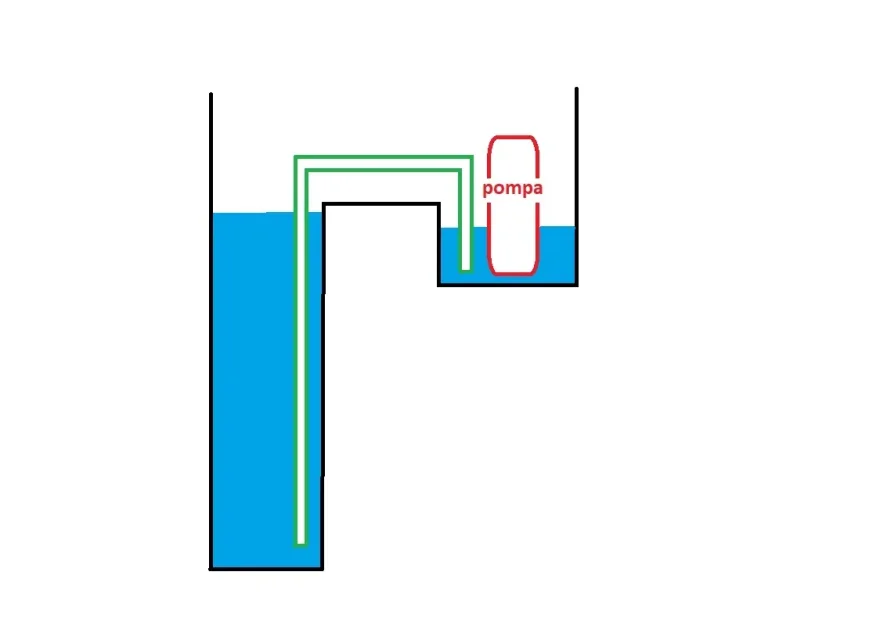
I try to schematize: to the left the most basic part, to the center the less base part, to the right the part in the middle between the more founded and less founded one and in which lies the aspiration of the pump. the level lowering leaves the left part isolated.
the liquid we simplify that it is water. But it's gasoline.
we are in a context made of small spaces, a few liter. small, those of a fuel pump.
what I can't do is use another machine or bypass the problem from the outside.
What I seek is a principle that helps to drain the part that remains isolated, but nothing comes to mind.
 
as suggested by hunter, add a tube in front of the pump aspiration and drown it at the deepest point. Usually pumps manage to fish from lower than the official aspiration.
but you are talking about small spaces and tiny courses: Are you sure you have enough space to add a suction tube? and, above all, that the pipe will stay down without floating?
from what you write to me seems to me the reservoir of some garden machine so I would think of a more practical solution: disconnect the tank from its housing and tilt it into a position more suitable for your purpose.
 
Write that you can't add other machines that make the solution very complicated.
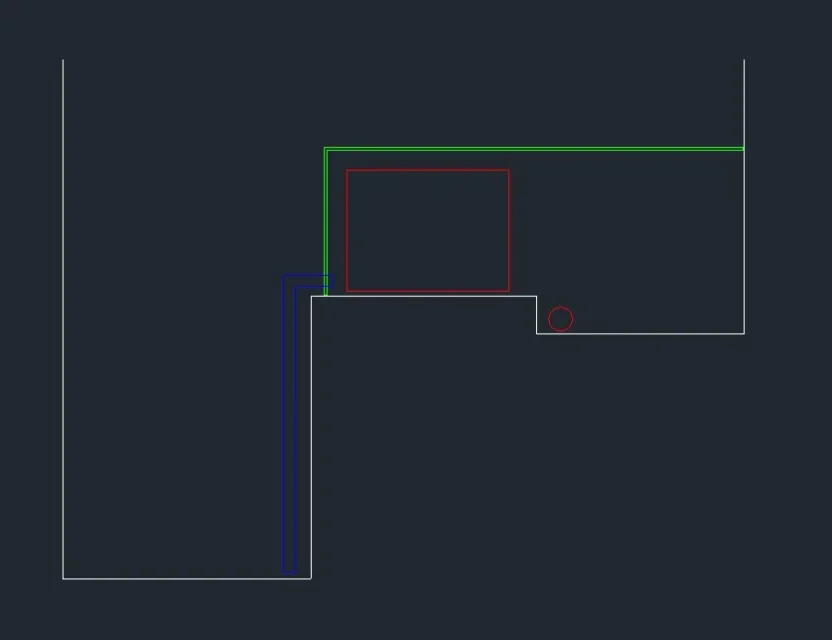
the only physical principle that comes to mind would only work if you could hermetically isolate the vacuum zone (green) and add a tube that goes fishing from the bottom (blue).
However, this system would prevent the isolated area from filling itself with fuel if it does not provide appropriately studied openings.
I attach a schematic
 

Attachments

  • schema aspiraggio.webp
    schema aspiraggio.webp
    2.6 KB · Views: 27
It is a fuel tank, the position of the pump can not be moved and the solution to bring the aspiration in the deepest area is the most intuition but provides invasive changes.
I stayed on the generic in the initial message not to induce easy reasoning. to understand me I have documented how the trees trace the water up to 50 meters high or more that can reach, I imagined I can extend the filter to the base of the pump up to the deep area or find something that has the property of being able to exploit the surface tension of the liquid that added to the vacuum in aspiration can for capillary rise in the filter. Boh...
 
apparently I didn't go far away with the story of exploiting the surface tension and there is also who patented it:
 
by stupid: we put a fixed tube starting from the pump zone (the intermediate one) to the bottom one.
aspirit from that bottom.
when the first is "island", the effect "damigiana" (communicating flows) should bring the liquid to the bottom, from which you aspire.
If I have understood wrong, I ask
 
you have understood well but as intervention presents not few criticalities. there is who has already developed it and has had to cope with problems of fixing of the pick-up that should not wander for the tank, they have served of a magnet that along with a metal plate outside the tank (plastic) keeps the pick-up that is surrounded by sponge always in order to hold in place.
If the pump is to be dry, the pump must be manually re-adjusted and, however, empty the tube section from the air does not bring luck to the pump and plant (injection).
the solution of the shaped filter brilliantly solves the problem, you can drain satisfactorily each tank meander, with a really effective principle.
The loser is that it is patented and that costs like a war.
 
It depends on how deep the tub is and what liquid you're treating. If you prolong the suction tube to the bottom of the tank, you could do it, while leaving the pump lifted, provided that when you turn on the pump this tube is already full of liquid.
not necessarily if you use a self-adhesive pump.
However, the firmness of installing a bottom valve so that the baiting transient (or self-adhesion) is as short as possible is commonly used.
remains to be evaluated also that the npsh of the pump is suitable for the application requested.
 
you have understood well but as intervention presents not few criticalities. there is who has already developed it and has had to cope with problems of fixing of the pick-up that should not wander for the tank, they have served of a magnet that along with a metal plate outside the tank (plastic) keeps the pick-up that is surrounded by sponge always in order to hold in place.
If the pump is to be dry, the pump must be manually re-adjusted and, however, empty the tube section from the air does not bring luck to the pump and plant (injection).
the solution of the shaped filter brilliantly solves the problem, you can drain satisfactorily each tank meander, with a really effective principle.
The loser is that it is patented and that costs like a war.
but what size of the tank is it?
and what kind of liquid is it?
 
It's written more on: motorcycle tank. Gasoline.
but I do not think there is much to add to the discussion, as I had anticipated the obvious solutions from standard hydraulics I did not care and I was looking for something that exploited a physical principle, something I had intuited and apparently exists, works and was created specifically for fuel tanks. Checkmate.
 
then this mad shot, of a principle of physics, simple and inexpensive,
It cannot be that this:
a curved tube that from the bottom of the middle compartment, overrides the upper compartment and reaches the bottom of the lower compartment.
when filling, also this tube fills, as soon as you release the lower exit, without needing to aspire, the pipe discharges all the liquid that can collect with the upper entrance.
I recently bottled the wine by dumping it with curved rubber, from a damigiana to a higher level, here I had to aspire to fill the tube.
 
when filling, also this tube fills, as soon as you release the lower exit, without needing to aspire, the pipe discharges all the liquid that can collect with the upper entrance.
I recently bottled the wine by dumping it with curved rubber, from a damigiana to a higher level, here I had to aspire to fill the tube.
I also used the example damigiana :-)
 
@marco: I have schematized the situation with the tube that you propose if I have well understood. the bottle and the damigiana exploit the principle of rarefaction that previews a decrease of the internal pressure to the tube (ciucciando) and the target container must then be placed lower to exploit then the principle of the communicating vessels, is not my case.
said this, with the scheme that I find myself, I have serious doubts that you can get a sufficient pressure drop around the pump aspiration and then tube to trigger the rarefaction and however to pump off (i.e. stopping the engine, which obviously can happen if one decides to stop) the tube would vanish completely because of gravity and there would be no way to reactivate the whole.
correct me if I say bad

p.s. as already written, connect the aspiration of the pump to a tube that moves the aspiration into the bottom part, in addition to being an obvious and already developed system, presents slightly appreciated contraindications, and is for what I was looking for something different.
 

Attachments

  • 1.webp
    1.webp
    5.8 KB · Views: 9
@marco: I have schematized the situation with the tube that you propose if I have well understood. the bottle and the damigiana exploit the principle of rarefaction that previews a decrease of the internal pressure to the tube (ciucciando) and the target container must then be placed lower to exploit then the principle of the communicating vessels, is not my case.
said this, with the scheme that I find myself, I have serious doubts that you can get a sufficient pressure drop around the pump aspiration and then tube to trigger the rarefaction and however to pump off (i.e. stopping the engine, which obviously can happen if one decides to stop) the tube would vanish completely because of gravity and there would be no way to reactivate the whole.
correct me if I say bad

p.s. as already written, connect the aspiration of the pump to a tube that moves the aspiration into the bottom part, in addition to being an obvious and already developed system, presents slightly appreciated contraindications, and is for what I was looking for something different.
but the pump must aspire from the deepest compartment and has no connection with the tube.
then there is no rarefaction but simply a leveling of pressure, when you discover the bottom of the tube, so the liquid upstream, climbs on the tube and descends down where the pump fishes.
then in your design, you just have to move the pump to the left and pump where the tray is deeper.
 
copy-neck from my first message:

" assuming that I can't move the pump aspiration to the bottom of the tank"
 

Forum statistics

Threads
44,997
Messages
339,767
Members
4
Latest member
ibt

Members online

No members online now.
Back
Top