• This forum is the machine-generated translation of www.cad3d.it/forum1 - the Italian design community. Several terms are not translated correctly.

hypermill help

  • Thread starter Thread starter olibass2011
  • Start date Start date

olibass2011

Guest
hi guys, I'm a designer in a metalmechanical firm, I ask you a help to build a hypermill learning base. in fact my company has just bought 2 licenses, unfortunately it is only using my partner of the other department because it was the only one to do the course while I was traveling abroad. In reality I should do the course in the next few months only that having hypermill already installed on my pc does not give me peace...:redface: ... until now I can import the piece to fresare and to recall the raw piece, I forgot use solid edge as cad. I just want to make a small processing View attachment pezzo.rarI'll coach you.
thanks for your answers.
 
thank you wilson for having responded. . .
In fact, I used the manual that I think will be more useful after the communque course I managed to perform an existing processing made by a colleague of another department... only that I can't do a simple processing starting from 0 . :confused: i.e.:
until now I have been able to insert the milling piece - to identify the rough - to identify the working surface - to create the type of tool - to select the type of processing. . but I see that it is not enough to perform the processing... and I remain in total darkness :frown:

Thank you again... you were very kind
Thank you again wilson.. .
 
hi, I just looked at the file you posted and at first glance I would say that there is no difficulty in deciding the processing strategy. Leaving aside some decisive details such as the material and type of the cutters you have available, you start with a cylindrical roughing leaving a metal over of 1/2 mm. then do a zero-cutting for floors with a finishing cylindrical to complete the areas parallel to the base. follows the profiling from 0 to 47° for the surfaces that, indicating, see from above but are not "ripid". In fact, you will work with a constant z. to finish you take a shot of all those surfaces that have a radius below that of the spherical used for profiling.

Note that the pdf/chm manual that you find in the hm folder is not a guide to use as a reference to illustrate all those items that appear in the processing cards. so to learn you need to try and try again, in these cases experience is decisive for having praiseworthy results.
 
hi, I just looked at the file you posted and at first glance I would say that there is no difficulty in deciding the processing strategy. Leaving aside some decisive details such as the material and type of the cutters you have available, you start with a cylindrical roughing leaving a metal over of 1/2 mm. then do a zero-cutting for floors with a finishing cylindrical to complete the areas parallel to the base. follows the profiling from 0 to 47° for the surfaces that, indicating, see from above but are not "ripid". In fact, you will work with a constant z. to finish you take a shot of all those surfaces that have a radius below that of the spherical used for profiling.

Note that the pdf/chm manual that you find in the hm folder is not a guide to use as a reference to illustrate all those items that appear in the processing cards. so to learn you need to try and try again, in these cases experience is decisive for having praiseworthy results.
Hello polymar,
Thank you for your answer, I have already started to put my hands and I am getting excellent results even if they are still in the first steps. the only favor I can ask you without abusing your availability is to make a video or photos to complete your explanation on the work, if you want I can send you a parasolid file... Thank you for everything.
 
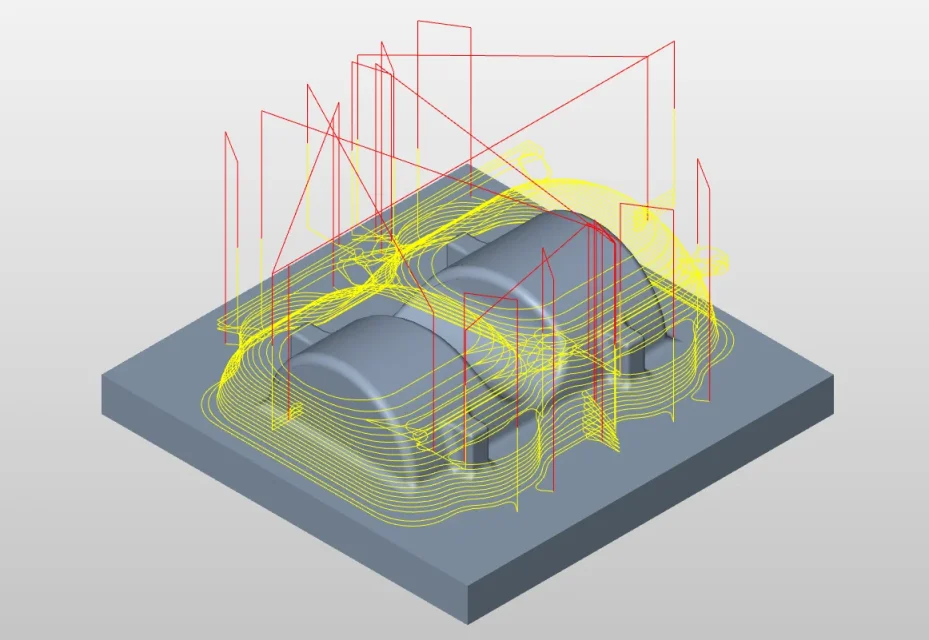
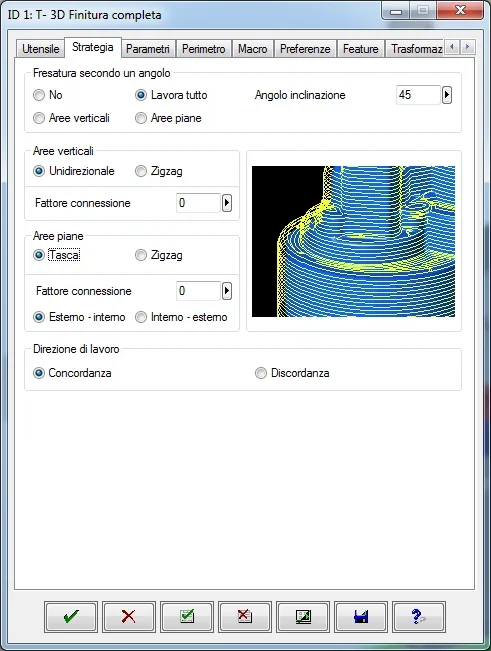
with hypercad I can do everything ... anyway you start with the typical roughness that I set up with the parameters you see from the screenshots getting the following results. based on the tools available and the material, it is logical that the parameters can greatly change, but what matters most is the processing strategy. tomorrow if I can place the next step.
 

Attachments

  • sgr0.webp
    sgr0.webp
    86.1 KB · Views: 31
  • sgr1.webp
    sgr1.webp
    34.5 KB · Views: 26
  • sgr2.webp
    sgr2.webp
    33.6 KB · Views: 22
  • sgr3.webp
    sgr3.webp
    33.3 KB · Views: 18
I would say that in this case with a complete finish using a spherical with reduced xy/z advances we can do everything else, although for flat areas a torica/cylindrical would be more sensible. In this case we could have made a 0 sgrossing for planes instead of a profiling. but as I said, the roads that can be covered are many, in the end the only discriminating is the time/quality ratio that inevitably determines the final cost of the piece.
 

Attachments

  • fin0.webp
    fin0.webp
    174.2 KB · Views: 14
  • fin1.webp
    fin1.webp
    39.5 KB · Views: 19
  • fin2.webp
    fin2.webp
    24.7 KB · Views: 17
  • fin3.webp
    fin3.webp
    27.5 KB · Views: 17
with hypercad I can do everything...
View attachment PEZZO.rarhello polymar, thank you very much for your commitment.
Now I'm doing a pretty hard work, I'll tie you the parasolid file
of the finished piece and of the turned piece, I would like to compare myself with you in a few days
on the types of work that on the times because the piece in question has been subject to discusion in my company
... I should start hypermill training and I think my purpose will be to reduce working time. . .
We'll be back when I'm done.
Thank you.
 
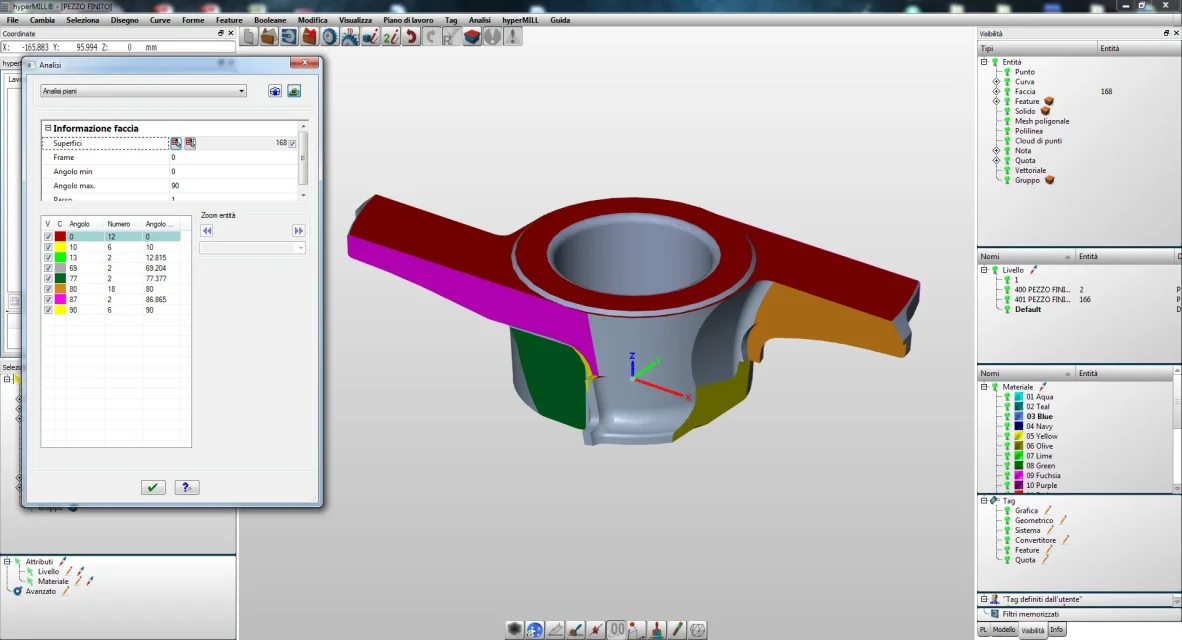
hi, I did an analysis of the piece you posted and I would say that it does not present particular difficulties, if anything could become rather articulated in the working sequences considering the need to set different frames, and especially in the perimeters to delimite the areas you go to work. doing some considerations of the minimum rays and especially of the angles, as from attached figures, you can choose to work on tip with a cylindrical planar faces, which then exclude from the profiling (supf of stop) when you go to do the profiling and the necessary shooting (to jump on a small spherical makes the times rise too much). Are the living edges voluntarily obtained or the result of the distraction of the designer?!? :) because in the first case, at the limit, you should also implement edge trajectories. Also in this piece the strategies that could be adopted are multiple, in relation to the usual factors of time/quality/preventive and brakes available, but unfortunately the hv report to me has not generated reliable times, indeed some totally ... out of normal :) is also very important the choice of the angles of work according to the extension of the perimeters that you will define, and eye to the collision control that must be activated. you know, the use of a prolong with a spherical of diameter 1 generates vibrations, and also with a ridge control of 0.001 and av. xy super reduced does not always generate smooth surfaces. Then comes the decisive factor, i.e. the car ... the secttimana prox, alleluja, I am on holiday in your region and I think I remain as much as possible:)
 

Attachments

  • asm.webp
    asm.webp
    73.8 KB · Views: 20
  • piani.webp
    piani.webp
    103.9 KB · Views: 18
  • raggi.webp
    raggi.webp
    108.2 KB · Views: 18
If you want alleluia I invite you first to my beautiful city if it will not be your destination then to dinner in a day of your choice... Today is my last day of work. Think about it and let me know.
Hi.
 
hi, I did an analysis of the piece you posted and I would say that it does not present particular difficulties, if anything could become rather articulated in the working sequences considering the need to set different frames, and especially in the perimeters to delimite the areas you go to work. doing some considerations of the minimum rays and especially of the angles, as from attached figures, you can choose to work on tip with a cylindrical planar faces, which then exclude from the profiling (supf of stop) when you go to do the profiling and the necessary shooting (to jump on a small spherical makes the times rise too much). Are the living edges voluntarily obtained or the result of the distraction of the designer?!? :) because in the first case, at the limit, you should also implement edge trajectories. Also in this piece the strategies that could be adopted are multiple, in relation to the usual factors of time/quality/preventive and brakes available, but unfortunately the hv report to me has not generated reliable times, indeed some totally ... out of normal :) is also very important the choice of the angles of work according to the extension of the perimeters that you will define, and eye to the collision control that must be activated. you know, the use of a prolong with a spherical of diameter 1 generates vibrations, and also with a ridge control of 0.001 and av. xy super reduced does not always generate smooth surfaces. Then comes the decisive factor, i.e. the car ... the secttimana prox, alleluja, I am on holiday in your region and I think I remain as much as possible:)
Hello polymar,
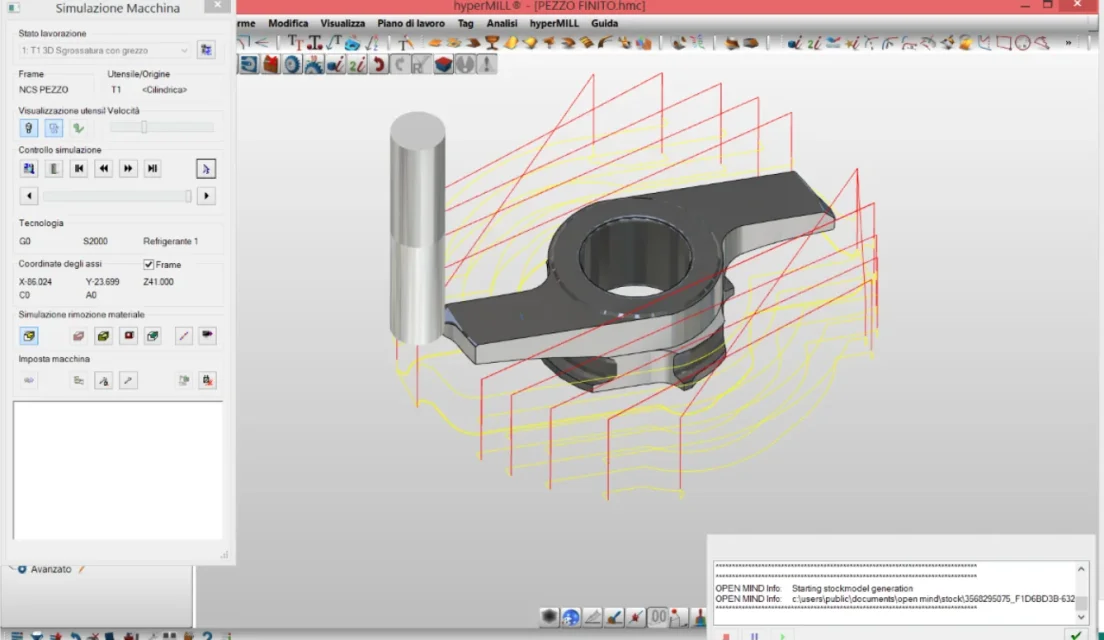
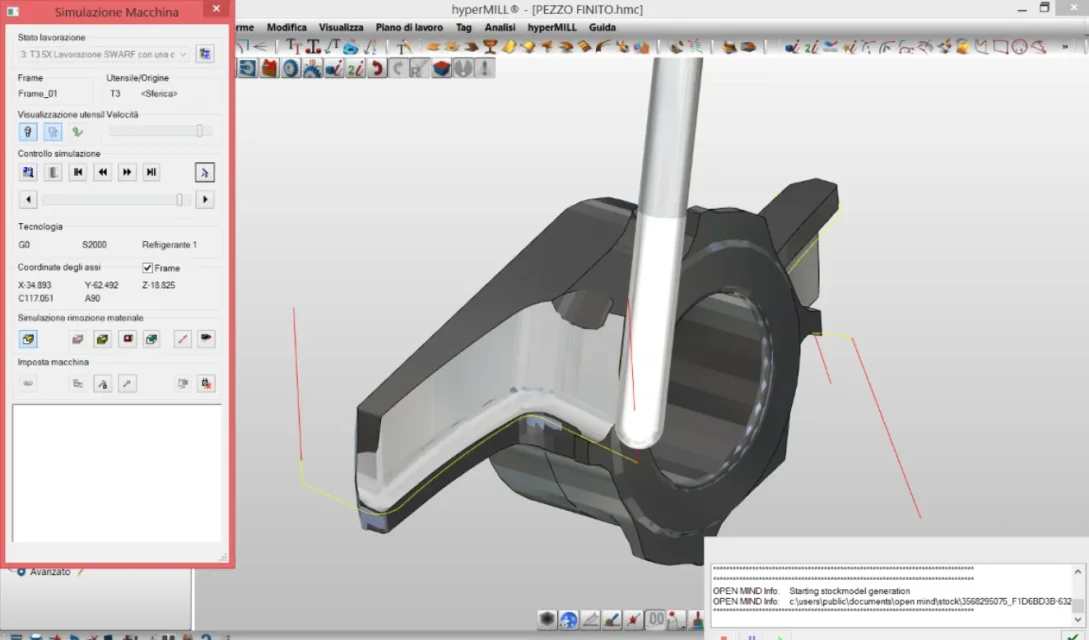
I'll send you photos of finished work... Remember I'm a beginner.
soon
 

Attachments

  • Immagine1.webp
    Immagine1.webp
    69.1 KB · Views: 22
  • Immagine2.webp
    Immagine2.webp
    54.2 KB · Views: 18
  • Immagine4.webp
    Immagine4.webp
    56.1 KB · Views: 17
  • Immagine5.webp
    Immagine5.webp
    57.7 KB · Views: 14
  • Immagine6.webp
    Immagine6.webp
    60 KB · Views: 16
  • Immagine7.webp
    Immagine7.webp
    59.2 KB · Views: 14
  • Immagine8.webp
    Immagine8.webp
    50.8 KB · Views: 13
  • Immagine9.webp
    Immagine9.webp
    61.5 KB · Views: 14
Hi.
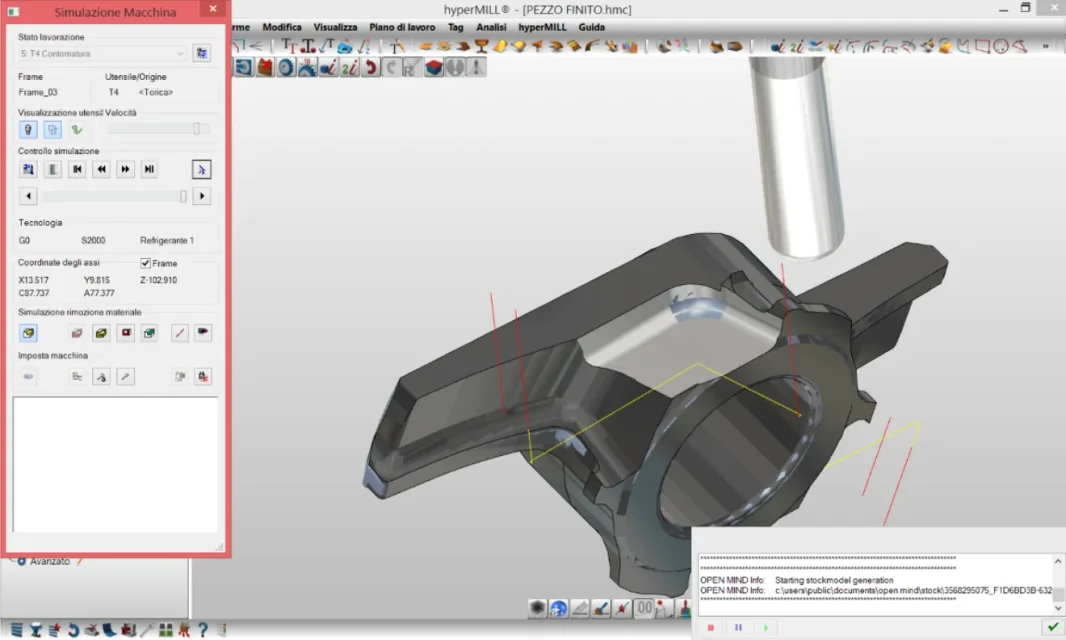
You don't have to feel you have to do anything, but I haven't done anything special so far. I know the territory of Marche quite well and for this year I will limit myself to the beach of sbdt where I already know several inhabitants of the place and some restaurants of my pleasure. but thanks to the invitation that may be made later;) but we come to the discussion of the processing: I press that from the images it is rather difficult to understand if how much you will do is the most correct choice in "technological" terms. beyond all processing parameters are never discounted to be assigned, indeed it is the experience that guides the best solution. But at first sight, if I have well interpreted the images, I have some doubts, some perplexity because except for the classic roughness (in it the parameters used are very important also to avoid an early wear of the tool), the constant z does not appear to me the best choice taking into account the geometry of the piece. and as it would have a radius of 1 max 2 mm, the times would be very long if you want to get a good surface finish. I see that you tend to use too much the 5x, which is not technically correct as the swarf function serves for an outline on walls having flat faces with different shapes, but in all other cases you proceed with a profile with a prefixed angle. in the latter case, you should not even worry too much about any faces with concave/convex corners. Remember that the 5x is slow and few post processors really work well as you see in hm simulation;) these cmq things will not be told even when you do hm courses as they are judged a business know-how and therefore... everyone does as they believe. but always watch the simulation of the residual material and unpack the 5x in different frames that you will use later with the shooting. and try to use as much as possible the same milling, since different processing with different cutters are very often obvious and make think of a laborious milling path that from a very dotty customer how much taccagno you will certainly be challenged... to save on the final price. knowing how to work on milling is a very complex and pleasant activity because you learn so many things, how it is true that it takes time to have a complete vision. Then good holidays!
 
the sadness of having declined my invitation will not make me forget the joy of having received your advice... :finger: I will treasure it.
besides being a good camista you are also a good rapporteur... I wish you good holidays! !
 

Forum statistics

Threads
44,997
Messages
339,767
Members
4
Latest member
ibt

Members online

No members online now.
Back
Top