• This forum is the machine-generated translation of www.cad3d.it/forum1 - the Italian design community. Several terms are not translated correctly.

infrared heating

  • Thread starter Thread starter Vittorio
  • Start date Start date

Vittorio

Guest
Good morning to all
I have a house built in the year 1978, the designer was far-sighted and all the perimeter walls have an air chamber of 8cm lined with rock wool.
complete with double-glass fixtures, radiator heating in cast iron, but of course a lot of thermal bridges that disperse the heat out.
I did not want to face the complicated bonus 110%, and I do not regret.. seen the swarms that have had people I know and that they are still in the high sea for lack of material.
I'm doing some research to break down energy costs looking for alternatives. years ago I put in a high-efficiency pellet fireplace that gave me a hand on savings.
aime... pellets had unjustified increases and from the average price of €4.5 for a lot of 15kg
today is sketched to €9.90
with these costs.. I think it is no longer convenient to use this renewable source and among ecological quotes.
So among my various research I focused on infrared heating.
My ignorance in this matter is abysmal.
I attach the link and if you can find some time to read, I would like to hear your opinion.
Thank you.
heating_infraredI also train videos
video1video2video3
 
as previously mentioned:
'the amount of thermal energy required to heat a room depends solely on its construction characteristics, i.e. its degree of isolation from the outside or the neighboring premises; such amount of energy is the same any emission system decides to install'.
this is 'almost' true, in the sense that, being the necessary power linearly dependent on the temperature difference between the internal air and the external air you must find that heating system for which the final data to be evaluated is the degree of well-being perceived by occupants in the considered space, that is the degree of thermal comfort. the useful tool for this purpose consists of the theoretical principles and methods of measurement for the forecasting of the thermal sensation perceived by people. the thermo-hygrometric environment is described through appropriate physical quantities.
You must also keep in mind the comfort depends on:
-air temperature
- radiant medium temperature of the surfaces that delimit the environment
- relative humidity of air
- air velocity
and it is from a suitable combination of the same that depends on comfort, so, since the power depends on the delta temperature, if you adopt a system that minimizes the temperature of the internal air you have an effective energy saving at equal conditions (superficies of the walls and thermal transmittance).
energy saving that, of course, does not prescind from the efficiency of the plant.
I should like to ask the Commission to take the necessary steps to ensure that the Commission is able to take the necessary measures. @vittori It has nothing to do with energy saving.
there would still be so much to say to frame the problem well for example by reading herefor these reasons do not convince me of the videos and the previous link.
 
given the technical possibility, you may proceed by installing a panel in a room, so you realize, in a practical way, consumption and proper operation, so that you don't throw away the money! if everything ok you can implement the system to the whole house! but in my opinion, unreliable condition is to have a photovoltaic system that allows you to access the public distribution network as little as possible, otherwise the game is not worth the candle.
 
Thank you very much for your interest.

In fact, a doubt came to me looking at the videos
It was enough to make a very simple test, i.e. turn on the panel and turn it towards the public to demonstrate the perception of well-being so chatted. but they did not:unsures:

I have to inform myself about the actual cost of these infrared panels, because the prices range from 200€ to 1700€, I hope there are reasons for these differences.
200€ I can even risk them, but they would turn me highly if it was a joke.

I agree that implementing with a photovoltaic is the best thing, but in my case there are several constraints to respect, including the paesagistico because my house is located near a creek of the cazxxx. and is part of a consortium territorial waters therefore.. She's lying.

and then I have the orientation of my roof that is not the maximum for photovoltaic panels, so I should make supports that cognize with environmental rules.
I mean... talk and talk to promote photovoltaics and then bureaucracy kills every personal initiative.

I'm also thinking of an internal isolation of the most exposed premises.
I have read that there are insulations, of little thickness, with a high thermal efficiency. Is there something to believe?

the outer coat would be ideal, but I abandoned it because if you have the bad luck of having a wall of your house on the border of the neighbor.... to increase by 12cm the thickness of the border wall, admitted that the neighbor gives you permission, then you have to upgrade catastral, go from the notary to redefine your property and everything is a joke from 4000/5000 euros, compensation of the neighbor adjoining aside.

All right. for this winter I will have sweatshirts, mountain bikes, thermal gloves, sunshine.
better buy them today, I don't want them to increase 100% too.
 
Last edited by a moderator:
Thank you very much for your interest.

In fact, a doubt came to me looking at the videos
It was enough to make a very simple test, i.e. turn on the panel and turn it towards the public to demonstrate the perception of well-being so chatted. but they did not:unsures:

I have to inform myself about the actual cost of these infrared panels, because the prices range from 200€ to 1700€, I hope there are reasons for these differences.
200€ I can even risk them, but they would turn me highly if it was a joke.

I agree that implementing with a photovoltaic is the best thing, but in my case there are several constraints to respect, including the paesagistico because my house is located near a creek of the cazxxx. and is part of a consortium territorial waters therefore.. She's lying.

and then I have the orientation of my roof that is not the maximum for photovoltaic panels, so I should make supports that cognize with environmental rules.
I mean... talk and talk to promote photovoltaics and then bureaucracy kills every personal initiative.

I'm also thinking of an internal isolation of the most exposed premises.
I have read that there are insulations, of little thickness, with a high thermal efficiency. Is there something to believe?

the outer coat would be ideal, but I abandoned it because if you have the bad luck of having a wall of your house on the border of the neighbor.... to increase by 12cm the thickness of the border wall, admitted that the neighbor gives you permission, then you have to upgrade catastral, go from the notary to redefine your property and everything is a joke from 4000/5000 euros, compensation of the neighbor adjoining aside.

All right. for this winter I will have sweatshirts, mountain bikes, thermal gloves, sunshine.
better buy them today, I don't want them to increase 100% too.
If I can give advice, perhaps denied by those most experienced, I would avoid the isolation made inside the house, it causes in most cases, mold training! Hell in your case I see it hard.. you can't make the outer coat.. you can't put photovoltaic panels.. You just have to put a small nuclear power plant! :
 
evaluated the nuclear.. As soon as they auction the cernobil pieces I make my offer. :
molds are also formed with the outer coat, in fact it is recommended to put ventilation plates to circulate the air.
They fish out cold air, heat it by taking advantage of the thermal difference and enter it into the inside.
generally are opposite plates a blow the other aspire.
 
hi vittorio, my first experience with an infrared radiant panel dates back to about fifteen years ago, when in a German hotel I found the heated bathroom with this system with an undersized panel; Surely a comfortable heat if you were under the direct action of infrared, but if you moved to the walls it was very cold.
Now there are definitely more advanced solutions with better returns and this makes hope in the future to have an optimal solution for saving and/or energy independence.
at the practical moment, however, from the videos you indicated it turns out that to heat a showroom of 85 sq m they used 5 panels of 360x1150 mm which means that a single panel would warm about 18 sq m with a nominal power of 550 w (pannelli that however are very expensive).
in practice similar performance are offered (confirmed by various reviews) also by panels of a considerably lower cost type these of larger dimensions and maximum power of 800 w.
I think that to date if you want to use this solution without the support of other alternatives in the winter months with low external temperatures, you must consider at least one panel every 10 sq m of surface and install it to ceiling. if you keep them access 24 hours a day, you would have a consumption of 1600 w/h that at the current cost of electricity (0.5 €, last bill) would give a monthly cost of 576 € (with 2 panels of 800 w) that would be a fairly high cost with current rates, unless in part you cover with photovoltaic. there is also to say that in reality these panels, unlike the very expensive ones have only an on/off switch for which it is necessary to integrate in the circuit an environmental thermostat that stands at about 20 °c; In this way it will probably be possible to achieve a saving. Of course I always refer to d or f class houses that represent most of the buildings, however, equipped with fixtures that give an excellent insulation.
account for the next winter to try at least one panel (of the cheapest ones) to test its performance.
With regard to sanitary hot water, the solution is much simpler: a 50 lt electric boiler (for 2 people) power 1500 w with an excellent insulation, allows in an hour and a half to have hot water for at least 20 hours. In my case, having the photovoltaic, I light it in the afternoon and at zero cost I have hot water even in the morning after, on days without sun the cost will be of 0.75 € per day.
I think that however today you break on everything, in fact if we think of the outer coat, fixtures, heating system, you risk spending 6-70000 euros that I think is an exaggerated figure. like all things, when these technologies will spread further and there will be greater competition will be seen a decrease in costs.
 
Last edited:
Hello.

I have more or less the same problem and I am trying to figure out if somehow you can face it increasing the efficiency of the current plant; I was curious about the system proposed by
I've been evaluating for some time.

I can't believe
 
ciao @frasco as I wrote abovethe amount of thermal energy required to heat a room depends solely on its construction characteristics, i.e. its degree of insulation' .
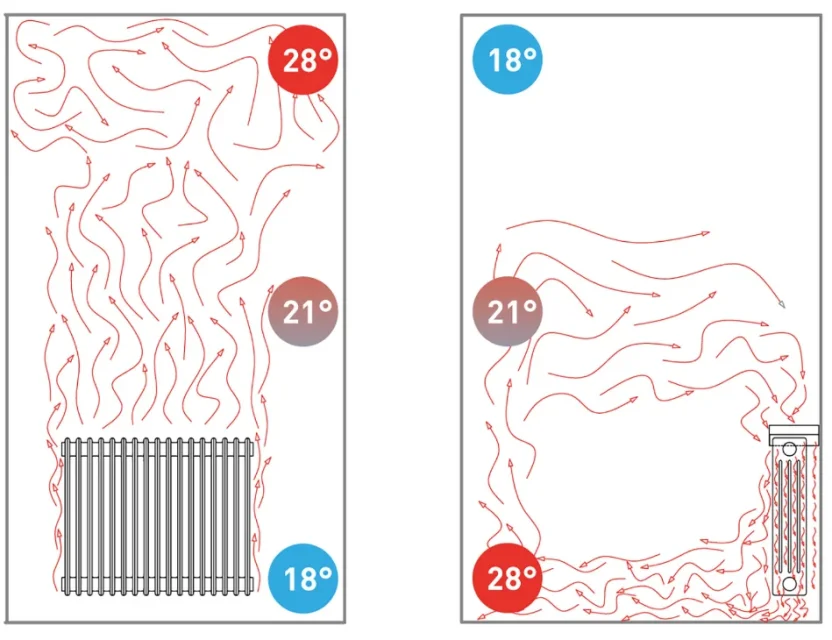
looking at the site known that the temperature gradient is simply reversed so I doubt that you can save up to 35%. .1660029877896.webpthe proposed system works more or less like a fan coil.
There may also be dust problems.
 
I have more or less the same problem and I am trying to figure out if somehow you can face it increasing the efficiency of the current plant; I was curious about the system proposed by
I've been evaluating for some time.
is part of the advertising findings of recent years for the cold winter months. there are also fans to apply on gas stoves or wood stoves but, above all the latter, are ineffective and is better a common fan.
the one indicated by you is certainly well done as construction but from the functional point of view it is a question of seeing from the reviews of who will buy it if the arrangement and the air flow will be sufficient to confirm the statements of the producer; I personally doubt a lot of savings of 35%. as maximum proof indications to see reviews (under functional appearance) of this similar product (English) but aspiring the warm air below and spreading it frontally; it seems that the temperature increases only a couple of degrees and this however seems to satisfy many, but there is no mention to an energy saving, so it is not known if the result obtained you have with the same temperature of the water of the radiator or lower.
Among other things, I am also convinced that the dust that settles on the ground near the radiator is diffused in the environment.
Moreover, on the basis of the second scheme annexed by _, since the fans push the air down, I think the hot air goes up long before meeting the opposite wall if it is located a few meters away, so I doubt even 28 °C on the ground over 1.5 meters away.
 
Good morning, everyone.
So one thing is clear to me: if you have a house that is a thermos heats it even with the human heat. the important thing is not to bring out the energy generated to heat or cool.
said this is useless to unlude to save by changing heating/cooling system.
Did any of you have experiences with internal thermal coat?
we talk about cork or panels with built-in steam brake thickness 3/4cm . do they work?
 
Last edited by a moderator:
I add:
I certainly have an economical mindset from housewives, but this story of 110% I don't understand it.
How is it possible that the state will return all the expenses incurred to improve the energy class of my house and, cherry on the cake, it also gives me a 10% :unsure: where is the trick?
It would be like going to the supermarket, filling the cart of every god, and at the cash register, beyond free, pay me 10% of the total I have in my cart?
I feel a torpedo.. height buttocks
 
Last edited by a moderator:
I add:
I certainly have an economical mindset from housewives, but this story of 110% I don't understand it.
How is it possible that the state will return all the expenses incurred to improve the energy class of my house and, cherry on the cake, it also gives me a 10% :unsure: where is the trick?
It would be like going to the supermarket, filling the cart of every god, and at the cash register, beyond free, pay me 10% of the total I have in my cart?
I feel a torpedo.. height buttocks
when I installed my condensing boiler 3 years ago I spent in all 2.800 € including assembly, pipes in aisi316l, preliminary inspections of the chimney etc. etc. for a boiler that list cost 3,200 €, recovering 50% in 10 years.
Now if you ask for a quote for the same installation ask you 3.200 € + the installer's gain (my gives it to you equal!) + the installation + a lot of other charges, so much we pay all of us in debt, but whatever.
This is the torpedo that will come in the ass of our children!
We're a tiny country.
 
Hello.

I have more or less the same problem and I am trying to figure out if somehow you can face it increasing the efficiency of the current plant; I was curious about the system proposed by
that, for some time, I have been
ciao @frasco as I wrote abovethe amount of thermal energy required to heat a room depends solely on its construction characteristics, i.e. its degree of insulation' .
looking at the site known that the temperature gradient is simply reversed so I doubt that you can save up to 35%. .View attachment 66272the proposed system works more or less like a fan coil.
There may also be dust problems.
It works as a twenty-eight convector (fan coil), sincerely dubious of this stratospheric saving, it would be to try. .
 
Good morning, everyone.
So one thing is clear to me: if you have a house that is a thermos heats it even with the human heat. the important thing is not to bring out the energy generated to heat or cool.
said this is useless to unlude to save by changing heating/cooling system.
Did any of you have experiences with internal thermal coat?
we talk about cork or panels with built-in steam brake thickness 3/4cm . do they work?
what can be done, in large lines, if you cannot use alternative sources and you have to use gas by force:

install a condensing boiler.

put on thermosiphons of balance thermostatic valves.

lower the delivery temperature to the allowed limit, both for the boiler type and to be able to heat the environment as you wish.

use a modern unit that manages the boiler intelligently, which adjusts according to the external temperature and according to the thermal behaviour of the house.

if necessary increase the surface of the radiators.

put behind the radiators of the reflective panels, so as to have less dispersion on the walls and have a better convective exchange with the air.

Try to handle the boiler evenly, do not lower the night temperature too much, because then the energy you need to heat at the daytime temperature would be excessive.

manage the temperature of the premises intelligently, heat only where you need it!

Perhaps they are obvious things, more than this I don't know, unless, as mentioned in a previous post, the nuclear solution remains, with attached and connected problems! :
 
I add:
I certainly have an economical mindset from housewives, but this story of 110% I don't understand it.
How is it possible that the state will return all the expenses incurred to improve the energy class of my house and, cherry on the cake, it also gives me a 10% :unsure: where is the trick?
It would be like going to the supermarket, filling the cart of every god, and at the cash register, beyond free, pay me 10% of the total I have in my cart?
I feel a torpedo.. height buttocks
bhe unfortunately the trick is not there, they are true things, which in theory served to relaunch the economy and at the same time improve the energy quality of the buildings.
Then as you know we're "furbious" and we know how to seize the "opportunities" by jumping on public money and depredating everyone's money, stealing them from those who need it most!
In theory the thing was right, but it was managed and controlled well, unfortunately the oxen fled and now it is useless to close the stable. .
Our children and grandchildren will find themselves with a little more debt to pay when they get out of their mother's womb!
 
Good morning, everyone.
So one thing is clear to me: if you have a house that is a thermos heats it even with the human heat. the important thing is not to bring out the energy generated to heat or cool.
said this is useless to unlude to save by changing heating/cooling system.
Did any of you have experiences with internal thermal coat?
we talk about cork or panels with built-in steam brake thickness 3/4cm . do they work?
time ago, documenting me on the site of the houseclima, they strongly did not recommend insulation inside the premises, maybe now there are better solutions. . .
 
install a condensing boiler.
put on thermosiphons of balance thermostatic valves.
put behind reflective panels radiators
all things done in 2017 with deduction 65% in 10 years
I always keep a constant temperature in the most lived rooms, on the 19th day and night. I noticed that the consumption in m3 gas remains slightly lower and I have a thermal well-being.
I remain the internal insulation for the premises that give on the outside that putin chapters and hoping for future forward-looking politicians for the benefit of our children.
 

Forum statistics

Threads
44,997
Messages
339,767
Members
4
Latest member
ibt

Members online

No members online now.
Back
Top