
• This forum is the machine-generated translation of www.cad3d.it/forum1 - the Italian design community. Several terms are not translated correctly.

iso tolerance display for couplings

  • Thread starter Thread starter MauroTC
  • Start date Start date

MauroTC

Guest
No, he's not ready yet.

but it would be the next application that I would like to develop, always in excel, (then once ready, if I can, I add it here); autocad already allows to view such information in the phase of quotation, but perhaps it is easier to have excel available on a pc, rather than autocad...

the part that most worries me, because of the time it takes away, is the realization of the table with all the numerical values.
These tables I find them in many manuals and are basically three, which I should "transvade" in three excel sheets:

- numerical values of tree deviations (page 3 of the linked document, to understand us)

- numerical values for holes (page 5 of the linked document)

-values of fundamental tolerances for different qualities and different size groups, to find the tolerance amplitude. (page 8 of the linked document,)

link: dispensation tolerancesNow, what I wanted to ask, to simplify this travase phase, is:
Does anyone have such tables in file format, from which to be able to draw to export the numerical values?
already in excel format would be the maximum; but also a compatible format, from which to
a copy/paste, or a compatible "traduction". . .

thanks in any case.. .
I add here the definitive link submerged in the discussion (although we recommend reading :smile: sandra)
 

Attachments

Last edited by a moderator:
No.
Now, what I wanted to ask, to simplify this travase phase, is:
Does anyone have such tables in file format, from which to be able to draw to export the numerical values?
already in excel format would be the maximum; but also a compatible format, from which to
a copy/paste, or a compatible "traduction". . .

thanks in any case.. .
I found this uni.tab file (it's a text file) in my two-dimensional cad installation folder. there are no propio all shocks but a discreet selection yes.

the function is also present in solid edge but unfortunately the data is in binary format.
 

Attachments

Thank you, but I don't think I can take advantage of it.
a little too textual... I don't know if there's a way to put it back in a table form.
In other words, if I have not misinterpreted it in its content, it seems to me that they are already composed tolerances, from the basic deviation more amplitude (probably the most common tolerances).
I would need the pure data of the tables indicated in the opening, so that it will be the same program to compote the tolerance value a9 or h7, etc. whatever it is. so that there is the possibility to comporsi quasiasi combination, without limitations to the only "most used"; I'd do it full. . .
 
Thank you, but I don't think I can take advantage of it.
a little too textual... I don't know if there's a way to put it back in a table form.
In other words, if I have not misinterpreted it in its content, it seems to me that they are already composed tolerances, from the basic deviation more amplitude (probably the most common tolerances).
I would need the pure data of the tables indicated in the opening, so that it will be the same program to compote the tolerance value a9 or h7, etc. whatever it is. so that there is the possibility to comporsi quasiasi combination, without limitations to the only "most used"; I'd do it full. . .
I don't know if what you say is possible, because a 50 h7 has deviations different from a 200 h7.

See if this table can help you, but maybe you've already found it with google.
http://www.roymech.co.uk/useful_tables/iso_tolerances/iso_limits.htm
 
I don't know if what you say is possible, because a 50 h7 has deviations different from a 200 h7.
Well, what's excel doing? :wink:
It's his job to apply the correct deviations depending on the diameter!
See if this table can help you, but maybe you've already found it with google.
http://www.roymech.co.uk/useful_tables/iso_tolerances/iso_limits.htm
No!
I had thrown an eye (it's part of my favorites), but then I was past it! probably with too much superficiality... :frown:
this is already of a certain utility; the tables are not complete (who knows why for example they stop at it14, while the paper arrives at it18), but it is already an excellent base.
Thanks again.
:finger:
 
Hi.

look at those on the technocentre website

Mar
:tongue::tongue:

I'm sorry, but I couldn't help but get a half laugh. .
(but you couldn't know. . . )

in that site no, I already know very well what I can find and what not:
I did it!

and even this application, if I manage to achieve it, would end there.

Thanks anyway!
 
Excuse me if I go a little bit with this request (to whom I chew on mechanics. . . )

I am proceeding with the implementation of the application and I almost arrived to complete the speech trees, facing for these a phase of verification.
Now to speed up this phase I support myself to autocad (mechanical), for recontrials, which automatically puts alone the numerical values of the scaffolding, once you choose the acronym (h7, f6, etc.).
only that puts too many, even where I think the values are not contemplated.
For example, it seems to me that in case of size over 500mm the tables iso do not contain shocks by degrees a, b, c, cd, and various others, up to v ÷ zc; instead autocad allows to put them! !
the same goes for size under 25mm, where are not contemplated the degrees t, v, y; if you choose t6 for a size 20mm autocad puts it!

only to understand better; I was oriented to make a n/a appear when choosing such combinations; but I would not have misinterpreted the norm, since autocad puts them, but I do not know according to which criterion.:confused:
Can anyone enlighten me?

already that there are another question:
I set the table of the degrees of tolerance it, referring to a paper table that contemplated values from 1 to 18, but without noticing a small note below that said that two other columns of values (for it01 and it0) were treated in a certain appendix.
reset the data matrix in excel now, to add the two columns, it would make me a decent job! As there are so many technicians who have handled a lot of tolerances here... have you ever seen certain tolerances applied, h01 or d0, etc.?

thanks in advance.
 
Honestly I never happened, in 20 of work in different sectors of mechanics I happened to use from it5 to it13.
Hi.
 
Honestly I never happened, in 20 of work in different sectors of mechanics I happened to use from it5 to it13.
Hi.
Thank you for your contribution.
I go ahead without considering it0 and it01;
Unless someone shows that those tolerance degrees saw them apply. . .
 
Thank you for your contribution.
I go ahead without considering it0 and it01;
Unless someone shows that those tolerance degrees saw them apply. . .
on the catalogues of johnson blocks you find the words "precision grade 0" or 1, but I did not understand if they refer to the value it. however they are really very particular applciations!
 
instead of manually inserting all values, why not make excel calculations? at the bottom are not randomly put values but they respond to very specific geometric/mathematic rules.
read more This is... at page 17~20 there are formulas for precise calculation... It should work. . .
 
acc. .
I had that document, but never looked deep enough to notice those formulas. that cmq seems to me limit to calculate the values of the normalized tolerance degrees, that is the simplest tabellina, that I had available in file format already compiled largely.
Instead, I don't think there's a way to calculate through precise formulas or rules the numerical values of the basic deviations for holes and trees, right?
that are the most complicated tables with a whole series of exceptions to manage, especially in holes, with the addition of "delta", roundings of js, etc. until the "exceptional" cases of the range of measures 250÷315 only for class tolerance m6!
In short, I admit I'm a little rusty about it, especially since autocad mech. I do it automatically, but I didn't remember the matter so twisted!! !
 
So, I'm pretty much supposed to be there. . .

the part that took away more time was the one dedicated to graphic representation; I found this very useful (my opinion, then maybe it is considered superfluous and "chaotic" for the most...) to immediately give an immediate glance, without having to go to interpret the numerical data and see how they relate to each other and how to "short" a tolerance with the other, etc.

the link below allows to download a version, which can be considered a kind of "beta".
Before considering it definitively, I would like to submit it to an in-depth test phase and for this, I would like to ask you a... donation of time!
As much as I can devote to it, the variables in play and the conditions set, to stay behind the interpretation of the norm (really so many and the most disparate [Bleep]), are definitely multiple and it is not easy to recreate all the cases that can be encountered in practice.
a first phase of testing I have already faced it and already this has allowed to discover a series of errors, already removed (the worst is that every time I text... one!:redface:). However, as mentioned, if this application considers it useful, if we want to give it an index of reliability as much as possible, of which we will all enjoy... to devote him 10 minutes, when it is possible, to test him in various aspects, in which everyone has possibilities, it would be useful not only to me, but to all those who will use him, even here in this community.
you can go from a simple random data entry verification, with the verification that the program always manages everything correctly; While those who have applied for example, they can also find the correct answer of values.. .

I don't know. I try, then of course everyone will do what he thinks best.

As soon as this final phase of testing can be completed, I will publish it in a definitive form, in two versions, Italian and English.
versione beta[Bleep] an extra appendix/consideration (almost a vent) :confused:
Sure that those who "invented" these tolerances for mating must have slept badly the night before!
I ask myself what can be the reason why it created the exception dedicated only to the holes, only for those of diameter between 250 and 315mm, only in case of application of class of tolerance m6, for which the upper deviation must be considered -9μ instead of -11μ !!! :eek:
I say: we are disdaining on two microns, for a hole of at least 250mm in diameter, as to say, you are firing with a cannon and you have to be precise on the target at more or less a cm!
 
But good work, really useful!

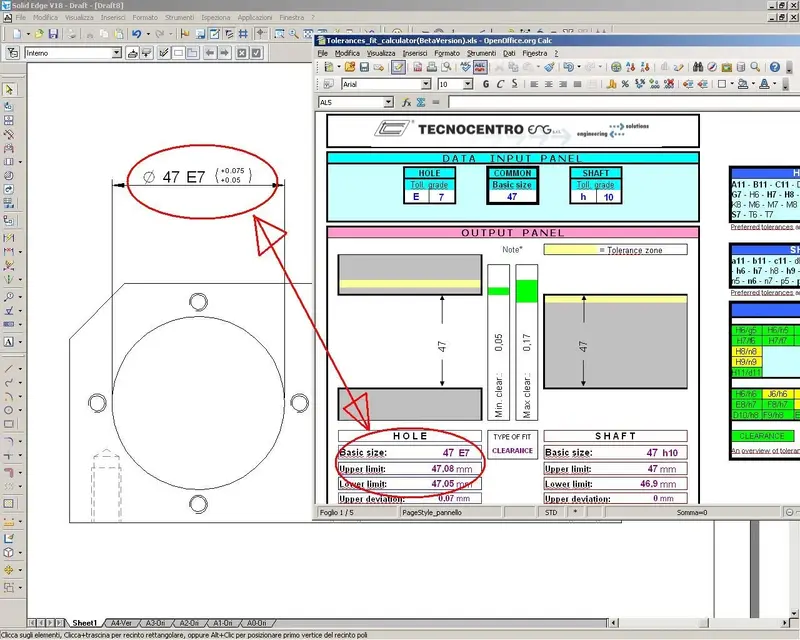
I'll show you something: you put two decimal figures for the shocks, but solid edge puts me 3. I don't know if it depends on having loaded the sheet with openoffice instead of excel.


is it possible to see the contents of "calculated" cells? or is it a professional secret?
 

Attachments

  • Immagine.webp
    Immagine.webp
    124.8 KB · Views: 66
But good work, really useful!

I'll show you something: you put two decimal figures for the shocks, but solid edge puts me 3. I don't know if it depends on having loaded the sheet with openoffice instead of excel.


is it possible to see the contents of "calculated" cells? or is it a professional secret?
Thank you, this is the feedback I would count on. .


I fear it depends on openoffice;
I attach the result with the same data.

regarding the content of calculated cells, more than a professional secret, I leave them not visible for a speech of "elegance": I find it bad to have the formulas above, especially if these then do not say or add anything to those who use the prigram, since they draw on data in part not accessible;
for example the content of q43 is:
(c)
 

Attachments

  • E7-h10.webp
    E7-h10.webp
    28.8 KB · Views: 57
I fear it depends on openoffice;
I attach the result with the same data.
No but then I was able to unlock the cells with oo, all right! I was just asking you for "cultural" purposes, actually better protect the document with so complex phones!

p.s. regarding openoffice, just set the number of decimals. Now the word is correct.
 
Excuse a question, did you protect the document with password? Because openoffice opened it to me and unlocked it without asking for a pass, while if I go back to the protection on the cells, I get a new password.
 
really a very useful job! For now with a few random turns he didn't give me problems, tomorrow I take him to the office to see some real case!
I feel a little parasite to use it..... I'll try to make myself useful somehow for testing.....
thanks again (think on behalf of all )
 

Forum statistics

Threads
44,997
Messages
339,767
Members
4
Latest member
ibt

Members online

No members online now.
Back
Top