• This forum is the machine-generated translation of www.cad3d.it/forum1 - the Italian design community. Several terms are not translated correctly.

isostatic structure resolution

  • Thread starter Thread starter spinner84
  • Start date Start date

spinner84

Guest
good evening, they are busy with this structure to be solved where the known data is l = 1.4 m, f = 5.5kn, q = f/l, m = f*l
isostatica1.webpI made the replacement of the q distributed load with q = q*l and, later I wrote the balance equations (moment compared to a)
[math]
ya - q + ye = 0 \\
xe = 0 \\
-q*l/2 +ye * 2l + m [/math]ke ho determin [math]n = -1/4 f \\
or = 5/4 f \\[/math]I would like to understand if I made mistakes and then how to determine reactions in the external zipper b.
 
I'm a little rusty about static calculations by hand.
However rightly you solved the balance before the ground constraints. And I trust the calculations are right.
Then you have to isolate an auction at a time, consistently reporting the reactions you calculated.
for me it is better to start from the auction of which being double hinged does not download the moment m in the adjacent beams.
then make the balance of ae and find the reaction in b.
and in theory the balance at the bcd auction you only need to confirm the congruence of everything you calculated before
 
Thank you! therefore since the moment m is applied in half of the rod de , the two cutting reactions on d and are equal in the form each intensity f (being m=fl).
 
In my opinion, it is a labile (or hypostatic) structure.
If it were labile, it would not admit solutions (so you would not be able to calculate all the reactions in force on the structure). Are you sure this is an isostatic structure?
 
Okay. follow the advice of @stan9411.
parts from the vertical beam de. I attach the free body diagram of the beam de.
the xe force is the horizontal reaction in the node/brain and?
 

Attachments

  • Dclverticale.webp
    Dclverticale.webp
    15.3 KB · Views: 15
So the rev is normal effort for the rod and cutting effort for the abe rod (and similarly the rex)? I have some blurred memories of this matter.
 
at the end are 3 double rods surrounded.
bcd can be seen as a single rod.
the b hinge is supported on the ae rod, without splitting it into 2. Otherwise it would be labile.

so it is histastatic
 
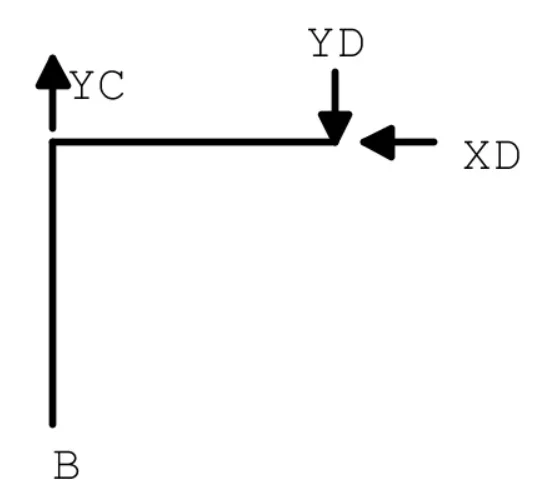
BCD.webpif I now consider the auction bcd, place xd = f and carrying out the balance compared to b, I get
xd * l - yd * l = 0, from which xd = yd = f.
This allows me to find yc = f and yb = f (returned to opposite yc, correct ?
 
free body diagram of the elle beam
 

Attachments

  • dcltraveLquadrata.webp
    dcltraveLquadrata.webp
    23.6 KB · Views: 6
are not masterpieces, but if you write for each beam:
  • the equation to horizontal translation;
  • the equation to vertical translation;
  • the rotation equation around any point (usually choose one of the knots, so reduce the number of moments to be inserted in the rotation equation).
After that, with a little patience, do the various replacements and you will find all the unknowns (in this case, the values of the missing binding reactions).
 
Thank you for your help.
So since rev is different from rbv, on the horizontal rod, the cut will not be constant between b and e?
 
if you can interest: cinematic analysis immediately shows that it is a hinge-carrello beam on which you set a bow to 3 unaligned hinges => non-labile isostatic structure. the hinge in the middle is a half zipper while it is complete the right one (both externally and internally).
the calculation of binding reactions is correct (I did so too).
with regard to the arc to 3 hinges it is immediate to note that the section of the left (the one with an angle beam) does not see applied loads and therefore must admit a direct force according to the director that unites the hinges (one on the zipper at the bottom and the other equal and contrary on the hinge at the top). considered that the sides are lxl then the force is inclined to 45°.
for the balance of the vertical mount then must be: f*(l/radq2) = m = f*l where the lever arm is obviously l/radicequadrata2 i.e. half the diagonal of the square.
therefore the force, according to the 45° direction, is worth f*radq2 (clearly with towards that to balance the rotation of the mount).
therefore, disassembling the force according to x and y obtain f both horizontal and vertical.
this means that in the central mount and in the upper traverse we will have constant axial action, constant cutting and variable moment linearly with maximum in the upper central node=f*l.
I tried to analyze it with frame2d by prof. gelfi and get the same solution.
I attach a small pattern (I know it sucks a little) but it should clarify.
 

Attachments

  • schema.webp
    schema.webp
    20.2 KB · Views: 12
Thank you for your help.
So since rev is different from rbv, on the horizontal rod, the cut will not be constant between b and e?
in the section be the cutting force is constant. if ever, in the trait ab you have a trend of the cutting force that decreases linearly. in a, worth 5/4f. poi, passing from a to the knot b, the cutting force is reduced to -3/4f.
in the section from b ad e, the cutting force is constant and then it will be annulled in the knot e. I'll draw you a pattern in the evening.
 
in my time, when you could not ask the professor, you used ftool that is free program for cast of 2d structures.... there is still and it is useful.
If the result is equal it is right....if it is not then we were trying to figure out where the error was and if we were not going out we were asking for help.
 

Forum statistics

Threads
44,997
Messages
339,767
Members
4
Latest member
ibt

Members online

No members online now.
ciao
Back
Top