• This forum is the machine-generated translation of www.cad3d.it/forum1 - the Italian design community. Several terms are not translated correctly.

linear motion

  • Thread starter Thread starter cimaguy
  • Start date Start date
Thank you very much. Can the pin have a smooth central part? I would not like to see during rotation.
As I have already told you, in the central part of the double screw, you have to put a little appetizer to rotate it, a nut for a key, practice a hole to insert a plug or buccola zigrinata as from your design or other.
It is evident that as you lift the structure, the two screws tend to see more and more, you can never hide them completely, unless, as from your figure, revenues the holes, threaded only in depth, size allowing.
 
Last edited:
if the particular threaded in the eyelet (not reported in the drawing) contrasts the rotation of the screw, I agree with the solution @marco f inox.
I have doubts about the m12 thread in the thin folder of the profile.
 
as it says rightly @terastore, it is to be assumed that the eyelet is held steady in rotation by the element attached there.
I also feed the fillet sealing perplexity on the pierced aluminum base, you can still thread and lock a threaded bushing, if from below even invisible.
 
No, in the brown eyelet the neck of a bottle must be threaded. all this mechanism
I need to adjust the eyelet height.
My intention would be to rotate the crumbled mouthpiece and slide along its axis the brown eyelet, without this ruoti on itself. I attach the 3d file in step format....if you wanted to take a look at it. Thank you very much.ps: regarding the hole on the bar : I planned to thread a compass
 

Attachments

I submit my idea, except for errors or omissions.
contoured bushing with guide milling for the plug that also serves to prevent the eyelet from slipping from the screw, while allowing the latter to rotate.
rotation given by the zigrinata wreath blocked with plug on the rod with partial thread.
the threaded rod is driven by a transverse upper hole quite precise (+0.1/+0.2) in the profile folder and the threaded part is engaged in a cylindrical block (with coupling as precise as possible in the longitudinal central hole of the profile) with a male-throttled hole m12 passing.
at the end of the eyelet you will still have a small swing.
 

Attachments

  • Boccola di guida 2.webp
    Boccola di guida 2.webp
    27.4 KB · Views: 36
I submit my idea, except for errors or omissions.
contoured bushing with guide milling for the plug that also serves to prevent the eyelet from slipping from the screw, while allowing the latter to rotate.
rotation given by the zigrinata wreath blocked with plug on the rod with partial thread.
the threaded rod is driven by a transverse upper hole quite precise (+0.1/+0.2) in the profile folder and the threaded part is engaged in a cylindrical block (with coupling as precise as possible in the longitudinal central hole of the profile) with a male-throttled hole m12 passing.
at the end of the eyelet you will still have a small swing.
elaborate but functional design, it also eliminates the rotation of the eyelet, now preferable or necessary, but that was not required.
must be fixed to the profile the cut bushing, with square as from sight.
the guide hole and thread, on the cylindrical block threaded in the profile, it is good to make them together, so the tolerance of the hole can also be very reduced, e.g., +0,05/+0,1.
good design as well as project.
 
I submit my idea, except for errors or omissions.
contoured bushing with guide milling for the plug that also serves to prevent the eyelet from slipping from the screw, while allowing the latter to rotate.
rotation given by the zigrinata wreath blocked with plug on the rod with partial thread.
the threaded rod is driven by a transverse upper hole quite precise (+0.1/+0.2) in the profile folder and the threaded part is engaged in a cylindrical block (with coupling as precise as possible in the longitudinal central hole of the profile) with a male-throttled hole m12 passing.
at the end of the eyelet you will still have a small swing.
Good morning and thank you again for the interest. your solution is interesting and functional. I have to deal with aesthetics too, which is the fact that you see the outside team, the plug quarry, etc., I don't know if it can be accepted. I'll take inspiration from your idea anyway. Thank you. I was thinking about something: In your opinion, if the parts were reversed, that is, if it were the widest central pin, and it would be the eyepiece?
 
Good morning and thank you again for the interest. your solution is interesting and functional. I have to deal with aesthetics too, which is the fact that you see the outside team, the plug quarry, etc., I don't know if it can be accepted. I'll take inspiration from your idea anyway. Thank you. I was thinking about something: In your opinion, if the parts were reversed, that is, if it were the widest central pin, and it would be the eyepiece?
That's what I meant. .
 

Attachments

  • 2024-02-21_083911.webp
    2024-02-21_083911.webp
    8.4 KB · Views: 26
If the parts were reversed, that is, if it were the widest central pin and the eyepiece would be housing?
I attach a possible solution to your aesthetically clean request.
the locking flange and the guide bushing the dots in teflon or similar antifriction material.
the thread would remain hidden even at the maximum extension.
p.s. the guide pin is the fuchsia color (reference interrupted on the drawing).
 

Attachments

  • Boccola di guida 3.webp
    Boccola di guida 3.webp
    29.3 KB · Views: 24
Last edited:
I attach a possible solution to your aesthetically clean request.
the locking flange and the guide bushing the dots in teflon or similar antifriction material.
the thread would remain hidden even at the maximum extension.
p.s. the guide pin is the fuchsia color (reference interrupted on the drawing).
interesting solution. logically the external flanges will be fixed to the aluminum square bar via screws...I try to develop it. Thank you very much for your interest
 
yes, the two flanges must be fixed to the profile with screws; check if the thickness is sufficient for self-tapping, otherwise you will have to predict tcei by accessing the dice laterally where there are the two grooves of the open profile.
 
ipotizzo..(and underline ipotizzo...) another solution .(also the 3d file) .the green wreath is "pressed" inside the bar and its side wings, bending, then prevent the exit from the hole . Inside there is a screw (fixed) that puts in motion the pin-eyed by the rotation of the zigrinata wreath.
 

Attachments

observing the image seems to me that when you roar the wreath all; ok for the caves that slide but lacks something that blocks the rotation of the sleeve and, consequently, of the stem of the eyelet.
in practice you should with one hand turn the wreath and with the other hold the sleeve with the grooves. Besides, with that kind of hook, I see it unstable.
 
observing the image seems to me that when you roar the wreath all; ok for the caves that slide but lacks something that blocks the rotation of the sleeve and, consequently, of the stem of the eyelet.
in practice you should with one hand turn the wreath and with the other hold the sleeve with the grooves. Besides, with that kind of hook, I see it unstable.
aesthetically would be the maximum
 
aesthetically would be the maximum
Yes, if it worked.
However, if you allow me, when designing a new solution that you will need to test others for approval, keep in mind that it is not said that you immediately find the ideal one but generally you have to orientate yourself on what seems more functional, you have to check if you perform properly the intended manoeuvre, you have to understand perfectly the operation in order to be able to explain it correctly to others and to be able to respond adequately to the questions, or criticisms, which will be placed. In addition to this, you must evaluate (using the resources you have in the company) if the system you propose is simple to mount, to use and to maintain, as well as verify if the components are easy to realize and how, or if they are commercial and indicative to what costs.
After these analyses, you will be ready to meet your referents to whom you will exhibit the project, meeting during which, generally, improvements could emerge useful to the subsequent industrialization and production of the product.
all this speech to tell you that when you have a couple of solutions follow the procedure I have reported above and expose them to your referents and listen to any suggestions; You certainly benefit from it at a professional level.
 
Yes, if it worked.
However, if you allow me, when designing a new solution that you will need to test others for approval, keep in mind that it is not said that you immediately find the ideal one but generally you have to orientate yourself on what seems more functional, you have to check if you perform properly the intended manoeuvre, you have to understand perfectly the operation in order to be able to explain it correctly to others and to be able to respond adequately to the questions, or criticisms, which will be placed. In addition to this, you must evaluate (using the resources you have in the company) if the system you propose is simple to mount, to use and to maintain, as well as verify if the components are easy to realize and how, or if they are commercial and indicative to what costs.
After these analyses, you will be ready to meet your referents to whom you will exhibit the project, meeting during which, generally, improvements could emerge useful to the subsequent industrialization and production of the product.
all this speech to tell you that when you have a couple of solutions follow the procedure I have reported above and expose them to your referents and listen to any suggestions; You certainly benefit from it at a professional level.
Sure. I agree with you. my intention, in fact, was to propose a solution that approached the request that was made, compatibly with its feasibility and simplicity of use. I am now being studied and, as soon as I have defined with my client the solution, I will write to update you on the choice made....stay tuned. I thank you again for your interest.
 
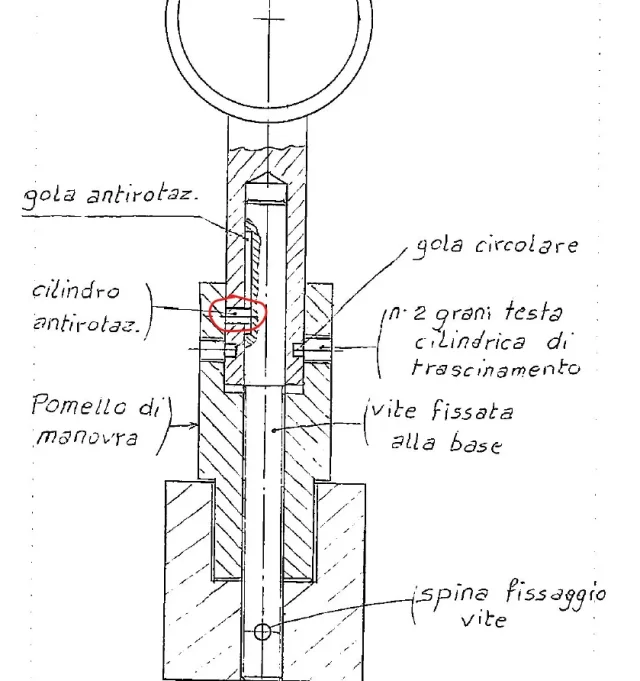
Hi, I have another solution to propose, it should be all clear in the drawing that I attach.
only modification, the diameter of the screw must be a bit larger, otherwise the knob of maneuver does not rise. I ran.
 

Attachments

Last edited:
Good morning
I get into the discussion
Excuse me. @marco f inox , maybe I didn't understand your design well.. But it seems to me that the anti-rotation cylinder together with the drag grains makes a body unique with the knob of manoeuvre. so how can it screw on the central screw?
Do I understand?
1708697739784.png
 
Last edited by a moderator:
But it seems to me that the anti-rotation cylinder together with the drag grains makes a body unique with the knob of manoeuvre. so how can it screw on the central screw?
for me it works properly; Let's see if I understand correctly:
the knob of maneuver, turning, screws (or turns) on the screw moving upward (or the bottom) dragging with it the stem of the eyelet, by means of the two cylindrical head grains acting on the circular throat (type seat of seeger).
the anti-rotation cylinder is solid with the stem of the eyelet but released from the knob, in this way engaging in the hollow obtained on the cylindrical part (without threading) of the screw, forces the stem to flow preventing the rotation.
what I have not understood is how the lower block is attached to the profile.
 
dragging with it the stem of the eyelet, by means of the two cylindrical head grains acting on the circular throat (type seat of seeger).
That's what I didn't understand. .
Those grains do not block but stick in the throat leaving that game that allows not to become a whole body.
Now it is clear to me,
always remains critical the grain that if you do not pay attention and screws too much blocks the whole.
Maybe more than a grain.. it would take a screw where his head beats on the outside so that there is no possibility of tightening it too.
and then all must be mounted on a bosch profile.

I think about it. .
 
Last edited by a moderator:

Forum statistics

Threads
44,997
Messages
339,767
Members
4
Latest member
ibt

Members online

No members online now.
Back
Top