• This forum is the machine-generated translation of www.cad3d.it/forum1 - the Italian design community. Several terms are not translated correctly.

linear movement+ rotation

  • Thread starter Thread starter asblo
  • Start date Start date

asblo

Guest
Good morning to all
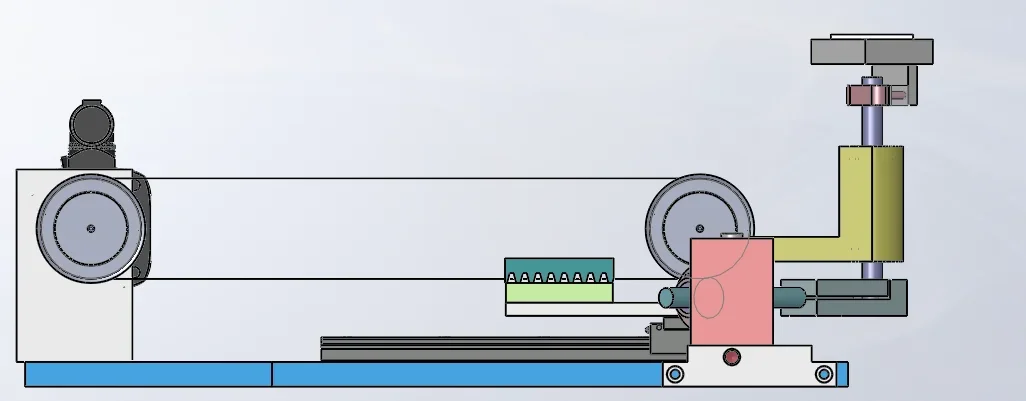
I wanted to undergo a scheme of an application: I have a skate (linear guide) that goes on alternating linear motion on a track. along this path I need a rotation that I thought to drive from a hinged arm on the guide and on the other end a contact bearing, whose rotation point will be determined simply by a horizontal barrier. the arm will always be preloaded by a twist spring
Do you see any technical mistakes in cinematism? do you have any practical suggestions? I thought I would tempt the barrier, because there will be some horizontal drag of the bearing, about 20 mm ahead and back a hundred times a minute.1698147000416.png
 
then, some thoughts spread:
1) by experience not my direct but reported, I am told that the torsion springs break soon enough.
2) it would be to understand that angle takes your cinematism to understand a little bit the breakdown of forces along the action lines. could reach very high values if corners tend to "close" very much.
3) you do very well with inertias: 100 cycles per minute are many and risks that the system will bounce while losing touch. Perhaps it is advisable that the bearing be mounted in a quarry (at that point you can do without the spring) rather than resting on one side as a schematized.
4) contact the guide and bearing supplier: with movements so reduced the fat may not "recirculate" sufficiently between the spheres leading to a poor lubrication.
 
Good idea about the quarry. or better, a counterbarrier to define the lower rotation point, not a bearing-sized quarry otherwise would not flow. so you don't need spring preload work
 
Good idea about the quarry. or better, a counterbarrier to define the lower rotation point, not a bearing-sized quarry otherwise would not flow. so you don't need spring preload work
Sorry a question: is there a bump between barriers and bearing or are they always in contact during the cycle?
 
it would be interesting to see the mechanism on the side, on a rail that turns horizontal, because you do not understand who has to rotate and how much.
 
Sorry a question: is there a bump between barriers and bearing or are they always in contact during the cycle?
I've dimensioned the arm to be always in touch, from there the spring. doing two symmetrical tracks to the wheel I have to take a couple of tenths of game to allow rotation
 
It's still all being developed because I'm first defining the schematic movement. Anyway, maybe you understand a little more. I set the movement of the two roller wheels on barrier and counterbarrel that will make from track
it would be interesting to see the mechanism on the side, on a rail that turns horizontal, because you do not understand who has to rotate and how much.
1698226651119.webp
1698226675322.webp
 
the alternating motion will be transmitted from a motor to a belt, where there will be a clamp for solid straps to the skate. for the rotation, however, that must be precise, needs a cam system
 
I can't understand much more, so I'd ask you a few questions.
1) What shape does the element have to rotate?
2) How many degrees of rotation should you do?
3) is it bound to something or is it just leaning on a plan?
4) after rotation is located at the same point or changes location?
5) Should the rotation axis move or remain fixed?
6) is it just the shock against a fixed wall that makes it rotate?
who produces the alternative linear motion of about 20 mm but always equal, it is certainly preferable to give it to a cam, mounted on the exit shaft of a motor.
to reduce friction, you will need to mount a bearing on the element that supports the cam.
here are specialists for solutions on mechanical movements, but they always need all data + 1.
 
the alternating motion will be transmitted from a motor to a belt, where there will be a clamp for solid straps to the skate. for the rotation, however, that must be precise, needs a cam system
I certainly miss something, but I think that the system you propose has various criticalities regarding precision, as well as having a transmission relationship difficult to define.
 
I certainly miss something, but I think that the system you propose has various criticalities regarding precision, as well as having a transmission relationship difficult to define.
I read the opening post and saw what I miss. I apologize for the intrusion.
 
in mechanical handling, they have realized very complex mechanisms, difficult even to understand, thinking for example to the cassettes.
don't lose heart, give us information about what you want to get, because that's where you have to leave.
facing new problems, for those who are passionate like me, is a stimulus that drowns only when you give up, especially if already in departureps. I jumped out this fat writing without wanting it, if someone wants to suggest how to get back to normal. . .
 
Last edited by a moderator:
Sorry I'm late. @marco f inox. I'm reviewing the system since other data and issues related to mounting on the rest of the line came out. I will post updates just developing something. However, I can answer a few questions quickly:

2) How many degrees of rotation should you do? slightly more than 90°3) is it bound to something or is it just leaning on a plan? is a form of vacuum-contained packaging tape6) is it just the shock against a fixed wall that makes it rotate? There is no shock, the cams always flowed. However I will not use a cam anymore
 
if I have not understood wrong your mechanism is cinematically equivalent to cross glyph
 
I promised to update you on the adopted solution. Since for some modifications the necessary rotation is about 90°, I abandoned the idea of the wheels (it would have been good for a small rotation) and I used for translation a cylinder a rod with linear bushings.
below the constraints scheme, the two images show point a and point b of the system

the red block is a further adjustment slip that can adjust it in y allows a little tolerance to the nominal rotation1699953771411.webp1699953794238.webp
 

Forum statistics

Threads
44,997
Messages
339,767
Members
4
Latest member
ibt

Members online

No members online now.
ciao
Back
Top