
• This forum is the machine-generated translation of www.cad3d.it/forum1 - the Italian design community. Several terms are not translated correctly.

low load beams ... difference between 2d and 3d analysis

  • Thread starter Thread starter mir
  • Start date Start date

mir

Guest
Hi.
I often encounter (in the project draft phase) in considerable oversizes and observe that a 2d analysis (classical analysis to be able to do with a paper leaflet) is very different from an analysis to the fem ... do you also observe it?
 
Hi.
I often encounter (in the project draft phase) in considerable oversizes and observe that a 2d analysis (classical analysis to be able to do with a paper leaflet) is very different from an analysis to the fem ... do you also observe it?
certainly mir, hand sizing is always very high. It's normal, it depends on formulas, coefficients, so much safety theory, so it's normal that it's oversized by hand.
 
I'm sorry to contradict mechanicalmg, but I'm not with what you say, mir.

If I have a loaded beam, and we find ourselves in geometric conditions such as to be close to the hypothesis of de saint venant, what the science of construction tells us, and what comes out of a fem analysis if they are not exactly equal, they differ from the decimal figures.

the test is done quickly.

Can you explain a few more examples where you came across? I'm sure there's some explanation.
 
I'm sorry to contradict mechanicalmg, but I'm not with what you say, mir.

If I have a loaded beam, and we are in geometric conditions such as to be close to the de saint venant hypothesis, ... can you better explain some examples where you came across? I'm sure there's some explanation.
the potential energy of each finite element and revenues, shifts, deformations etc. and to write the equations of potential energy use the same theory of construction science, nothing has been invented :biggrin: There's definitely something that might have escaped you, and you get weird stuff.
 
then I have a 6 meters long beam [185 x 70 x spessore 2] with a load (which should be distributed) of 2000 n.

the problem is that, according to me, in the 3d of the fem if I apply the load on the upper surface of the beam it is distributed on an area of 70mm x 6 meters while, in the 2d, I simplify my life and distribute the 2000 n along the line or 2000/6 = 333.3 n/m


Is that what differentiates the analysis?
 
then I have a 6 meters long beam [185 x 70 x spessore 2] with a load (which should be distributed) of 2000 n.

the problem is that, according to me, in the 3d of the fem if I apply the load on the upper surface of the beam it is distributed on an area of 70mm x 6 meters while, in the 2d, I simplify my life and distribute the 2000 n along the line or 2000/6 = 333.3 n/m


Is that what differentiates the analysis?
I don't think...
How do you see the maximum voltage in the 3d? In fact, no, where is the maximum tension? if it is on the faces above and under the beam ok, if by chance you find it in correspondence of the inner edge of the beam... well, that is clearly a numerical error not found?
 
I'm sorry to contradict mechanicalmg, but I'm not with what you say, mir.

If I have a loaded beam, and we find ourselves in geometric conditions such as to be close to the hypothesis of de saint venant, what the science of construction tells us, and what comes out of a fem analysis if they are not exactly equal, they differ from the decimal figures.

the test is done quickly.

Can you explain a few more examples where you came across? I'm sure there's some explanation.
fulvio, our friend says that he comes into design phase with different values means to me that he is making a sizing not a verification. so if you have an axis or a tree we have an admissible sigma equal to a sixth of that break.. .

instead if it compares the stresses in the field of validity of von mises with both methods I would say that in case it is framed and loaded to an extreme it is wrong of 0.2/0.5% comparing the two methods.

with distributed loads, applications of forces, I would say that it is the case to analyze what is done through software because in the 3d there is an area of application of the forces, therefore if you want a dot force the area must be infinitesimal.
 
then I have a 6 meters long beam [185 x 70 x spessore 2] with a load (which should be distributed) of 2000 n.

the problem is that, according to me, in the 3d of the fem if I apply the load on the upper surface of the beam it is distributed on an area of 70mm x 6 meters while, in the 2d, I simplify my life and distribute the 2000 n along the line or 2000/6 = 333.3 n/m


Is that what differentiates the analysis?
in the application form of the forces that measure units you have? load distributed on line 2d is not equal to load distributed on area, in fact it is a pressure. :finger:
check the fea form conventions.
 
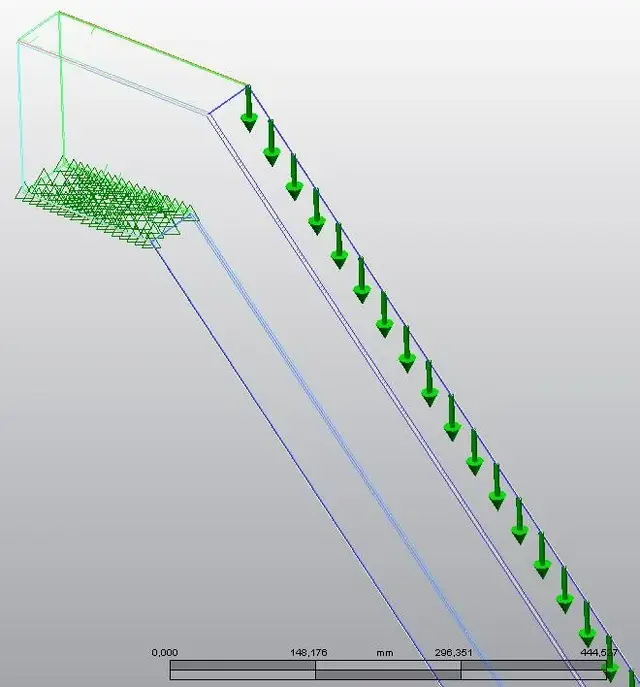
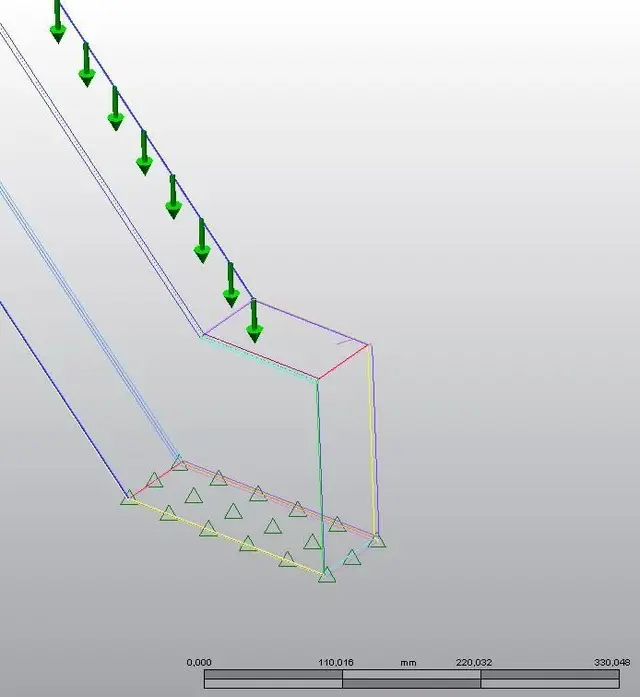
If you want to try, here's what I did:

one.jpg: see the upper bond

two.jpg: lower bond

three.jpg: I distributed the load of 2000 n along the edge and in the center there is also a concentrated load of 2200 n (all directed down)

displacement.jpg: displacement according to the fem is max 0.62 mm

Now, to make a simplified count, I calculated the beam 2d considering only the inclined part of 48° long 6.37 m and I find a deformation of 3.38 mm
 

Attachments

  • uno.webp
    uno.webp
    32.9 KB · Views: 13
  • due.webp
    due.webp
    23.3 KB · Views: 10
  • tre.webp
    tre.webp
    28.2 KB · Views: 9
  • spostamento.webp
    spostamento.webp
    30.5 KB · Views: 17
in the application form of the forces that measure units you have? load distributed on line 2d is not equal to load distributed on area, in fact it is a pressure. :finger:
check the fea form conventions.
always asks me ... both in the case of loading on line and on load on area and, clearly, on dot load.
 
I was looking at my inventor simulation notes... certain asks for strength but the area or line of application makes change meaning. therefore consider a pressure at this point if it is uniform or a force but with different value. then look at the driving force.. .
 
fulvio, our friend says that he comes into design phase with different values means to me that he is making a sizing not a verification. so if you have an axis or a tree we have an admissible sigma equal to a sixth of that break.. .

instead if it compares the stresses in the field of validity of von mises with both methods I would say that in case it is framed and loaded to an extreme it is wrong of 0.2/0.5% comparing the two methods.

with distributed loads, applications of forces, I would say that it is the case to analyze what is done through software because in the 3d there is an area of application of the forces, therefore if you want a dot force the area must be infinitesimal.
I can't follow you. it is not possible to make sizing with the fem, but only check, right? (you cannot insert tensions and calculate dimensions).

Then, the fem does not know the breaking load, we, therefore considering a certain safety factor, we calculate the admissible sigma. we make a sizing of the beam to have that admissible sigma and we get a dimension.
Now, if we make a beam of that size, and we apply the project loads, I could play parts of the body that we get numbers pretty close to the admissible voltage decided previously.

What's wrong?
 
attention ... I am making an overestimated predimension:
1. I establish the load
2. oversize the beam
3. I do the fem and see what happens
4. I'll take my hand and see what happens and... ta dammm ... they differ a little too much!
 
here are the accounts in 2d

where the red line at the center is the deformation of dx=-2.5 mm and dy=-2.28 mm i.e. disconnection= 3.38 mm
 

Attachments

  • cinque.webp
    cinque.webp
    16.8 KB · Views: 21
regardless of overestimation or oversize, that poor fem cannot know.

How much is the equivalent sigma of von mises with the fem?
How much does it come by hand?
Have you considered moment and traction? the cut you can overlook it, also because it is null on the surface.
 
here are the accounts in 2d

where the red line at the center is the deformation of dx=-2.5 mm and dy=-2.28 mm i.e. disconnection= 3.38 mm
Do you use ftool?
tax n/m, which cuts the figures after the comma.. .
 
according to the fem in the middle of the structure I have between 5 and 10 n/mm^2 ... according to the hand accounts in half beam:

σ= m/w_x=m/i_x h/2=(1500000 nmm)/(38921 mm)=38.53 n⁄mm^2
 
but in the fem the hinge and cart bond, did you set them correctly or put two inks?

the fea module of inventor doesn't like me much either for how it does to apply forces, however the only system to come to head of how it thinks, if after reading the guides does not work anything, you have to try to solve the isostatic standard beams with a force in the center, with linear distributed load. check if the result changes by changing the area of application (often for pe point forces it is necessary to achieve a small surface break) and to compare them. found the way he reasons inventor with the application of forces then applies it to this more complex beam.
 
I've put in circles without possibility of moving or rotation... but I still tried to make two inks even in the 2d but it doesn't change much as deformation.

ps use algor not inventor but will be very similar
 

Forum statistics

Threads
44,997
Messages
339,767
Members
4
Latest member
ibt

Members online

No members online now.
Back
Top