
PDS
Guest
Good morning;
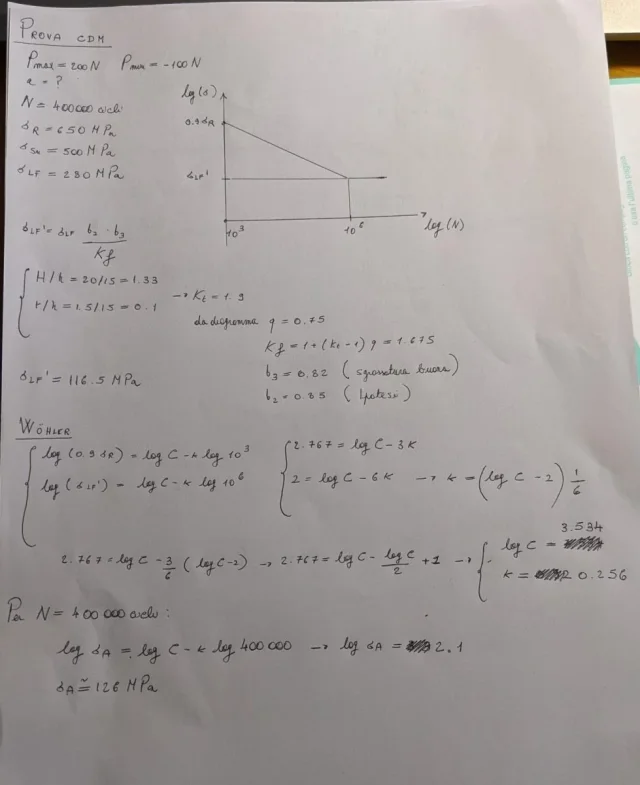
I am a mechanical engineering student and exercising myself for the construction examination of machines I came across this exercise. Whereas it is a finite fatigue dimensioning, on the wohler diagram I considered the correct fatigue limit from the various coefficients for the geometry in question, in particular I hypothesized b2 of 0.85 (since I could not calculate an equivalent diameter).
on wohler I hypothesized the knee of the curve to (10^6; sigmalf').
I then built the haigh diagram and from the ratio between the vertical segments I drew the report for the safety coefficient (considering a condition in which the average sigma does not vary) according to the unknown a.
I wanted to ask if that reasoning was correct, because I should still assume a safety coefficient.
Thank you in advance.
I am a mechanical engineering student and exercising myself for the construction examination of machines I came across this exercise. Whereas it is a finite fatigue dimensioning, on the wohler diagram I considered the correct fatigue limit from the various coefficients for the geometry in question, in particular I hypothesized b2 of 0.85 (since I could not calculate an equivalent diameter).
on wohler I hypothesized the knee of the curve to (10^6; sigmalf').
I then built the haigh diagram and from the ratio between the vertical segments I drew the report for the safety coefficient (considering a condition in which the average sigma does not vary) according to the unknown a.
I wanted to ask if that reasoning was correct, because I should still assume a safety coefficient.
Thank you in advance.


 .
.