• This forum is the machine-generated translation of www.cad3d.it/forum1 - the Italian design community. Several terms are not translated correctly.

manual gnome-rhone 14m

  • Thread starter Thread starter Er Presidente
  • Start date Start date

Er Presidente

Guest
Let's start here a new adventure that, I hope, will not get bored too much.
the purpose of this new story is twofold, at least in my current intentions.
First I would like to share with you a reading of a technical manual that for its ancient beauty and for the subject covered should enrich the technical and historical baggage.
by deepening the details of this engine we could also discover, together, also because, despite the excellent assumptions, he never managed to maintain the promises of power and reliability that many nations placed in this project.
born as an extreme development of jupiter, an unsurpassed progenitor of the entire history of radial engines, he never managed to be truly mature.
They all tried to follow a road that seemed simple, put together two jupiter to create a powerful and robust double star like his progenitor.
 
roy fedden had designed the jupiter before the end of the great war but the cosmos that produced it did not survive the crisis of the sector with the end of military orders immediately after the end of the conflict.
the original engine was an honest 9 cylinder that had its peculiarity in the four valves per cylinder. the base was excellent but only the aluminum heads, first fused then forged, made it legendary, making fedden a giant of the history of aircraft engines and the bristol, which had found the project, a true protagonizta of the world production of engines.
in france, as everywhere, the jupiter with its magical aluminum heads made proselytes and the gnome-rhone (fusion of two legends of rotational radial engines) engaged their economic resources (noteable thanks to the extensive military supplies) in the production of the English motor and its development.
the double 14-cylinder star immediately appeared as a real protagonist.
 
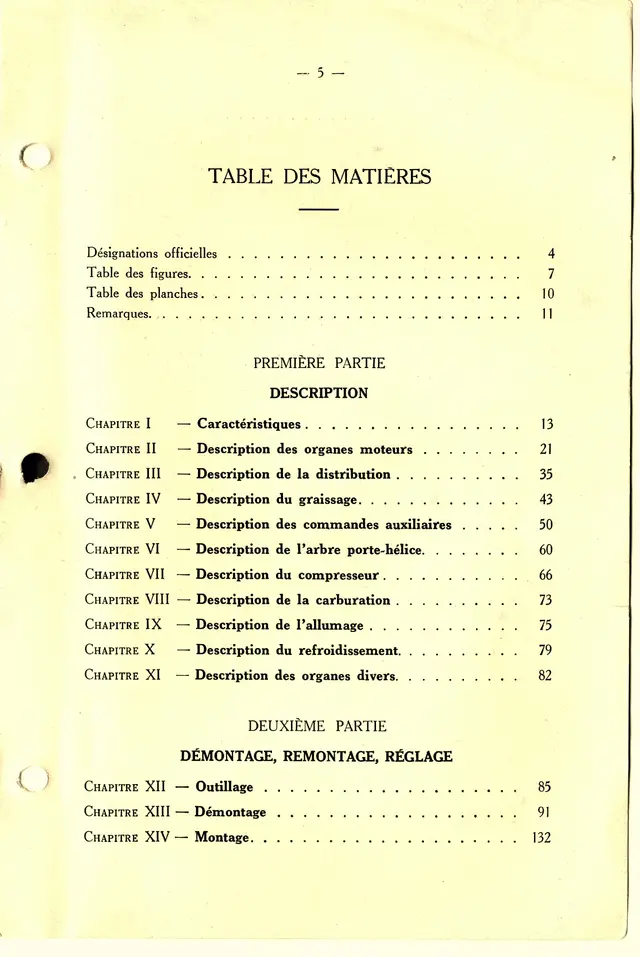
I attach the first five pages of the manual.
the significant part of this group is the table on page 4 which summarizes the engine variants and the main differences.

apart from the direction of rotation, positive or negative (we will then try to discover its meaning) it is seen that the variables are the ratio of the reducer (which modifies the "vitesse de l'helice") that instead of normal 12/17 becomes 1/2 on a couple of prototypes.
the compression ratio is 6.4, not bad for a supercharged engine of the 1930s.
the ratio of the mechanical centrifugal compressor multiplication, constant at 8.24 per tutte le versini excluding two "semi-superpowered".
The last variable is the fixed or variable pitch propeller.

already from this table it is possible to obtain interesting considerations and to have a photo of the "scenario" of the epoch".

It would seem that, even if the variable step propeller is treated separately, the manual is reported to the first two fixed-step versions.
 

Attachments

  • Gnome-Rhone 14M 01.webp
    Gnome-Rhone 14M 01.webp
    334.4 KB · Views: 96
  • Gnome-Rhone 14M 02.webp
    Gnome-Rhone 14M 02.webp
    868.1 KB · Views: 51
  • Gnome-Rhone 14M 03.webp
    Gnome-Rhone 14M 03.webp
    540.4 KB · Views: 50
  • Gnome-Rhone 14M 04.webp
    Gnome-Rhone 14M 04.webp
    789.2 KB · Views: 62
  • Gnome-Rhone 14M 05.webp
    Gnome-Rhone 14M 05.webp
    617.7 KB · Views: 57
I attach the first five pages of the manual.
the significant part of this group is the table on page 4 which summarizes the engine variants and the main differences.

apart from the direction of rotation, positive or negative (we will then try to find out the way) yes ...
the sense of rotation was not of great importance even if the various nations often tended to prefer one.
There was no particular reason except to avoid complicating life in logistics and production of weapons synchronization systems and building propellers.
the Germans were always strict in respect of the rule of turning the propellers clockwise (it being in the driver's place), the English were rigid black and the Americans simply followed the "commercial" rules of the motor manufacturers.
on multimotors, often, the propellers turn in the opposite direction to cancel their gyroscopic effects.
In our case the option of the direction of rotation is undoubtedly linked to the multimotor, the French maintained the tradition of anti-clockwise rotation.
 
He thinks it's show, I'm gonna fix it, and you're gonna open it like it's done in brep.
Is it possible to add something remunerative... or should we resign to work aggratis? :-)
If we "do" it well, then we make it build in print 3d in scale 1:8 and sell the models.
:biggrin:
 
If we "do" it well, then we make it build in print 3d in scale 1:8 and sell the models.
:biggrin:
I'm going to model the bolt. :biggrin:

p.s. in the multimotors I always thought that the engines were counter-rotating precisely to cancel the reaction pair of the propeller (or at least to attenuate it in the case of the multiple "diseven"), but instead they were produced also with all the engines that rotate in the same direction?
for reasons of economies of scale (all equal motors, all equal propellers) or even for technical reasons?

Bye.
 
I'm going to model the bolt. :biggrin:

p.s. in the multimotors I always thought that the engines were counter-rotating precisely to cancel the reaction pair of the propeller (or at least to attenuate it in the case of the multiple "diseven"), but instead they were produced also with all the engines that rotate in the same direction?
for reasons of economies of scale (all equal motors, all equal propellers) or even for technical reasons?

Bye.
You have no idea how many non-rotating engines, lancaster, b-17 and atr, so much for "make names."

the reasons are purely logistic, not to keep in stock two types of engines and propellers, as well as a whole series of minor differences in the components.
 
If we "do" it well, then we make it build in print 3d in scale 1:8 and sell the models.
:biggrin:
the job is challenging in terms of time... but it tries me a lot.
I just miss this and then I'm fine:-) I told my wife but, I don't know why, she took my greeting:-\
 
...the ratio of the reducer (which modifies the "vitesse de l'helice") that instead of normal 12/17 becomes 1/2 on a couple of prototypes.
...
the reducer for the propeller has a reduction ratio around 1/1.4, so quite "blando", the engines had a quite low rotation regimen, less than 3000 turns and the propellers had a fairly low diameter.
the fact that you tried to experiment with more 'spient' reducers (1/2) means that there was awareness that larger and slower propellers would give better returns.
 
the job is challenging in terms of time... but it tries me a lot.
I just miss this and then I'm fine:-) I told my wife but, I don't know why, she took my greeting:-\
They already hate me on the planet, please, don't enlarge the list!
:biggrin:
 
now someone will come to propose us a pdm with distributed file system support and automatic conversion in compatible format of data.... :biggrin:
 

Forum statistics

Threads
44,997
Messages
339,767
Members
4
Latest member
ibt

Members online

No members online now.
Back
Top