• This forum is the machine-generated translation of www.cad3d.it/forum1 - the Italian design community. Several terms are not translated correctly.

measurement rotondity error.

  • Thread starter Thread starter Mark_navigator
  • Start date Start date

Mark_navigator

Guest
I have a measurement repeatability problem:

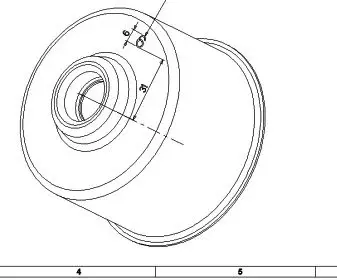
a particular cylindrical shape obtained by cold moulding of aisi304, if measured a diameter with machine cmm (depending on us) the error of rotondity detected is attested on 0.1mm.
if measured with a comparison rested on the surface to be detected and the piece mounted on an autocentre and centered the piece made to rotate then on itself, the rotondity error is much higher, more than double, reaching 0.28mm.
Can someone explain why?
in theory with the 2 methods the values detected should look like.......
 
What is the tolerance of the autocentre? I guess it's a spindle mounted on bearings.
the goddess detects the points of the particular stop, does the interpolation and calculates the circle that approximates them better, and from this gets the error (if I remember well). the comparison measure the error of your piece added to that of the autocentre. I would explain the difference. how to counterprove by trying different derl pieces on the spindle you should get different values of error (depending on whether they sit or subtract)
 
is it possible that there is excess between measured zone and zone fixed in the spindle?
in this case with spindle and comparison you would measure the sum of errors of circularity and eccentricity.
Bye.
 
then, before measuring I centered the piece with a rubber hammer minimizing the excursion of the comparator placed on a perpendicular surface to the grip piece (sinpoad get 0.03mm of excursion).
Moreover the sum with the coaxial error of the diameter to be measured should not be there because it itself on the outside is used for taking piece on the spindle..... .
 
......I don't understand what you mean....the problem is the different result with comparison and self-centered compared to the goddess...... .
 
I tried with 8 points and also with 30 but the result doesn't change much... .
 
......I don't understand what you mean....the problem is the different result with comparison and self-centered compared to the goddess...... .
I am not an expert in the tasting machine, but from what I understand you find via software the theoretical cylinder that contains the encumbrance of your solid. the axis of this theoretical cylinder will be variedly oriented in space so as to minimize this volume.

Putting the piece on the lathe instead, you choose a priori axis perpendicular to one of the two faces, that if your piece is particularly "wrong" it will be quite different from the axis above, so the piece tends to flaunt more when you turn it on the lathe, which is exactly the measure that gives you the comparison.
 
Putting the piece on the lathe instead, you choose a priori axis perpendicular to one of the two faces, that if your piece is particularly "wrong" it will be quite different from the axis above, so the piece tends to flaunt more when you turn it on the lathe, which is exactly the measure that gives you the comparison.
Hello hunting
in fact and as you say
to measure that piece put in the spindle (theoretically)must not turn the piece but must turn the comparison around the piece

for the measuring machine the meter according to the number of measurements made
from an average
Thank you very much
 
Hello hunting
in fact and as you say
to measure that piece put in the spindle (theoretically)must not turn the piece but must turn the comparison around the piece

for the measuring machine the meter according to the number of measurements made
from an average
Thank you very much
thanks for the comfort!!! :biggrin:
 
I am not an expert in the tasting machine, but from what I understand you find via software the theoretical cylinder that contains the encumbrance of your solid. the axis of this theoretical cylinder will be variedly oriented in space so as to minimize this volume.

Putting the piece on the lathe instead, you choose a priori axis perpendicular to one of the two faces, that if your piece is particularly "wrong" it will be quite different from the axis above, so the piece tends to flaunt more when you turn it on the lathe, which is exactly the measure that gives you the comparison.
Now I understand, so if it is curved the surface, I would still get the rotondity error + the coaxial error with the comparator, right? but then in this case it is not possible to distinguish the 2 errors with a comparison, it takes for force a machine cmm!
 
Now I understand, so if it is curved the surface, I would still get the rotondity error + the coaxial error with the comparator, right? but then in this case it is not possible to distinguish the 2 errors with a comparison, it takes for force a machine cmm!
in current times
But when there were no measuring machines how did you do it??????? ? ? ? :mad:

Then if the cylindrical is the one posted
It is obvious that to return it it was necessary to make a hole with center tip on both faces
if you use the centers and put the piece between tip and counterpoint you can measure
ovalization with a comparison
which and make it travel on the cart or cart of the lathe
can also measure any diameter differences by telling you if the diameter is conical
It's useless to tell you that the lathe doesn't have to be an old wheelbarrow.
Thank you very much
 
the particular is this obtained from cold moulding of stainless steel:
c:\documents and settings\marcob\desktop
 
I should be there now.... .
This is the cold molding piece of stainless steel....so the surfaces are no irregular.... more....
 
Maybe we're...
Here he is.
Hi.
Now I'm struggling to follow you
because in your first post you said you measured 0.1 mm out of center
Don't you think you did a good job??? ? ? ? ? ? ?
having printed with lower tolerances means working mecc.
However you can do a male at the lathe of the inside of the printed
insert on it the piece
and mix it with the comparison
Thank you.
 

Forum statistics

Threads
44,997
Messages
339,767
Members
4
Latest member
ibt

Members online

No members online now.
Back
Top