
• This forum is the machine-generated translation of www.cad3d.it/forum1 - the Italian design community. Several terms are not translated correctly.

passage from tree to base hole and vice versa

  • Thread starter Thread starter Drenthe24
  • Start date Start date

Drenthe24

Guest
hello to all, I am preparing the examination of cad and performs do some exercises I have a doubt about the passage from the tree system base to the basic hole system. in particular I thought that in the passage greatnesses such as maximum play and maximum interference remained unchanged but I'm noticing that this only applies to some couplings. If for example I decided to pass from a h7/e7 to an e7/h7 then the quantities I indicated above remain unchanged but if the same speech I had to do so with a h7/s7 to s7/h7 this is not respected and this is true for all classes after h. someone would know to give me an explanation? I noticed that the difference is exactly equal to the delta. Thank you.
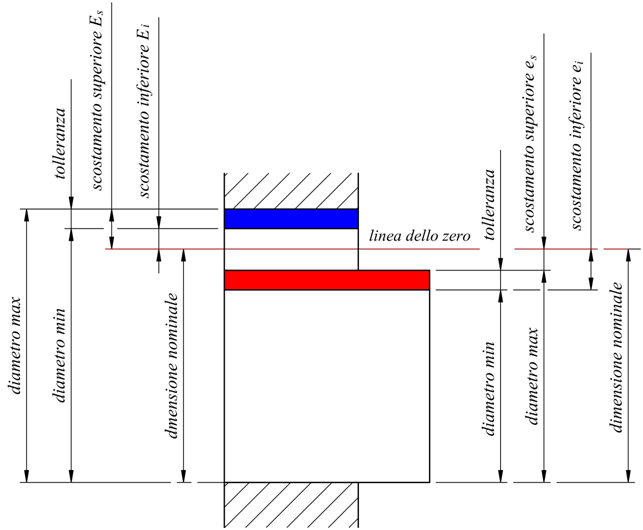
 
It is normal that if you use base hole i.e. example h7 or if you use base tree h7 the reference is zero. the other element has the identical tolerances more or less guaranteeing equivalence. for this reason he invented tree or base hole.
If you refer to two different tolerances in the middle you will have to calculate the single tolerance and you will find the numbers that come.
 
the other element has the identical tolerances more or less guaranteeing equivalence.
really is not exactly so and that's what you're asking for (though I don't understand why)
to look well all the degrees of tolerance under h/h have the same shock values for hole and treeImmagine.webpabove the h/h degree instead the values differ while maintaining the same deviationImmagine.webpcertainly when deciding tolerances this is not relevant because you decide the type of tolerance (mobile, uncertain, rigid) and consequently the degree to attribute to the two dimensions by verifying the deviations between them and certainly not among the considerations to inverted roles.
If for some mysterious reason you should pass from base tree to base hole you would do the calculations.
 

Attachments

  • Immagine.webp
    Immagine.webp
    44.5 KB · Views: 5
This should help you
I used the program that I found at the bottom to verify what I had noticed by doing hand calculations.

My observation more specifically was this, I try to make an example.
30 h7/e7 I will have a pair with game in which gmax= 0.082mm and gmin=0.040mm
passing now to base tree, i.e. 30 e7/h7 I will always find a pair with game and the values of gmax and gmin will be identical to those written above and this I think is reasonable.
now I consider a 30 h7/s7 that will be a coupling with interference with imax=0.056mm and imin=0.014mm
if now I pass to base tree I will have a 30 s7/h7 that will always give me a coupling with interference in this case but with imax=0.048 and imin=0.006. Why don't I keep the same values? so the choice between base tree and base hole does not change also the mating conditions which does not happen for the couplings between h and classes before h. the thing I noticed is that in the tolerance tables the delta= itn-it(n-1) enters into play and I noticed that the difference between the imax written before is precisely equal to this delta 0.008 (0.056-0.048) as well as for the imin (0.0-140.00). Can someone give me an explanation for this? does the delta not serve to ensure the symmetricity of the couplings?
thank you for the answers you have given me already.
 
First of all in the link I posted is explained that there are special cases in which the scaffolding, at equal degree of tolerance, comparing tree and hole are not equal.

However, it is necessary to understand that the degree of tolerance is representations, but in fact it indicates nothing more than the range of dimensions.
if after making your design calculations decides that the coupling must be forced and you have verified that you need a minimum interference of 0.014 and maximum of 0.056, but you decide to switch from base hole 30h7/s7=(+0.021/+0.0)/(+0.035/0.056) to base tree, which however at equal shocks you reduce the minimum interference and compromises your calculations

Moreover, in practice it must be considered that the ideal dimension to which the processing should be used is the one that remains half-disturbed so the two extremes are to be considered as cautionary; with the exception of uncertain couplings, the mobile and rigid ones require certain precautions of assembly according to the deviations.
precautions that will not change to the change of a few cents: to stay on your example, such a forced coupling will require a slight hole heating and if instead of s7 puts s8 (minimum interference of 0.014 and maximum of 0.068) will not change this approach.
 
really is not exactly so and that's what you're asking for (though I don't understand why)
to look well all the degrees of tolerance under h/h have the same shock values for hole and treeView attachment 64462above the h/h degree instead the values differ while maintaining the same deviationView attachment 64463certainly when deciding tolerances this is not relevant because you decide the type of tolerance (mobile, uncertain, rigid) and consequently the degree to attribute to the two dimensions by verifying the deviations between them and certainly not among the considerations to inverted roles.
If for some mysterious reason you should pass from base tree to base hole you would do the calculations.
Oh, that's bad. I never noticed that it was not the same delta...
at the end of the day, every company does as it best believes. in different companies not putting us more h7 f8....but they put the tolerance in cents maybe rounded.
think a 100g6/h7 to mount it has an air supply but almost you do not understand....and eccentricity is little. once we did a nice 1200 g6/h7 and we had to do the center because it turned so eccentric that it vibrated.
I am convinced that the use of tolerances is indispensable to have a uniform and interchangeable system but it is not true that the coupling tolerances is good for any measure. Sooner or later this rule will be abolished ... it will pass a couple of decades....like the rectification gorges that are no longer regulated in Italy....so they all do with the iron they have.
 
First of all in the link I posted is explained that there are special cases in which the scaffolding, at equal degree of tolerance, comparing tree and hole are not equal.

However, it is necessary to understand that the degree of tolerance is representations, but in fact it indicates nothing more than the range of dimensions.
if after making your design calculations decides that the coupling must be forced and you have verified that you need a minimum interference of 0.014 and maximum of 0.056, but you decide to switch from base hole 30h7/s7=(+0.021/+0.0)/(+0.035/0.056) to base tree, which however at equal shocks you reduce the minimum interference and compromises your calculations

Moreover, in practice it must be considered that the ideal dimension to which the processing should be used is the one that remains half-disturbed so the two extremes are to be considered as cautionary; with the exception of uncertain couplings, the mobile and rigid ones require certain precautions of assembly according to the deviations.
precautions that will not change to the change of a few cents: to stay on your example, such a forced coupling will require a slight hole heating and if instead of s7 puts s8 (minimum interference of 0.014 and maximum of 0.068) will not change this approach.
In reality the values included in the 80% band of the bell usually are to be considered good....but in the workshop especially on single pieces tell you that if there is written that number you can get there and it's okay.... Let her understand
 
In reality the values included in the 80% band of the bell usually are to be considered good....but in the workshop especially on single pieces tell you that if there is written that number you can get there and it's okay.... Let her understand
we say that being in the midst of tolerance is pure theory, but in my opinion when making the last processing pass it is not wrong to consider the average measure as a result to obtain so that the compensation of the tool allows to remain in the range; otherwise pointing to the minimum shock if the tool is wrong of a couple of cents less would oblige me to a tougher recovery as tighter is tolerance; On the contrary, pointing to the maximum shock if the tool misses a couple of extra cents leads to the irremediable error.
However, my reasoning is only a reflection perhaps for an exchange of ideas at absolutely not a teaching
 
I take advantage of this discussion to see if there is any case where you really need to use the basic tree system. I in more than 40 years of technical office I have never needed it and extend this statistics to all colleagues I worked with (except when it comes to commercial components). I still remember the teaching of the prof who said it was absolutely preferable to use the basic hole because the metrological rooms were equipped with swabs pass/do not pass all in basic hole and I think it was a sensible teaching. but if from time to time the regulators took the brigade to double the system, there will be a reason. Does anyone know why and/or know the historical reason for this choice? Thank you.
 
in a previous discussion:
 
in a previous discussion:
thanks for the link. But I do not think there is an explanation about why they decided to double the system, complicating things a bit. if, for example, they had decided to normalize the only base hole, recommending only that the holes were preferably in h, wouldn't it be better? I do not find a reason to make the base tree live, but certainly there will be (or it will be...).
 
I do not find a reason to make the base tree live, but certainly there will be (or it will be...).
- without doing in-depth research - if I use a threaded bar in h (h6, h7, h9) using the base tree system avoided processing; gearboxes have the output shaft tolerated in h; bearings recommend for certain shaft tolerance couplings in h.
 
- without doing in-depth research - if I use a threaded bar in h (h6, h7, h9) using the base tree system avoided processing; gearboxes have the output shaft tolerated in h; bearings recommend for certain shaft tolerance couplings in h.
Yes, thinking about it a little more, I think that was the reason too: making the life of those who produced tolerated bars, because nothing else comes to mind...
 
- without doing in-depth research - if I use a threaded bar in h (h6, h7, h9) using the base tree system avoided processing; gearboxes have the output shaft tolerated in h; bearings recommend for certain shaft tolerance couplings in h.
heavy steel mill gearboxes are normally in m6 and not in h7.... so you do the hub in h7 and definitely stands on mounted in interferences (hot assembly).
red gears with parallel and orthogonal axes are in k6 up to 48mm and in m6 beyond.
while for hollow shaft versions are all h7.
of h7 gearboxes on tree I have seen very few, only on special project. normally the tree in h7 calls a hub in h7 on the practical side so a light heated salt and the tongue also she in h7 seats is not complicated to mount but enough not to swing....but without too many pretenses.

certain commercial bars are both in h7 and in f8 depending on the type of bronzine that they mount. clearly that on large diameters it is easy to find a rectified in commercial f8 rather than a h7.

I only have the use of the base shaft on the construction of special gear shafts, where the bearings have to go up and go down without using hot-rolled ovens.

otherwise we also go of base hole.
 
Heavy steel mill gearboxes are normally in m6 and not in h7.... so you do the hub in h7 and definitely stands on mounted in interferences (hot assembly).
red gears with parallel and orthogonal axes are in k6 up to 48mm and in m6 beyond.
I lost a good chance to shut up... or at least check before writing to vanvera.
Sorry
 
I lost a good chance to shut up... or at least check before writing to vanvera.
Sorry
It can happen. . because in the workshop often you do everything in h....poi lustrano....and they do not say....ecco because it is easy to be convinced
 
in addition to considering the type of mating that you will consider (with game, uncertain, with interference) you must go to consider upstream where this blessed mating is and how you will get tolerance on the hole/mode and on the tree/pin.


I give you two practical examples on an axial-symmetrical coupling.
If the hole creates it on a milling machine... you will have to track, pre-work as many, drill, alear (if required, rectify)... the tolerance gets because the alexer gives you tolerance.

if the hole / hub is on a bar you work on a lathe... then tolerance could also be obtained from the last passing of the turning cycle (and not necessarily from a dedicated aleizer).

So you have to think about the type of mating you need, but also how to get it (and here also comes an economic discourse).

Unfortunately, aspects of "economics of mechanical processing" are treated but not in drawing exams, rather in those of mechanical technology.
 

Forum statistics

Threads
44,997
Messages
339,767
Members
4
Latest member
ibt

Members online

No members online now.
Back
Top