• This forum is the machine-generated translation of www.cad3d.it/forum1 - the Italian design community. Several terms are not translated correctly.

path brake spherical

  • Thread starter Thread starter Oxcart12
  • Start date Start date

Oxcart12

Guest
Good morning to all,
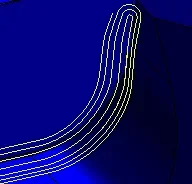
I have the following problem that I would like to solve; given a connection radius between 2 surfaces, as I can highlight the curve that traces the center of the spherical mill that is able to work such form. I would need to check to see if the shape is feasible before delivering the step file to the miller so as not to waste time in post revisions of the project.
Thank you so much to those who can help me.
 
hi, offset of the value of the milling radius, and find the curve drawn from the milling center.
if you want the curve drawn from the tip cut off: offset of the value of the milled radius and translation, long axis milled to the surface, of the same value. .
 
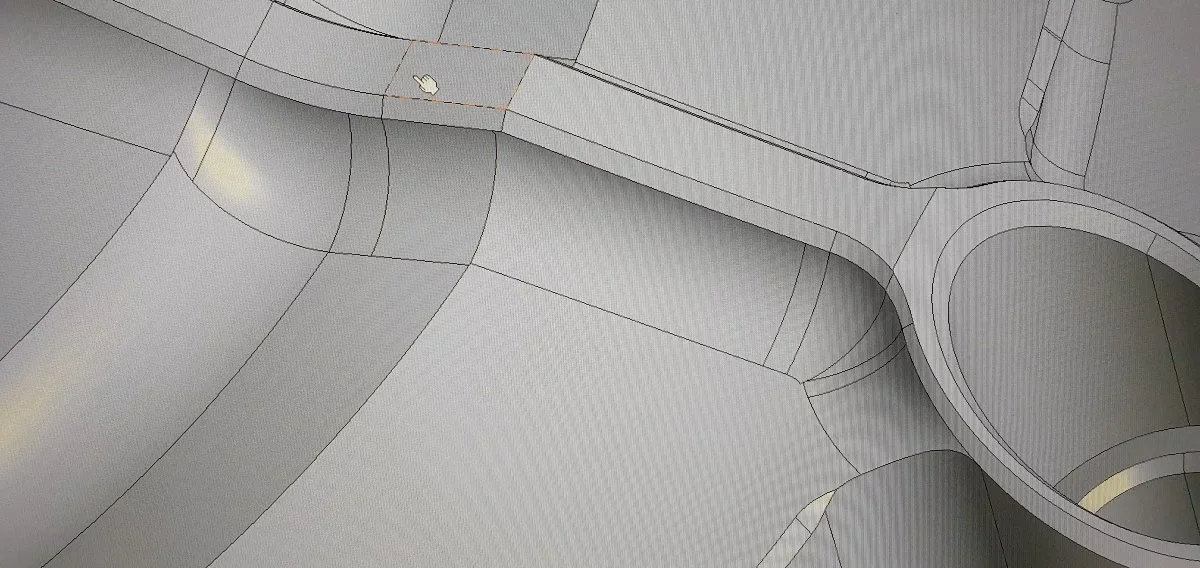
Certainly, it is a valid method for a simple geometry with 2 perpendicular surfaces. but if you have a case like that pictured in figure with slope changes, curves and fittings that stop on the bevel, then the thing becomes infinitely more complicated and not more decisive with the previous method.16956227895423839086189126583729.webp
 
I honestly don't understand the meaning of your verification.
Why do you have to show him to the miller? Do you have to do this manually?

Plus, that's a radius that doesn't end it with equal radius spherical braking, using a trajectory/contour 3d cam command.
Finish it with a lower radius spherical cutter, always working in 3d.
 
hi fabietto, the piece under consideration is a particular aesthetic that is milled in close past on the "main" surfaces if you pass the term. at the end of this phase the final finish consists in retracing the "bords", i.e. the fittings that delimit it, with a spherical cut of the radius identical to that of the connection. the final result is remarkable.
to me would need to find the busy path on the connection because it allows me to make any adjustments before passing the file to the miller effectively eliminating a subsequent revision phase.
 
hi, I use I create as cad and I used it as cam.
but I think any other cam can make a 3d trajectory with a "supported" spherical frieze at that radius. So I still haven't figured out which "fit" could make you the miller. .

For example, we assume that is a r4.
the cam programmer could, wanting, make a tool path with a r6 cutter. the result would always be a radius, but it would remain of the overmetal given by the radius difference.

or the cam programmer makes a program with a milling equal radius (r4), but that is not r4 constant, and therefore, in some areas, remains of the overmetal.

said this, once you find the busy path, how can you judge whether it's okay or not? and then you have to adjust the geometry.
Why does the route in certain areas make some strange "snake"? Why is it not generated in some places? Or?
 
Just like you say. in some areas does not generate the path or does not compatible curves and therefore indicates that the working strategy is not persecutable for which an adjustment is urgent. generally the connection between the surfaces must be corrected (not the one that is reverted but the one between the "vertical" surfaces)
 
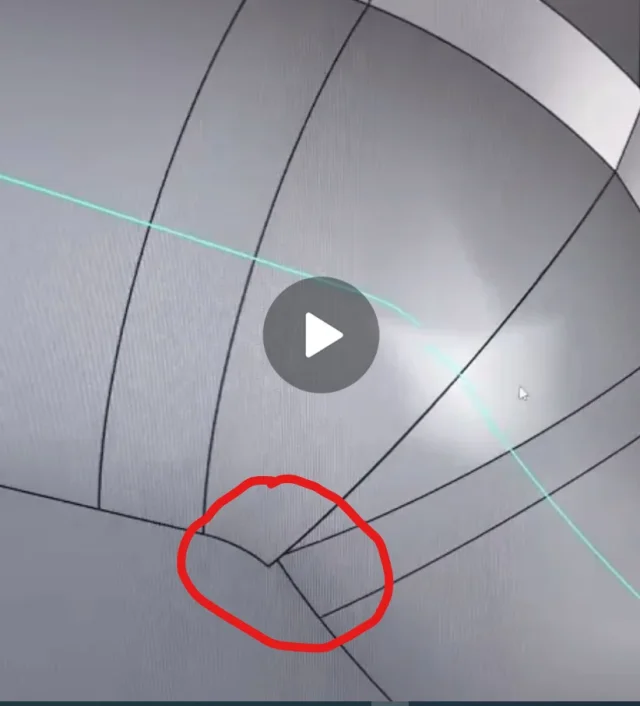
here you see what generates the milling machine
 

Attachments

  • Screenshot_20230926_081945_WhatsApp.webp
    Screenshot_20230926_081945_WhatsApp.webp
    44.1 KB · Views: 12
as it says victorious the area is that, but you have to correct the connection radius between the vertical walls.
to see the radius does not seem tangent to the right wall.
I recommend to make, if possible, a vertical radius at least 0.5/1mm greater than the connection radius on the bottom, so you will have a connection radius that "race" along the vertical radius, instead of "plant" on that "pick" of radius.
 
I try to follow the guide line drawn by fabietto on the vertical connection and then I follow you
 
in my experience, that kind of irregularity occurs when you want to make fittings of the same radius of the mill. I usually see making different choices:

1. a smaller radius is used, so the connection is copied point-point as illustrated by @face2. a little smaller than the theoretical radius, and in processing they are finished in bitangenza with the milling of the right radius.
 
here you see what generates the milling machine
but in this case, what does the cam generate? Are you wrong?
What's he doing? Get up, move, and come back down? Will you stop?
or can generate the tool path and that is only a "visual" discontinuity?
 
yes the cam fails to close the trajectory for which it generates errors. the 2 splines must be properly connected, but as the model is very large, of similar problems if they find different ones and therefore it takes a long time to perform the corrections.
 
so out of curiosity, what is cam?

if it has done a bitangenza processing, and then it has selected the bottom surface and the wall, in the stretch of wall that generates that radius the braking fails to go in tangence with the bottom, without going in heel with the left radius.
That's why I think he doesn't even work the whole right-hand radius of the snitch.

Forgive me the terms. .

at cam level could remove from the heel control all the surfaces of the rays you want to mill in this way.
of course oci verti e rece alto (open eyes and high ears.. )
 
bho.. sincerely of molds I have made many and programming cam I am not sure to the first weapons.
I cannot understand this difficulty.
as I do not understand what you want to do with this curve that simulates the center of the mill, since the female rays of the model are not equal to the eye, but vary.
So... what should be used?
However I speak for the cam I use, it has a strategy that solves the problem of the topic. .1695821708246.pngBut I think all the cams, even the most modest, are able to do so.
Will it also be a limit of the cam in question? ..from the title would appear catia machining
 
Last edited by a moderator:

Forum statistics

Threads
44,997
Messages
339,767
Members
4
Latest member
ibt

Members online

No members online now.
Back
Top