
• This forum is the machine-generated translation of www.cad3d.it/forum1 - the Italian design community. Several terms are not translated correctly.

pressure of a steel or iron pipe

reyrey

Guest
hi I would like to know if having a stainless steel tube aisi 304 60.3 mm thick 3 mm how many bars can resist and a iron tube diameter 50mm thickness 5mm.
because I tried every formula around the web but I didn't understand much....
Thank you very much
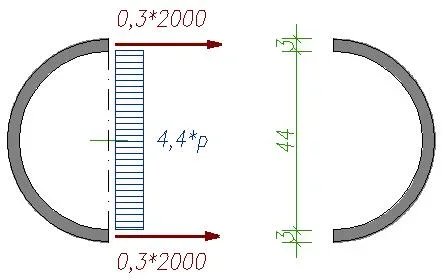
 
on the baldassini there is a half page dedicated to the calculation of the resistance of pressure tubes.
 
steel a304 yields to 2000 kg/cm2
imagine to cut vertically a piece of tube of 1 cm
the internal force will be 4,4*pression.
the resistance of the tube will be 0.3*2000.
for balance must be:
4,4*p=2*0,3*2000
from which the pressure p=272 kg/cm2
this is the pressure that can rinse the tube.
Bye.
Tubo.webp
 
simple curiosity that maybe could be published on the puzzle week.
the formula used takes the name of mariots, famous physicist (I always thought it was a gardener) who studied this problem, if I do not remember badly to realize the iron-cement tubes in order to bathe the gardens of the sun king's court (a little before 1700).
 
al post #5 di This is what discussion there are the formulas of tensions that undergoes a pressure tube.
internal pressure generates an increase in volume outwards that generates tensions in the tube. when this voltage exceeds that of the yield you have the deforestation of the pipe.
However, each tube falls into a specific class and, according to regulations, has a declared operating and burst pressure.
If you want to take a random tube and put pressure on it, you might get hurt by the presence of defects along the pipe.
for security reasons are things to take with certificate and follow regulations. don't make up or you get hurt... you and who's around you.
Take a nice catalog of hose tubes and browse it. You'll find what you need.
 
al post #5 di This is what discussion there are the formulas of tensions that undergoes a pressure tube.
internal pressure generates an increase in volume outwards that generates tensions in the tube. when this voltage exceeds that of the yield you have the deforestation of the pipe.
However, each tube falls into a specific class and, according to regulations, has a declared operating and burst pressure.
If you want to take a random tube and put pressure on it, you might get hurt by the presence of defects along the pipe.
for security reasons are things to take with certificate and follow regulations. don't make up or you get hurt... you and who's around you.
Take a nice catalog of hose tubes and browse it. You'll find what you need.
I read different catalogs but I guess I had a doubt I wanted to ask who from more than I... However I speak of a threaded cylinder hermetically closed to a certain pressure in these cases I spoke of a stainless tube diameter 60.3 thickness 3 and I wanted to see if it meets what I wanted to do (obviously all in safety)...I asked my professor but are more the turns of formulas than the result. . .
 
@reyrey you should apply a calculation code for pressure tubes (asme b31.3, en 13480...): attention that are very complex codes and that are to be chewed very well, even considering the potential danger of the component.

if you need an estimate, you can apply the straight pipe formula (not curved) in thin wall (which is a particular case of the most general and much more complex formula of thick wall tubes)

== sync, corrected by elderman == @elder_man

being the pressure, of the outer diameter, t the thickness and sigma the tangential tension (in the thin wall tubes the radial tension is neglected). this formula is reported - with some corrections - on many calculation regulations, so it is reported. the asthma b31.3 says for example that it can be applied when the thickness t is less than d/6, therefore in many practical cases.
the biggest problem is the correct choice of the admissible voltage with which to compare the tangential calculated above, since the first depends on material and temperature (and it is here that the norms are unbalanced, besides other aspects). If you are at room temperature, you have a carbon steel and have no more specific data, for a first approximation you can consider the yielding voltage/1.5 or the breaking voltage/2,4, which of the two minors.
 
I'm sorry for the surgery, but seeing "iron pipe" by a student makes me mad: if you are going to use iron, have fun making jewelry, not pipes
I know that you mean carbon steel, but it also doesn't make any sense: you can go from a yield voltage of 120 n/mm2 (just to keep not using si) to a few thousand.
 
I'm sorry for the surgery, but seeing "iron pipe" by a student makes me mad: if you are going to use iron, have fun making jewelry, not pipes
I know that you mean carbon steel, but it also doesn't make any sense: you can go from a yield voltage of 120 n/mm2 (just to keep not using si) to a few thousand.
I apologize for using "iron pipe" per
 
I'm sorry for the surgery, but seeing "iron pipe" by a student makes me mad: if you are going to use iron, have fun making jewelry, not pipes
I know that you mean carbon steel, but it also doesn't make any sense: you can go from a yield voltage of 120 n/mm2 (just to keep not using si) to a few thousand.
If we want to do the pinions, it is implied that steel has carbon and also cast iron, depends on what percentage. :
 
All right, I basically wanted to do some kind of potato shoot because I'm a fisherman who sometimes freezes and this time I wanted to take advantage of "I'd call it bait" at the sea of course where there is no one that can hurt... and the mei doubts was about the tank from 50diamx5sx350l mm... knowing that I wanted to do a kind of "extinguit"
 

Attachments

  • Screenshot_20230306-213140.webp
    Screenshot_20230306-213140.webp
    2.3 KB · Views: 6
io use questa:
press in tube [FORMULA DI MARIONETTE]
Desternum
60,3​
[mm]temperature
230​
[°C]
thickness
6​
[mm]on the temperature of the flow control not to have t above the 38°c otherwise change sigma dinervamento (mpa 130 to 200°c, mpa 240 up to 38°c) for aisi304
safety coeff.
1,2​
sigma snervamento
130​
[MPa]stainless steel yielding sigma
sigma 0,2
104​
[MPa]* 0,8
sigma amm
86,67​
[MPa]sigma 0.2 / safety coeff.
8,67​
[kg/mm2]
pmax
2,15​
[kg/mm2]
21,53​
[MPa]1 [kg/mm2]~10 [MPa]
215,32​
[bar]1 [MPa] = 10 [bar]
rest/spessore>5 => I can use puppets
nb: the yield data are taken from ped legislation
maximum pressure of stainless steel pipes (no ped!)
 
io use questa:
press in tube [FORMULA DI MARIONETTE]
Desternum
60,3​
[mm]temperature
230​
[°C]
thickness
6​
[mm]on the temperature of the flow control not to have t above the 38°c otherwise change sigma dinervamento (mpa 130 to 200°c, mpa 240 up to 38°c) for aisi304
safety coeff.
1,2​
sigma snervamento
130​
[MPa]stainless steel yielding sigma
sigma 0,2
104​
[MPa]* 0,8
sigma amm
86,67​
[MPa]sigma 0.2 / safety coeff.
8,67​
[kg/mm2]
pmax
2,15​
[kg/mm2]
21,53​
[MPa]1 [kg/mm2]~10 [MPa]
215,32​
[bar]1 [MPa] = 10 [bar]
rest/spessore>5 => I can use puppets
nb: the yield data are taken from ped legislation
maximum pressure of stainless steel pipes (no ped!)
wow
 

Forum statistics

Threads
44,997
Messages
339,767
Members
4
Latest member
ibt

Members online

No members online now.
Back
Top