matteo.minghetti
Guest
Good morning to all,
I have a problem about pro-mechanism on the old version wildfire3.0
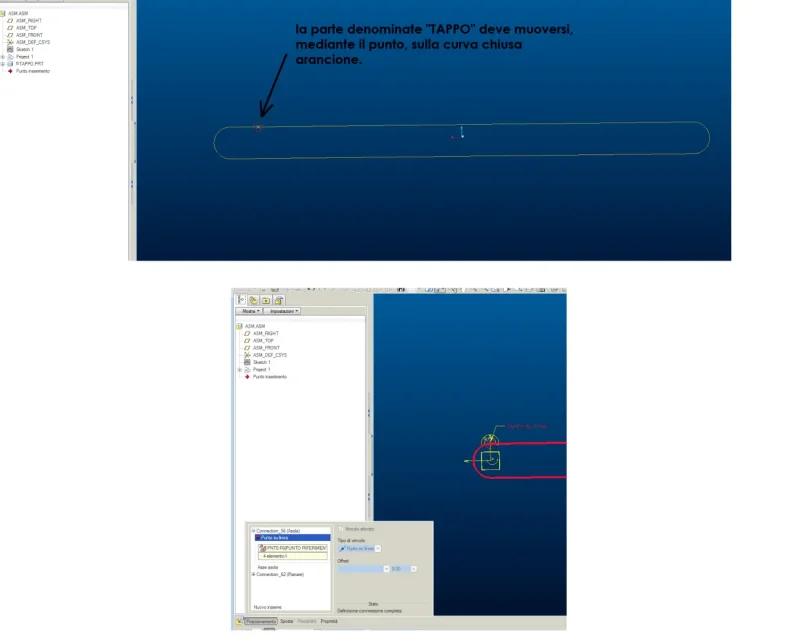
the problem is of this type:I must simulate the movement of a point on a closed curve.in the standard environment I created a set in which I modeled a sketch that represents my closed trajectory that must follow my point.
I then entered a part consisting of a simple sketch in which a circumference is drawn and its center identified from one point.
in the assembly environment I have inserted the part and I have bound it with the mechanical constraints through a vincolo flatre ed un constraint.
moving the axieme in manual, the part follows the curve profile correctly and there is no problem.
the problem comes when I switch to mechanism: what I should do is assign a speed at this point that must follow the line, but I couldn't do the analysis.
using geometric engines, for my knowledge, I can only assign a linear translation engine or a rotary engine.
assign a linear motor, position analysis turns (i.e. the point moves on the line) until the line remains straight. When the curvature begins, the analysis stops.
by consulting the guide, in the section "general steps on geometric motors", it is mentioned that results in various types of geometric motions that are: plane/plane translation engine; point-plan and point-point.
In fact, the point-point translation engine seems to be the one suitable for my case, but I don't know how to activate it.
this the point-point engine description that provides the guide:
point-point translation engine — a point-point translation engine controls the shift of a point belonging to a body in a specified direction in another body. the measurement of the shorter distance is equivalent to the position of the guided point compared to a plane containing the reference point and is perpendicular to the direction of the movement. the position of a point-point motor is zero when both the reference point and the guided one are on a plane whose normal corresponds to the direction of the movement.
Note: the point-point translation engine is a very weak bond that must be used carefully to achieve a reliable movement. you cannot define the orientation of a body compared to the other using only a point-point motor. In fact, to define this orientation, six point-point engines would be needed.
Consider also that the guided point is free to move perpendicular to the specified direction and can do so if you do not specify other constraints. block these degrees of freedom using another engine or connection. by defining the three components of x, y and z motion of a point compared to a plane, you can make sure that the point follows a complex 3d curve.
the question is:
is there someone who has ever had a problem of this type and managed to assign a law of motion, or a motor, to a point that must follow a curve - in ambient pro-mechanism wf 3.0?
thanks to all
I have a problem about pro-mechanism on the old version wildfire3.0
the problem is of this type:I must simulate the movement of a point on a closed curve.in the standard environment I created a set in which I modeled a sketch that represents my closed trajectory that must follow my point.
I then entered a part consisting of a simple sketch in which a circumference is drawn and its center identified from one point.
in the assembly environment I have inserted the part and I have bound it with the mechanical constraints through a vincolo flatre ed un constraint.
moving the axieme in manual, the part follows the curve profile correctly and there is no problem.
the problem comes when I switch to mechanism: what I should do is assign a speed at this point that must follow the line, but I couldn't do the analysis.
using geometric engines, for my knowledge, I can only assign a linear translation engine or a rotary engine.
assign a linear motor, position analysis turns (i.e. the point moves on the line) until the line remains straight. When the curvature begins, the analysis stops.
by consulting the guide, in the section "general steps on geometric motors", it is mentioned that results in various types of geometric motions that are: plane/plane translation engine; point-plan and point-point.
In fact, the point-point translation engine seems to be the one suitable for my case, but I don't know how to activate it.
this the point-point engine description that provides the guide:
point-point translation engine — a point-point translation engine controls the shift of a point belonging to a body in a specified direction in another body. the measurement of the shorter distance is equivalent to the position of the guided point compared to a plane containing the reference point and is perpendicular to the direction of the movement. the position of a point-point motor is zero when both the reference point and the guided one are on a plane whose normal corresponds to the direction of the movement.
Note: the point-point translation engine is a very weak bond that must be used carefully to achieve a reliable movement. you cannot define the orientation of a body compared to the other using only a point-point motor. In fact, to define this orientation, six point-point engines would be needed.
Consider also that the guided point is free to move perpendicular to the specified direction and can do so if you do not specify other constraints. block these degrees of freedom using another engine or connection. by defining the three components of x, y and z motion of a point compared to a plane, you can make sure that the point follows a complex 3d curve.
the question is:
is there someone who has ever had a problem of this type and managed to assign a law of motion, or a motor, to a point that must follow a curve - in ambient pro-mechanism wf 3.0?
thanks to all