
• This forum is the machine-generated translation of www.cad3d.it/forum1 - the Italian design community. Several terms are not translated correctly.

problem in technical design.

  • Thread starter Thread starter Apprendista
  • Start date Start date
Sorry guys, I have not yet entered the quotas in the drawing, because today I tried to study a little mathematical analysis (limits of succession), which is for its part quite challenging and Monday there is already the 1 appeal, although I do not have hopes since I saw what kind of exercises there are, mostly stuff on complex numbers, things not much to the hand:rolleyes:

Wednesday I also have the chemistry writing, so I'm fine you'll be thinking:smile: the fact is that for Wednesday morning, when there will be the drawing lesson, we will have to start the 6 table! I do not want to put my hand to the fifth, which also includes the topic tolerances, but for this day I would like at least to finish the 2 exercise, consisting of 3 tables to be carried out, of which I miss the second and the 3 exercise, which I still have to begin.

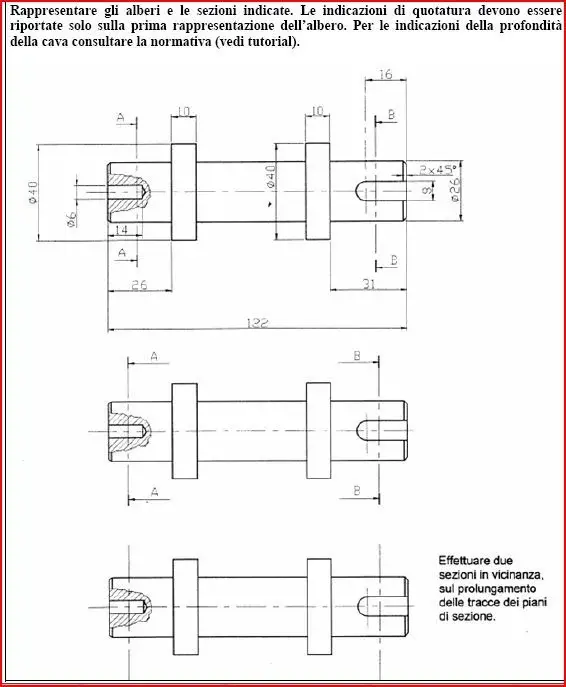
said this, the table of the 2 exercise that I still have to do is this:

That is, I have to copy these trees and make the sections by side, even if I did not understand the third thing we have to do... then we talk about depth of the quarry, which I did not understand how to determine or to what extent it refers. . .

I now realized I didn't own the digital version of the 3 exercise:frown:, and I also have the camera in assistance...:4404:, perfect...both say that at least the second I should finish it before Tuesday. .

ps: you know how to recommend some site/review where the operation and usefulness of the various mechanical parts are explained, so at least to see how they are in practice what we have to draw, otherwise the thing for me remains very abstract.. .

not only for me anyway, even for many young people who come for example from the scientific do not know what a certain piece/object can serve, compared to a student who is due to a mechanical specialization, where in 3 years he could use lathes, mills, drills and so on. . .
 

Attachments

  • Cattura.webp
    Cattura.webp
    28.9 KB · Views: 107
you must represent the same sections in three different ways.
the first drawing in another requires to represent the two sections (seeking in the previews of the book ( http://books.google.it/books?id=xhoqs3_nl34c&printsec=frontcover#v=onepage&q=&f=false ), projecting them on the plane indicated by the arrows, and placing the sections on the side of the piece in the sense indicated by the arrows (the sez. sx should be drawn to right of the piece and vice versa); Moreover these sections will require, even if it is not mandatory but I believe that in your case it is implicitly required, to draw what is behind the section plane (the portion of pin d.40).
in the second drawing the section plans are specular to the first, even the seeds. They must be represented specularly, and in this case the sez dx goes to dx and vice versa, but this time there is nothing behind the section plans.
in the third case you will have to represent the two sections above or below the piece, centered on the track of the section plan; and here you have to do a minimum of attention because the cross sections of this type do not require identification letters of the section, are sections where it is required to represent only what lies on the section plane and therefore would not require arrows to indicate the direction of the tipping of the plan, but this is true only for the sx sez, for the dx one you have to indicate the sense of projection because it has to be agreed with the position of the quarry.
the quarry should be, given the width, for a tab uni 6604 ( http://books.google.com/books?id=xhoqs3_nl34c&pg=pp17&dq=uni+6604#v=onepage&q=uni-ray. ) or for a single key 6607 or 6608 ( http://books.google.com/books?id=xhoqs3_nl34c&pg=pa289&dq=uni+6608#v=onepage&q=unipy6608&f=false ).
ciao.
 
Sorry guys, I haven't yet entered the odds in the drawing, because today I tried to study a little mathematical analysis (limits of succession), which is for its part quite challenging and Monday there is already the 1 appeal, although I do not have hopes since I saw what kind of exercises there are, mostly stuff on complex numbers, things not much to the hand

Wednesday I also have the chemistry writing, so I'm fine you'll be thinking:smile: the fact is that for Wednesday morning, when there will be the drawing lesson, we will have to start the 6 table! I do not want to put my hand to the fifth, which also includes the topic tolerances, but for this day I would like at least to finish the 2 exercise, consisting of 3 tables to be carried out, of which I miss the second and the 3 exercise, which I still have to begin.

said this, the table of the 2 exercise that I still have to do is this:

That is, I have to copy these trees and make the sections by side, even if I did not understand the third thing we have to do... then we talk about depth of the quarry, which I did not understand how to determine or to what extent it refers. . .

I now realized I didn't own the digital version of the 3 exercise, and I also have the camera in assistance..., perfect... so let's say that at least the second I should finish it before Tuesday.. .

ps: you know how to recommend some site/review where the operation and usefulness of the various mechanical parts are explained, so at least to see how they are in practice what we have to draw, otherwise the thing for me remains very abstract.. .

not only for me anyway, even for many young people who come for example from the scientific do not know what a certain piece/object can serve, compared to a student who is due to a mechanical specialization, where in 3 years he could use lathes, mills, drills and so on. . .
Look, here you have a nice disregard on the sections:http://www.dmti.unifi.it/graphic/new/frames/tdr/theory/4 sections.pdfbetween the various pages is your case equal (the prof will have taken it from there:biggrin:) .

here something about quotations (poke in truth):http://www.laureadesign.it/lmv/quotature.pdfand here a manual type the previous vademecum you indicate:http://books.google.it/books?id=xhoqs3_nl34c&printsec=frontcover&dq=disegnatore#v=onepage&q=&f=false of this you can scroll through the pages, there is enough preview.

Then come on, down to your head and let us know:biggrin:

greetings
Marco:smile:

p.s. but did you eventually study higher?
 
Look, here you have a nice disregard on the sections:http://www.dmti.unifi.it/graphic/new/frames/tdr/theory/4 sections.pdfbetween the various pages is your case equal (the prof will have taken it from there:biggrin:) .

here something about quotations (poke in truth):http://www.laureadesign.it/lmv/quotature.pdfand here a manual type the previous vademecum you indicate:http://books.google.it/books?id=xhoqs3_nl34c&printsec=frontcover&dq=disegnatore#v=onepage&q=&f=false of this you can scroll through the pages, there is enough preview.

Then come on, down to your head and let us know:biggrin:

greetings
Marco:smile:

p.s. but did you eventually study higher?
Thanks guys for the material, I did an itis, chemical specialization.
 
for that at the right you have to indicate the sense of projection because it must be agreed with the position of the quarry.
.
..forgive me, I usually do not like to contradict:smile:
However not, even that case non puts the arrow for the sense of projection (never in the "proximity sections"), also because it is implicit that the "rebalt" takes place around the axis of the section plan. and the representation will include only and exclusively the profile lying on that floor, so for the quarry you will always see an open "rectngolino" outside.. usually proceeding as for the reading from left to right, the "imaginary arrow" would be turned to the right and the quarry you see it "cut" on the right of the circular profile.
all this if the section halfway lies on the extension of the axis (as required by exercise), otherwise you can also place the view "where you want" but in this case the direction arrows should be indicated as well as the note (a-a) on the view.

greetings
Marco:smile:
 
And how did you get into the mechanics? ?
(You thought it was the beautiful mechanic's wife? :biggrin::biggrin: lose the bark. . )

greetings
Marco:smile:
eheh

The choice I did not make so much to do it, I thought for a long time...it is that in my city the only scientific faculty was engineering, and if I had to do some faculties, I decided that it should be in one of this field, both because for example letters does not guarantee a minimum of work nowadays, both because economic faculty/law etc. etc. I don't care.

then I thought: what engineering faculty to do? in my city there are mechanics, electrical, civil, managerial and computer science and telecommunications.

In computer science I already knew something, but I said: I do not want to devote myself to the realization of programs, besides the fact that here at the end I do not study even chemistry, while in mechanics there is an examination. I was not inspired, as well as the others, while mechanics seemed to me the most complete, or rather the most ductile, the one that is a bit at the base of everything... my passion for chemistry was also not so much to be so hard to leave my city to study it, also because pure chemistry did not go to make it because of the occupational outlets that did not go to genius, besides I would rather get a qualification of engineer... . .

the fact is also that I never really got closer to mechanics, because I'm not one of those grown in the environment, indeed...

But if you don't try things, you can't understand them, I'll give you an example: Two years ago when I saw my chess player I was interested in the topic and slowly I became more passionate, so much so that at almost two years at this part, I try every day to devote at least 10 minutes to this game... here, remaining on chemistry, I would have studied physical chemistry, organic chemistry, chemical analysis etc., in practice I would have stayed only on that field, while here everything is more multidisciplinary and who knows. .

to me the design is not that I disgust myself, indeed... I would like to succeed in doing good work, but I miss the basics and for this I will have to try to commit a lot, but I can succeed in having a discreet knowledge of this subject with the commitment, at least I hope.

Chemistry is also very abstract, it is true that everything around us is chemical, but sometimes when you study the principle of heisenberg, rather than the shape of the orbitals, you are spontaneous to ask yourself: but to me this in which I become useful?

and so you realize that you may mature a great deal of notions, but without being in a certain manner competent in this matter, or without the ability to create, realize, design, as a knowledge of the design actually allows you. . .

I have longed for myself, just to try to understand that I have not chosen a faculty so much to choose it, anything else, maybe do not imagine how much time I thought about what could be more appropriate. . .

on the other hand here at mechanics there are several categories of students: those who have seen how this faculty goes on naturally, but even if they benefit from specialist subjects they will have to work a lot in analysis tests, where scientific students are more advantageous; there are these last ones who have seen in mechanics a good opportunity for the future, even if they are not very passionate about motors, confiding also on their excellent mathematical skills perhaps; and then there are those who are passionate about mechanics, but it is soon understood that this passion is not enough to overcome rocks of the calibre of mathematical or chemical analysis, where you have to study. ..this is a bit the summary of the situation and idea that I made myself:rolleyes:

better I go to draw now, after I place the fifth exercise, it seems really discouraging!!! And I think we'll have to finish this Wednesday, I'll have to start it and I'd like to go there with a little idea... : )

Bye.
 
Hi.
I just want to suggest another very interesting book of technical drawing or the strange - consort you.
It is three volumes that deal with the design in relation to the workshop practice with very clear and exhausting examples, I have also returned useful in work.
Unfortunately I don't know the return home mentioned above and so I can't compare you to the two, but one in the wolf's mouth to apprentice!
 
Hi.
I just want to suggest another very interesting book of technical drawing or the strange - consort you.
It is three volumes that deal with the design in relation to the workshop practice with very clear and exhausting examples, I have also returned useful in work.
Unfortunately I don't know the return home mentioned above and so I can't compare you to the two, but one in the wolf's mouth to apprentice!

graxie, crepi:wink:
 
slowly I am beginning to enter the matter (but just slowly, eh :d). for the first two trees, the sections I understood how they should be represented, fine. But I did not understand how to deduce the depth of the quarry, I realized that it depends on the size of the wrench (which I discovered to be a parallelepiped that serves for connection to the motor shaft), but I can not districate myself between norms and dimensions. . .

As far as the sections are concerned, I did not understand the concept of how they should be represented, i.e. how do I imagine cutting and looking? to say it in a dripping manner. . .
 
... no, even that case non puts the arrow for the sense of projection (never in the "proximity sections"), also because it is implicit that the "rebalt" takes place around the axis of the section plan. and the representation will include only and exclusively the profile lying on that floor, so for the quarry you will always see an open "rectngolino" outside.. usually proceeding as for the reading from left to right, the "imaginary arrow" would be turned to the right and the quarry you see it "cut" on the right of the circular profile.
all this if the section halfway lies on the extension of the axis (as required by exercise), otherwise you can also place the view "where you want" but in this case the direction arrows should be indicated as well as the note (a-a) on the view.

greetings
Marco:smile:
given that giving incorrect indications to those who ask for an opinion is a very serious crime (and there is also a figure of m...a); after taking care of the wounds for falling out of the pear (and having fixed the dishwasher that just this evening has expired), I removed a bit of dust from my old textbooks, and I consulted the bible of the designers (the baldassini); the latter reports the sections of proximity as a method to illustrate the later sections, and puts good arrows (such as this doc. p.12 http://dismac.dii.unipg.it/~bianco/...triale/materiale/_5_sezioniedintersezioni.pdf ), this document http://www.dmti.unifi.it/disegno_mec/pdf/2-6sezioni.pdf describes the next sections so as you say (v.pag. 40 sez. a sx).
in my old books I find later sections and proximity con The arrows...
I don't know what to tell you, personalmte in cases like this the arrows I put them, but if anyone who will evaluate you says it is incorrect, it means it is incorrect, point.
Bye.
 
I never paid attention. the sections nearby I have always seen them without arrows, but in some cases it can be useful to have them (page 11/12 of your first posted document).

instead what I said on page 9 if I had found it in a drawing I would have stamped it as error without thinking twice. Are we sure it's correct?
 
...instead of what I said on page 9 if I had found it in a drawing I would have stamped it as a mistake without thinking twice. Are we sure it's correct?
even for me it is not correct what reported on p.9, if I have to do a section so I pass the lines of sez. in the midst of ribs.
In truth, it is foreseen by the uni 3970 that "auxiliary views with the main oblique axes" can be realized that as a result they produce a representation like the one in the lower right of page 9 but without the dotted and not dissected part.

However, as I said at the good hunting a few hours ago, it is Saturday evening and we are questioning about methods of representation of the sections; Are we sure we're okay?

Bye.
 
I don't know what to say... If anyone who will evaluate you says it is incorrect, it means it is incorrect, point.
Bye.
bho? I don't know what to say to you either. Apparently the sources are contrasting:biggrin: (that to see them well would seem all the same only "impacted" differently. and above all it seems all pretty dated only renewed for digitization; what are the latest norms? ).
and in your same document (page 11 pane 136) arrows are not indicated and the difference is explained if the view of sez is moved from the axis (as I mentioned in the previous).
then immediately after there is that example of the tree with arrows.. perhaps because they are a series of sez of proximity but successive? but in the text is not specified.. And what is it?
But if it were also I do not understand why you would distinguish between the right and the left; If I have to put them both.

to say it all to me also happens to put them (also because the program puts them in automatic - and perhaps sti cad are making us dislearn to draw-) and maybe the everything is more understandable. However, they could be considered useless, since the profile is drawn only on that floor and once it is established that you always look from left to right there would be no doubt.

in the case in question the design of the exercise assigns the axes for sections without arrows, given the previous traces I would draw under the sections without adding anything else except as required.
Are we sure we're okay?
..no, so sure I am not:biggrin:

greetings
Marco:smile:
 
I have not understood well how to deduce the depth of the quarry................................... .
..as far as the sections in the vicinity are concerned, I have not understood exactly the concept of how they should be represented, i.e. how do I imagine to cut and look? to say it in a dripping manner. . .
consult the indicated links better, there is everything. .
(and then in your exercise it is written <see the tutorial>>>; don't you have that tutorial? )

greetings
Marco:smile:
 
slowly I am beginning to enter the matter (but just slowly, eh :d). for the first two trees, the sections I understood how they should be represented, fine. But I did not understand how to deduce the depth of the quarry, I realized that it depends on the size of the wrench (which I discovered to be a parallelepiped that serves for connection to the motor shaft), but I can not districate myself between norms and dimensions. .
hi apprentice (but very willing). :finger:
I think you don't know the difference between a key and a tab. Let's make up for it...and if I can contribute to what friends have already told you
among the most common links between tree is hub to transmit a torque there are keystrokes and tabs. provided that both are not sized but are unified and are chosen according to the diameter of the tree, the practice is to predict that the width, approximately 1/4 of the diameter of the tree. for the length instead, you will have to evaluate the torque moment to transmit. the material with which they are made is generally low-carbon steel and without thermal treatments (except exceptions).
the difference in choice if using a tab or key is in the type of coupling you have to achieve. the stick prevents both rotation and transfer between hub and tree, the tab only prevents rotation.
here:http://www.ingegneria.unical.it/ingegneria/docenti/luchi/lezioni/collegamenti_smont_non_filet.pdffind what I told you.
Say hi.
 
hi apprentice (but very willing). :finger:
I think you don't know the difference between a key and a tab. Let's make up for it...and if I can contribute to what friends have already told you
among the most common links between tree is hub to transmit a torque there are keystrokes and tabs. provided that both are not sized but are unified and are chosen according to the diameter of the tree, the practice is to predict that the width, approximately 1/4 of the diameter of the tree. for the length instead, you will have to evaluate the torque moment to transmit. the material with which they are made is generally low-carbon steel and without thermal treatments (except exceptions).
the difference in choice if using a tab or key is in the type of coupling you have to achieve. the stick prevents both rotation and transfer between hub and tree, the tab only prevents rotation.
here:http://www.ingegneria.unical.it/ingegneria/docenti/luchi/lezioni/collegamenti_smont_non_filet.pdffind what I told you.
Say hi.
to clarify an important point, even if reported in the interesting annex:

The key is stuck between tree and hub. is pushed into force, so it prevents reciprocal rotation thanks to the friction of its faces both on the tree, and on the hub. in practice work compression

the tab is inserted effortlessly and prevents the reciprocal movement only because it represents an obstacle. in practice he works in cutting.
 
to clarify an important point, even if reported in the interesting annex:

The key is stuck between tree and hub. is pushed into force, so it prevents reciprocal rotation thanks to the friction of its faces both on the tree, and on the hub. in practice work compression

the tab is inserted effortlessly and prevents the reciprocal movement only because it represents an obstacle. in practice he works in cutting.
I also add this link that illustrates what is said by Roman lightning.http://nazzarenocorigliano.interfree.it/linguettechiavetteprofili.pdf
 

Forum statistics

Threads
44,997
Messages
339,767
Members
4
Latest member
ibt

Members online

No members online now.
Back
Top