
• This forum is the machine-generated translation of www.cad3d.it/forum1 - the Italian design community. Several terms are not translated correctly.

problem modeling rail traction hook

  • Thread starter Thread starter accipiter84
  • Start date Start date
I have attached table (it is not perfect because I don't know how to quote and aesthetics leaves to want, I don't have my favorite configuration file here) and relative model in .iges. the two odds inside the square do not fit for a few tenths with your initial designs. Let me get the rest of the drawings for the attack. Can you tell me what kind of simulation you're going to do? I must say that I am interested because I work marginally in the sector.
 

Attachments

hi "folle" (that is so crazy is not:-))))) ) thank you very much for all you have posted.
I now realized what I'm wrong with modeling....I also thought of a "modelling" on the contrary on the idea of work of this video... starting from the real photos of the hook
process by imageis not a real design but can be an alternative method of work.

As for the simulations......for now I am using the cosmos solutor of solidworks2009 available to the unit; I have obtained requests of the order of 250 mpa for a load of 136 kn applied in order to simulate the binding of the chain. I framed the hook in the shaft hole (although in reality it is not a real ink), then I loaded with remote mass the inner faces of the hook where it supports the chain of the screw tensioner.

thanks again for the collaboration
greetings, tommaso,

p.s. now I attack the scanner and place the remaining part of the design.... give me a half hour. Okay? I also send you the simulations I've done.
Since you are in the industry I can tell you that we have to perform a non-linear static analysis and that the hook must be loaded with 50 tons/force. If you want, I'll send you the evidence extract to be carried out by the law.
 
as promised I attach the other views of the hook.
for anything else do not hesitate to ask. later place the view of my simulations on the hook.

greetings, tommaso
 

Attachments

I now realized what I'm wrong with modeling....I also thought of a "modelling" on the contrary on the idea of work of this video... starting from the real photos of the hook
this is a crazy idea (not so much, it is a reverse engineering)!!!! It's very difficult to model from a photo, much more than the drawings in your possession are understandable and it's not worth driving. Did you see my video in you tube? Can't replicate the same way of building surfaces? cmq if in the project you do not have to give the native model you can give him my .iges. The last one you posted as an image was not bad, but to judge you have to attach geometry.
As for the simulations......for now I am using the cosmos solutor of solidworks2009 available to the unit; I have obtained requests of the order of 250 mpa for a load of 136 kn applied in order to simulate the binding of the chain. I framed the hook in the shaft hole (although in reality it is not a real ink), then I loaded with remote mass the inner faces of the hook where it supports the chain of the screw tensioner.
we do things by order:
1) complete the 3d
2) We check the table with 2d drawings in your possession.
3) we have available as cosmos, promechanic and straus7 solutors.
4) I must understand how the thing must be bound.
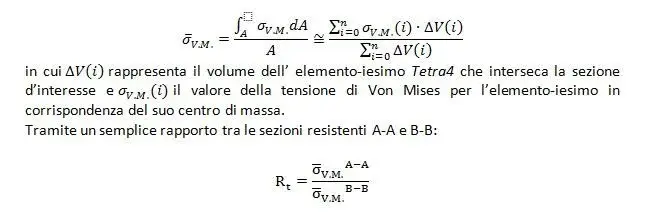
5) we compare the results and then analyze not so much the peaks of tension that do not count a mine in the non-linear analysis in the lifting sector (the peaks depend a lot on the size of the mesh for example, and it is necessary to analyze if you want to make fatigue design for example). Take some reference sections and calculate an average voltage: for example the integral on the von mises voltage area. see image. then deformations etc...
cmq if you send me the other material in your possession for me is fine. I give you a hand and you give me information that might serve me.
 

Attachments

  • Cattura.webp
    Cattura.webp
    16.6 KB · Views: 17
this is a crazy idea (not so much, it is a reverse engineering)!!!! It's very difficult to model from a photo, much more than the drawings in your possession are understandable and it's not worth driving.
mine was just an idea of approach... not applicable in this case given the drawings available as you say.


The video you posted is more than good.... now I'm focusing on improving the geometry of the model in solid edge, I think the right way to follow is this here.......... everything is in improving me... .

I also thought that the nerve simulation would not make much sense.
I do not understand, however, why the norms do not give a load limit within which the hook should not yield.
 
excuse the delay in the answer; I had two days of fire.... .
I delivered my model, slightly improved since, as you see in your video, I tracked an intermediate surface between the throat section and the hole.

I thank you infinitely for the help and the tips,
greetings,
Tommaso
 
you could try with the command "sliding protection" using the sketches of the significant sections.

to me came out very simple. .
 

Forum statistics

Threads
44,997
Messages
339,767
Members
4
Latest member
ibt

Members online

No members online now.
Back
Top